

The Eastern Mediterranean is heating up again. Behind the maps of maritime zones and diplomatic statements, an invisible yet critical war is unfolding, not over oil or natural gas, but over the underwater “arteries” that carry the lifeblood of modern Europe: the cables that connect continents, governments, and markets.
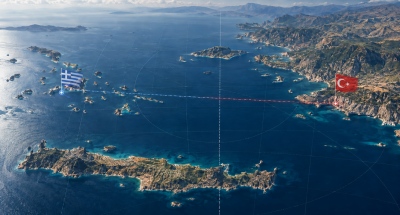
Turkey is moving aggressively, contesting Greek maritime zones and obstructing research vessels, while Athens tries to secure its digital sovereignty.
At the bottom of the Mediterranean, not only energy security but also the strategic future of Europe is at stake, and Greece lies at the center of a dangerous geopolitical game.
Specifically, according to an analysis by the Middle East Forum, the Eastern Mediterranean is a theater of a contest with implications for the digital and strategic future of Europe…
Last summer, Turkish warships blocked a research vessel that had been chartered to map the route of an underwater cable that would link Israel and Greece, in waters where Ankara claims its continental shelf, provoking intense confrontation.
Although naval operational maneuvers dominated headlines, equally important is the rapid construction of new submarine digital arteries from Greece to Israel via Cyprus.
It should be noted that underwater infrastructure is critical in a global economy driven by data.
The EU’s dependence on submarine cables for international internet traffic and global financial flows is evident.
This underwater infrastructure includes cables, power interconnectors, and networks for the supply of oil and natural gas.
According to the EU Institute for Security Studies, today submarine cables carry nearly 99% of intercontinental data.
Nevertheless, many diplomats and analysts treat these cables more as mechanical components than strategic infrastructure.
This is especially true in the Eastern Mediterranean, where states dispute maritime borders and the presence of major powers is increasing.
The region has become a critical corridor for new cable systems aimed at linking Europe, the Middle East, Africa, and Asia.
Projects such as the Medusa submarine cable system, stretching 4,400 miles and budgeted at $400 million, underscore precisely these ambitions.
Turkish claims
At the same time, Turkey disputes maritime zones declared by Greece and Cyprus, rejects the provisions of the United Nations Convention on the Law of the Sea regarding Exclusive Economic Zones of islands, and has repeatedly acted against research vessels and cable-laying missions.
Historically, anchors and fishing activities have been responsible for most damage to undersea cables, but analysts now warn of patterns and sabotage.
Cybersecurity firm Recorded Future documented nine cases of possible Russian or Chinese sabotage in 2024-25, both in the Baltic and Taiwan.
In response, the European Union issued a Joint Communication warning that “a hybrid campaign against these critical infrastructures could disrupt essential functions and services in the EU.”
In the Eastern Mediterranean, where depths are shallower, jurisdiction is uncertain, and naval forces are strong, the risk of disruption, whether accidental or intentional, is greater.
A severed cable in the Eastern Mediterranean would affect European financial and defense systems.
The map of submarine cable infrastructure published by the European Commission indicates that Europe is “the continent with the largest underwater communications in the world.”
The battle for infrastructure is shifting the balance of regional power.
Landing stations give countries like Greece, Cyprus, and Israel economic advantage, geopolitical weight, and influence.
Turkey, and potentially Russia and China, seek more indirect influence by threatening access to these states or facilities.
Europe cannot afford complacency. These submarine arteries must be reconsidered as strategic lifelines.
The resilience of critical infrastructure requires joint monitoring and coordinated response.
However, implementation of such a plan is slow. The creation by NATO of the Critical Undersea Infrastructure Coordination Cell in Brussels is positive, but it lacks a permanent base in the Eastern Mediterranean.
In this gap between NATO and relevant European bodies, establishing a regional coordination center in Greece or Cyprus would enable joint patrols, information sharing, and rapid repair missions.
The Eastern Mediterranean has long been a theater of competition in the energy sector, but today it serves as a stage for digital geopolitics.
If Europe and Greece continue not to fight for their seabed, they may discover that their next major crisis will not erupt in the sky or at their borders, but deep beneath the sea.

www.bankingnews.gr



Σχόλια αναγνωστών