

A new dimension is revealed in Greek-Turkish relations by the international press, specifically Armiya.az, which links tensions in the Aegean to Israel’s broader plans and the strategy of Defense Minister Nikos Dendias.
In particular, the Azerbaijani outlet emphasizes that Israel is exploiting Greece’s fear and Dendias’ ambitions to strike Turkey.
It notes that the latest fruit of this strategy is Israel’s attempt to sell Greece the new anti-drone system Spyder All-in-One.
The Azerbaijani geopolitical media outlet highlights that Greece is working to upgrade its old air defense systems and is expanding cooperation with Israel in the field of drones.
New systems offered by Israel to Greece – Greece on the hunt for Bayraktar
According to Armiya.az, citing SavunmaSanayist and Greek press sources, Israel has offered Athens additional systems suitable for the complex geography of the islands, in addition to the frequently discussed air defense system “Spyder All-in-One.”

Within this framework, Israel reportedly offered Greece lasers that could also be used as UAV defense systems.
The Hellenic Armed Forces are currently evaluating these proposals.
The article also notes that Israeli companies have proposed state-of-the-art “killer drones” that can be easily deployed even on small uninhabited islands, operate on batteries, collect data, and respond to potential threats.
The piece underlines that Greece is working to upgrade old air defense systems and expand cooperation with Israel in the UAV sector.
It also recalls that Greek Defense Minister Nikos Dendias recently stated that measures must be taken against Bayraktar TB2 and Bayraktar TB3 drones.
“How do we handle a swarm of drones? In our case, with Bayraktar II and Bayraktar III drones. How do we do this economically? Because the simplest answer is to fire missiles at them. We would go bankrupt within a week,” the minister said.

Greece turns to Israel’s expensive systems and abandons Russian systems
Meanwhile, a new geopolitical confrontation is shaping in the Mediterranean and regarding Greece’s position there, as tensions between Israel and Turkey escalate over the war in Syria, highlights the online magazine EurAsian Times.
The international outlet notes that Greece announced its largest defense reform in history.
Prime Minister Kyriakos Mitsotakis, speaking in Parliament last April, announced that the country will invest €25 billion (USD 27 billion) over the next 12 years, aiming at a major modernization of the Armed Forces.
“The world is changing at an unpredictable pace. We are now facing a different type of war than the one for which our Armed Forces were prepared,” Mr. Mitsotakis stated.
At the center of the new security doctrine is the plan for the “Achilles Shield”, a multi-layered high-tech defensive umbrella.
Defense Minister Nikos Dendias, speaking in Parliament, said the country is abandoning traditional strategies and turning to networked, AI-driven missile systems, drone technologies, and advanced command units.
“What we propose is existential for the country – a complete change in the defense doctrine. It is no longer enough to assume the Aegean is protected solely by the Fleet,” noted Mr. Dendias.
Greece’s new defense doctrine
This military upgrade is especially significant, following a long period of fiscal constraints during the 2010–2018 economic crisis.
Greece is one of the few NATO countries already spending over 3% of GDP on defense, alongside Poland, Estonia, and Latvia.
In 2009, the country spent USD 10.6 billion (3.22% of GDP), but by 2015 spending had fallen to USD 4.82 billion (2.46%).
However, chronic Greek-Turkish disputes in the Aegean and increasing Turkish activity in the Eastern Mediterranean forced Athens to reprioritize defense.
The result is an ambitious USD 27 billion rearmament program through 2036.
The new “Achilles Shield”
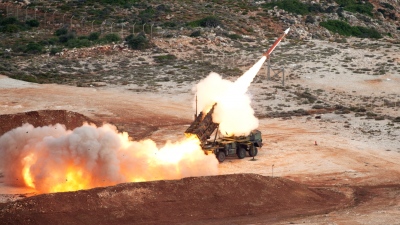
This is the most ambitious program within the plan, aiming to install multi-layered defense covering anti-missile, anti-aircraft, anti-ballistic, anti-submarine, anti-ship, and anti-drone protection.
The cost of the Achilles Shield is estimated at €2.8 billion (USD 3 billion), with an operational horizon of 2027.
According to Greek media cited by Eurasian Times, Athens is negotiating with Israel to acquire a corresponding “defense dome.”
The Prime Minister referred to Tel Aviv as a strategic partner in strengthening the country’s air defense capabilities.
“Greece already has U.S. Patriot systems. If we were to purchase new ones, the wait would be four to five years. European capabilities are limited. Israel, with which we maintain a strategic alliance, can provide solutions faster,” explained Mr. Mitsotakis.
In addition to Israel, potential suppliers include France, Italy, and Norway. According to Eurasian Times, Greece is also considering the Israeli BARAK system as a replacement for Soviet S-300s.
BARAK is a short-range missile system designed to protect ships from aircraft, missiles, and UAVs, while countries such as Germany and Finland have already ordered similar Israeli systems.
Greek participation and industrial base
Although procurement relies on foreign suppliers, Greek companies are expected to actively participate in implementing the Achilles Shield, though the scope of involvement is not yet clear.
Nikos Dendias recently stated that every new foreign defense contract must include 25% Greek participation.
“With the Achilles Shield, we implement a full, multi-layered defense network across the territory. We utilize an advanced and cost-effective network of hidden and AI-guided missile systems under unified command and control, against threats from missiles, aircraft, drones, ships, and submarines,” concluded the minister.
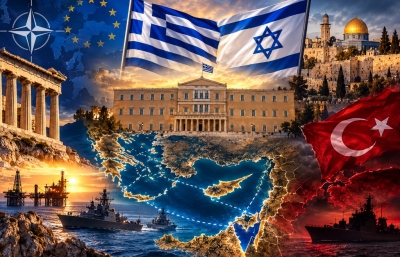
Turkey brings Israel and Greece closer together
Geopolitics in the Mediterranean and Western Asia are undergoing intense reshuffling.
The Israel-Gaza war, Houthi attacks in the Red Sea, the possibility of a major confrontation with Iran, and rising tensions between Israel and Turkey over influence in Syria have turned the already fragile region into a powder keg.
In this context, Turkey’s growing ambitions to play a central role in Europe’s new security architecture after the Russia-Ukraine war are added.
Turkey sees itself as a key player due to its strategic geographic location in the Mediterranean and on the Black Sea borders, as well as its NATO membership.
Turkey also has the largest army in NATO after the U.S., and the largest in Europe after Russia and Ukraine.
After years of stagnation, Turkey has reignited its request to join the European Union, which has received explicit support from Poland.
Turkey’s growing influence in both Europe and Western Asia causes concern in Greece and Israel.
www.bankingnews.gr

Σχόλια αναγνωστών