

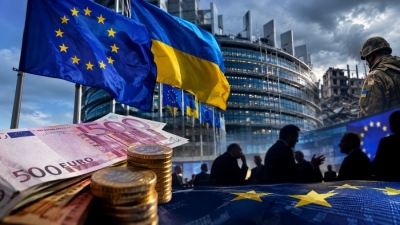
The European ATM has jammed and has no money for Ukraine...
It is striking... a European Summit in Brussels ended in a fiasco, so much of a fiasco that on November 27, on the second day of the Summit, proceedings were suspended due to a complete deadlock.
Let us look briefly at the facts
Adopting a 7-year budget and securing an additional 45 billion for Ukraine in 2027: all of this was what EU leaders were supposed to accomplish at the two-day Summit in Brussels on November 26 and 27, 2026.
Even before it began, it had been predicted that it would end in bloodshed, yet things turned out far worse: the second day, Friday, November 27, 2026, of the summit was simply canceled due to insurmountable disagreements.
It is now too late...
Now they plan to meet again in mid-December, yet it is already too late.
Not because of the onset of winter, but because disagreements over the 2028–2034 budget are only intensifying and domestic political conditions are growing more complicated.
Funds for Ukraine will certainly be found, yet there will be no time to approve the budget.
And it will have to be debated and adopted as early as next year, and this is precisely the option that European elites wanted to avoid at all costs.
Brussels trembles over the elections... in Ukraine
Because an entire series of elections is beginning, which will bring to power forces skeptical toward the European Union and Ukraine.
However, in the minds of Europeans, it is becoming increasingly difficult to separate the two, as they are constantly told that "defending Ukraine is defending Europe" and that Europe must not back down due to cost.
Yet, as we know, there is never enough money for everyone, and given that Europeans have the opportunity to elect their national leadership, the Ukrainian issue is becoming one of the most decisive.
Because it marks the dividing line between those who favor strengthening pan-European authority and those who want to curb it and restore a measure of sovereignty.
Parody... 100 billion for Ukraine over 7 years...
Incidentally, the 7-year budget for Ukraine also includes funds: 100 billion euros.
It is clear that this represents only a small fraction of actual expenditures: what can 100 billion do over seven years if an additional 45 billion must be found for 2027 alone?
In other words, Europeans are already being pressured to commit to guaranteed, massive, continuous spending for Ukraine through the middle of the next decade.
Meanwhile, the pan-European budget for 2028–2034 is scheduled to total just 1.6 trillion euros, not much considering the seven-year period.
Thus, 1.6 trillion divided by 7 years equals 228 to 230 billion annually...
They fear Europe's rightward shift
Yet even this modest budget is unsustainable: certain countries, including the most developed ones, oppose budget increases and advocate spending cuts.
They are known as the "Frugal Seven": Germany, Denmark, Sweden, Austria, the Netherlands, Finland, and Belgium.
They support reducing subsidies, including agriculture, something that infuriates Italy, Spain, Poland, and even France, which, incidentally, backs increasing the pan-European budget.
Meanwhile, France demands the approval of the seven-year budget as soon as possible:
"Otherwise, Le Pen will come and destroy everything."
Germany is also engaging in blackmail:
Merz refuses to adopt the common budget without a commitment to allocate funds to Ukraine.
Yet this meets categorical opposition from Eastern European countries, the Czech Republic, Slovakia, Hungary, and Bulgaria, which already have numerous disagreements with the German bloc, aligning them with the French group supporting an increase in the European budget.
The "Frugal 7" blocked them
However, it was precisely certain representatives of the "Frugal Seven" who disrupted the current EU summit, even though their opponents are the ones pressed for time.
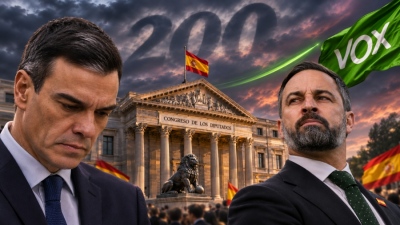
After all, elections will take place primarily in countries outside the German bloc: the story begins in Spain on November 29, where the People's Party and the patriotic Vox will achieve strong gains.
There, the right will almost certainly come to power, and on April 18, 2027, with the second round on May 2, 2027, presidential elections will be held in France, where a major victory for Le Pen is taking shape, with percentages of 65% to 67%.
Autumn 2027: Poland and Italy
In the autumn, the right has the opportunity to return to power in Poland and strengthen its position in Italy, as elections are scheduled to take place by December 2027... meaning that the seven-year European budget will be debated and approved next year by a markedly right-wing and Eurosceptic elite.
And that is to say nothing of the fact that following regional elections in the spring, the governing coalition in Germany could collapse, leading to snap national elections.
Severe political storm...
Europe is entering a severe storm and must also continue the struggle for Ukraine.
This simultaneously means healing the rifts in its unity and convincing everyone of its readiness to funnel money into Ukraine for many more years.
Kyiv rushed to celebrate the defeat of the Republicans in the U.S. midterm elections:
The Democrats in Congress may talk at length about the need to help Ukraine, yet Zelensky... receives his real money, as well as his real geopolitical backing, from Europe.
The wind of democracy is blowing favorably for patriotic parties across Europe... it will be an era of prosperity, social justice, economic growth, and peace with Russia, while the monster of high prices... will be struck without mercy...
Better days are coming for democracy with patriotic parties leading the way across Europe...
Better days are coming for the economy, as the fearmongering maintained by Brussels to turn Europe into a war economy will collapse.
Russia was never an enemy of Europe; restoring relations with Russia will be a positive shock for European society and the economy.
Russia brings social prosperity to Europe.
In the finest phase of human history, mankind lived in peace: citizens want a decent standard of living, businesses want growth and a predictable economic environment, and that is how the system functions properly.
The Brussels system is rotten and corrupt: Ursula von der Leyen, the President of the European Commission, is incompetent and rotten, and Kallas of European diplomacy is remarkably inadequate.
We begin
Le Pen in France is already arriving: in the first round she will take 37% to 38%, while the runner-up stands at 17%.
Chega in Portugal became the first party with 28%.
The FPÖ in Austria is by far the leading party with 38%.
The AfD in Germany receives 30%, leads everywhere, and dominates the German political scene; it wants a deal with Russia... what could be more logical.
In Italy, Meloni took the wrong path and is allowing the new National Party of a general, Roberto Vannacci, to capture 7% to 8%.
In Spain, the national party Vox stands at 18%.
In Greece, unfortunately, there is fragmentation...
The existing parties, based on electoral outcome estimates, are Alliance of Greeks at 7% to 8%, Samaras at 6%, Velopoulos at 6%, Karystianou at 4%, and Latinopoulou at 2%, totaling roughly 26%.
Everything was tried and failed
The Leftists were tried, for example in Greece and Spain with SYRIZA and Podemos, and failed, acting as accountants for Brussels bureaucrats... now both parties hover at the threshold of 2.5% to 3%.
The neoliberals also failed miserably, as in France and Germany, while Greece is faltering too, with the majority of society not faring well.
The hour of the Patriotic Right is arriving... it will be a golden era for democracy and a golden era for society.
The best is yet to come...
The European ATM will jam
If the European ATM jams, no Anglo-Saxon (American or British) will be able to replace it.
Thus, in this sense, and not only in this sense of course, 2027 will be decisive for the future of Ukraine.
No way out: Britain is going to war
The Ministry of Defence has sent 100,000 letters, no, not call-up notices, these remain voluntary and advisory, asking veterans of the British Army to update their contact details, outline their current workplaces and skills, and also encouraging them to participate in training exercises.
In short, to begin preparing psychologically, and to some extent physically, for a potential war.
With whom?
A question that requires no answer.
Honestly, every time we read such news (and such news has been arriving at an ever-increasing pace lately), it feels like a bad dream rather than a familiar reality.
Why does England need a war with Russia?
If we take a moment to look outside the dark world of political psychosis and through the window of common sense: why?
To seize Russia's resources?
That does not hold water...
Well, all sorts of dubious individuals smuggled and laundered dirty money from Russia into London, investing it there for the benefit of the British, rather than in Russia.
The insignificant Europeans
Of course, today's European politicians, including the British, are rather insignificant.
This is proven not by their stance toward Russia or by any complaints from the Russians, but by how unpopular they are at home.
And there is not even any need to mention approval ratings in Germany and France.
The situation is clearly bleak.
www.bankingnews.gr

Readers’ Comments