

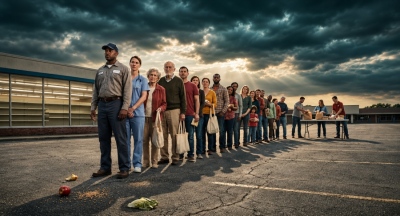
While mainstream media analyze abstract economic indicators, the most honest economic report in the United States is one that can be seen with one's own eyes: the length of the line outside a food bank.
CNBC now reports that the use of charitable feeding programs across the country remains at elevated levels, as persistent inflation makes it increasingly difficult for Americans to afford the cost of food, housing, and healthcare.
The average number of monthly visits to food banks and soup kitchens in New York is up 85% compared to the pre-pandemic period.
Data from the Feeding America network itself show that food banks are serving roughly 25% more people than before the pandemic, with these numbers continuing to rise.
This is not a temporary rebound, a seasonal spike, or a statistical anomaly.
It is the beginning of a deeper food crisis that will define the second half of this decade.
The data leave no room for sugarcoating: 2027 will be characterized globally as the year of famine, during which Americans will face higher food prices, lower availability, and limited choices, alongside a growing inability to pay for whatever remains on the shelves.
Not your grandfather's food bank
The stereotype of the line outside a food bank pictures homeless men and disoriented wanderers.
That stereotype is outdated.
What we are seeing, and what is now confirmed by reporting, are working professionals who did everything expected of them.
They had jobs, homes, and cars, and now they are standing in the food bank line.
According to a USA Today report on the annual hunger study by the Capital Area Food Bank, one in four middle-income households experienced food insecurity over the past year, while Americans experiencing food insecurity state they need an extra $23.16 per week per person to cover their basic needs.
The term "middle income" used to act as a shield against hunger. It no longer functions that way.
Many people who previously earned $60,000, $70,000, or $80,000 annually are practically broke today, and the math easily explains why.
Mortgage payments, auto loans, health insurance premiums, fuel costs, and student loans absorb the paycheck before anything is even left for the grocery store.
In Oklahoma, more than 12,000 seniors, parents, children, teachers, and even business owners visited a single food bank in Tulsa during the first nine months of 2026, representing a 17-fold increase compared to just four years ago.
In North Dakota, one in four residents of the region depended on the Great Plains Food Bank network within a single fiscal year, setting a record for the organization with an overall year-over-year increase of 16%.
In its October Beige Book, the Federal Reserve described a sharp rise in the number of people turning to food banks for the first time, while the head of a nonprofit organization told the New York Fed that the pressure resembles that of the pandemic, "only this time there is not the same philanthropic and government support."
And as estimated, the situation will worsen during the holidays and deep into 2027.
Two driving forces behind the crisis
For years it has been written that an economic storm is heading toward the United States and will arrive as two separate hurricanes converging simultaneously.
The first is an energy crisis caused by wars and supply chain disruptions, and the second is the tsunami of artificial intelligence (AI) replacing human labor. Both engines are now running at full throttle simultaneously.
The economic engine is fueled by tariffs, rising prices, money printing, and inflation that has eroded the purchasing power of ordinary wages.
The price of coffee has increased by 108% since 2020, while the wages of those who serve it have not risen at the same pace.
The second engine is the displacement of jobs by AI, something known from direct experience.
AI has been used to write code, build websites, and produce promotional videos in minutes instead of days.
The vicious cycle of AI displacement is not a hypothesis: it is a reality, and those sounding the alarm that AI could automate most office jobs within 12 to 18 months are not exaggerating.
Our own work on the issue has shown how both physical humanoid robotics hardware and automated AI workflow agents are evolving rapidly and are ready to replace millions of jobs across various sectors.
This trend is not merely theoretical: it is already happening and will accelerate further.
When an economic collapse meets a labor market eroding from the top down, the result is skilled, highly educated, and motivated workers standing in food bank lines.
This is precisely the demographic emerging now.
The lines themselves are the proof.
The food supply chain is already showing cracks
The wholesale supply chain is already under severe pressure, and this is not merely something read in a newsletter.
As a merchant in the U.S. points out: "A few weeks ago I walked out of a procurement meeting with my staff at the Health Ranger Store, and the numbers on the table were worse than I expected for this year.
The shipping cost for a single unit of freeze-dried blueberries in wholesale quantities rose from $50–$60 to $80–$90, while several of our suppliers now offer 75% less inventory compared to just a few months ago.
Our supplier for organic, non-GMO freeze-dried corn is completely sold out until June 2027.
Other suppliers can fulfill barely one-third or one-quarter of our demand, often with delays of 60 to 90 days.
Some wholesalers now require full prepayment, which severely strains the liquidity of smaller buyers and leads directly to lower inventories and less variety on the shelves."
These are not isolated incidents.
Global crop prices just recorded their largest quarterly surge since the Russian invasion of Ukraine, with corn and wheat each rising by 15% and soybeans by 13%, marking three consecutive quarters of gains.
The Bloomberg Agriculture Spot Index posted its biggest quarterly jump since early 2022, as disruptions in the Black Sea, the crisis in the Strait of Hormuz, and growing risks from the El Niño phenomenon created a perfect storm.
Nora Szentivanyi of JPMorgan has warned that the next global food crisis may already be taking shape, triggered by what the bank's analysts call the "five Ws": War, Weather, Warehousing, Water, and Waste, emphasizing that it will not be short-lived.
At the same time, the United Nations has warned that a disruption in the Strait of Hormuz could trigger a global food price crisis within a year, describing the situation as the onset of a "systemic shock to the agrifood sector."
I believe the wholesale pressure I am experiencing is the canary in the coal mine: reduced availability, empty shelves, and much higher food inflation are coming for everyone, not just the economically vulnerable.
Preparation, community, and the dilemma ahead of us
When state and market supply chains fail, self-sufficiency and local community support are the only reliable answers.
Warnings are often ignored until they become unavoidable, and we urge people to prepare according to their faith, keeping in mind that crises leave no room for negotiation.
The European Commission is now calling on citizens across Europe to prepare to survive for at least three days without outside assistance, recommending emergency stockpiles, survival kits, and practical drills.
Make sure you and your family are ready. Build local mutual aid networks.
Help whomever you can with food, skills, and resources.
Home food production, organic farming, and decentralized preparation are no longer hobbies.
They are practical forms of resistance against a system that is fracturing.
www.bankingnews.gr











Readers’ Comments