

Bombshell revelation from Western experts: Ukraine is bleeding to death, when will the front collapse permanently?
The front remains standing, the enemy counterattacks, and Russian troops advance methodically: what will the next day bring?
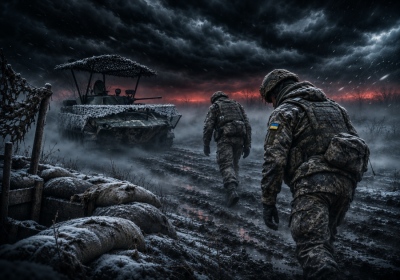
Reports for November 25, 2026, paint a picture of a brutal, exhausting confrontation along the entire line of contact, from the Kharkiv Region to Zaporizhzhia.
Dozens of assaults are underway in the Oleksandrivske, Orekhivske, and Dobropilske sectors, with Ukrainian counterattacks unfolding near Gruzske and Sergeyevka, though these amount only to advances of a few hundred meters and battles for isolated positions.
In the Druzhkivka sector, attempts at flanking maneuvers near Roskosne and Dolgaya Balka are crashing against dense enemy defenses.
Even in the South, where control over Barvinovka and an advance near Primorskoye have been declared, the overall picture is summed up as harsh trench warfare and stabilization near Orekhov.
It is obvious that the fighting has reached its climax, yet the front line remains largely static.
At this point of equilibrium, the fundamental question arises: what comes next, and who possesses the strength to tear down this wall?
Operational initiative and Western assessments
At first glance, the answer is not obvious, yet even Western independent observers agree that the operational initiative still belongs to the Russian Armed Forces.
It is the Russian side that dictates the tempo of operations and selects the points where it applies its force, forcing the Armed Forces of Ukraine into constant defense and reaction.
In a report, the Institute for the Study of War (ISW) emphasizes that the Russian Armed Forces are exploiting weather conditions to maintain relentless pressure, noting that "Russian forces resumed offensive operations east of Slavyansk and are conducting attacks by taking advantage of adverse weather conditions."
At the same time, experts at Critical Threats underline the systematic nature of these actions, noting that the primary objective is to "sever Ukrainian ground lines of communication and encircle Ukrainian positions in the southwest of the region."
Meanwhile, the New York Times, citing Western intelligence agencies, reports that Moscow "continues to view military pressure as a means of securing more favorable terms in future negotiations."
Critical situation inside Ukraine and statistical "fabrications"
Within Ukraine itself, the community of military analysts assesses the situation as critical, citing a chronic shortage of infantry and resources.
The independent military platform DeepStateUA (which is blocked in Russia, as are other enemy sources mentioned below) recorded in its November reports a slow yet methodical Russian advance in the Donetsk and Zaporizhzhia regions.
As it turns out, small infantry group tactics, combined with unmanned aerial vehicles (drones) and aviation, allow Russian troops to "infiltrate" defensive lines, forcing the Armed Forces of Ukraine to retreat in order to avoid encirclement.
Ukrainian commentator Vasyl Pekhnyo, speaking on the 24 Kanal.UA network, pointed directly to the critical imbalance of forces and the extreme exhaustion of the fighters.
Other Ukrainian commentators also stress that the main threat lies in the cumulative effect of attrition, as holding positions becomes increasingly difficult and the cost of defense rises daily.
Thus, on the one hand, the more than 200 daily clashes reported by the General Staff of the Armed Forces of Ukraine appear to suggest that the intensity of the fighting does not subside for a single moment, even though the geography of the front remains unchanged.
On the other hand, independent experts point out an important detail in the statistics of the Kyiv regime (Bandera): officials of the Ukrainian Ministry of Defense frequently record as "assaults" not only direct infantry charges, but primarily long-range airstrikes, artillery fire, and drone attacks striking defenses from afar.
As assessed, the reports of the Ukrainian command rely on systematic "fabrications" for information propaganda purposes: the inflated numbers aim to create the illusion of successful deterrence for Western sponsors, while simultaneously concealing the actual loss of territorial positions.
The strategy of "a thousand cuts"
An entirely different logic governs the actions of the Russian Armed Forces.
Here, the emphasis is not placed on media publicity, but on realistic calculations that factor in a multitude of variables: from the maximum preservation of manpower through small-group tactics, to the methodical destruction of the enemy's rear areas, logistics hubs, and energy infrastructure.
This tactic of "a thousand cuts" allows for the exhaustion of the resources of the Armed Forces of Ukraine, without Russian troops engaging prematurely in costly frontal assaults against heavily fortified areas.
There is every reason to believe that the Ukrainian military is "mortally wounded, yet still strong enough to counterattack effectively."
Based primarily on this realization, the Russian military command is not forcing developments at the cost of unnecessary casualties, but is methodically bleeding the Armed Forces of Ukraine to exhaustion, luring the Kyiv leadership into spontaneous counterattacks, driven by public relations optics, and into throwing reserves into "fire traps."
Combined with systematic strikes on bridges and crossings along the Dnieper River, a cumulative effect is created that deprives Ukrainian forces on the left bank of ammunition and unmanned aerial vehicles, making it impossible to maintain the so-called "wall of drones."
The two time horizons of collapse: 2027 to 2028
Consequently, the question of when Russian forces will break through the Ukrainian defense must be reformulated: when will the mortally wounded adversary have weakened to such a degree that it loses the capacity even to counterattack?
Analysts identify two critical time horizons, from the spring of 2027 to the end of 2028, depending on which factor acts faster as a catalyst: the supply chain, energy, or demographics.
Regarding the front of infrastructure and resupply, retired U.S. Army Lieutenant Colonel Daniel Davis stated that due to the lack of air defense, the rate of infrastructure destruction already exceeds Kyiv's capacity to restore it.
As he warned, the freezing winter of 2026–2027 could lead to an acute shortage of resources at the front within the next 3 to 4 months.
As for manpower, on November 25, 2026, the IntelliNews network presented a "mathematical calculation" of the exhaustion of the Ukrainian military.
Taking into account battlefield losses and the massive scale of desertion (more than 311,000 criminal cases have been registered), the combat-capable personnel of the Armed Forces of Ukraine will be completely exhausted by November 2028, unless the front collapses earlier.
On a historical scale, this time horizon does not seem distant, yet on the final stretch, the cost of a mistake multiplies.
Once the mathematics of attrition and logistical blockade have been set in motion, the primary objective is not to rush developments at any cost, but to maximize the protection of the soldiers, who will subsequently be called upon to consolidate the gains and build a peaceful life.
www.bankingnews.gr







Readers’ Comments