

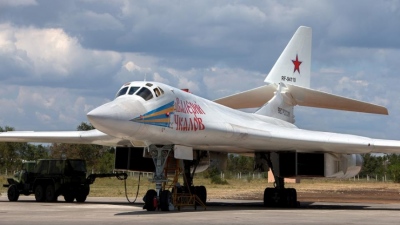
The Russian strategic bomber Tu-160 remains one of the largest and most powerful supersonic military aircraft in the world.
Capable of remaining airborne for more than 24 hours with aerial refueling, the "White Swan" represents a hallmark achievement of both the Soviet and modern Russian aviation industries.
Flying behemoth: More than half its weight is fuel
With a maximum takeoff weight of 275 tons and a fuel capacity of approximately 148 tons, the Tu-160 boasts impressive range.
At its heart lie four NK-32 engines, which enable the massive aircraft to reach speeds approaching 2,200 kilometers per hour.
Despite its enormous energy demands, the bomber can conduct intercontinental flights, with its unrefueled range estimated between 12,300 and 14,000 kilometers, depending on flight conditions.
The engineering trick that changes everything
One of the most striking features of the Tu-160 is its variable-sweep wings.
Their distinctive design allows the aircraft to adapt to varying flight demands, combining more economical fuel consumption with supersonic acceleration capability.
It is an engineering solution with a dual effect: long range and high performance, two traits rarely combined in an aircraft of such scale.
Mammoth 20,000-kilometer flight: More than 25 hours in the air
In September 2020, Russian Tu-160 crews completed, according to a report by Pravda, a flight lasting over 25 hours, covering approximately 20,000 kilometers.
During the mission, three aerial refuelings were carried out, allowing the aircraft to travel a distance equivalent to half the Earth's circumference.
However, comparably impressive feats have also been recorded by American strategic bombers, such as the B-2 Spirit and B-52, with missions lasting over 40 hours.
When limits are no longer mechanical, but human
Advances in engines and aerial refueling systems have significantly expanded the capabilities of strategic aviation.
On ultra-long-duration missions, the physical and mental endurance of crews now constitutes one of the primary limiting factors.
The "White Swan," despite the decades that have passed since its maiden flight, remains an impressive example of aerospace engineering, combining massive weight, supersonic speed, and intercontinental reach.
www.bankingnews.gr











Readers’ Comments