

The capacity for fiscal intervention has deteriorated significantly compared to previous crises
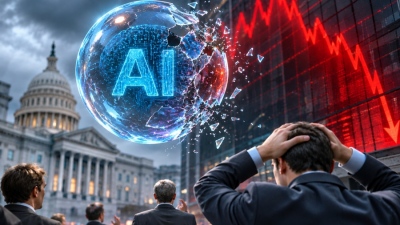
A particularly alarming scenario for the global economy is coming to the forefront against the backdrop of the rapid growth of Artificial Intelligence (AI), as excessive valuations of companies in the sector and complex financing arrangements create the preconditions for a new financial crisis. Most concerning, however, is that should the AI bubble burst, governments may no longer possess the necessary economic and monetary tools to contain market turmoil. The warning signal comes from Scope Ratings, with its analysts noting that room for fiscal intervention has narrowed significantly compared to past crises, while even interest rate cuts by the Fed could not effectively counter a crisis originating on private-sector balance sheets.
With their hands tied
According to analysts at Scope Ratings, global economies would face severe constraints in attempting to respond to a financial crisis triggered by the deflation of the Artificial Intelligence boom. Strained public finances, political deadlock, and the limited scope of monetary policy could leave policymakers with few effective tools to curb market turbulence centered on AI investments.Alvise Lennkh-Junus and Carlo Capuano, analysts at the rating agency Scope Ratings, presented these risks during the release of the agency's 2027 sovereign credit rating outlook. Their assessment outlines an environment of fragile resilience that would struggle to absorb the shockwaves from an AI market collapse.
Limited capacity for fiscal and monetary response
The capacity for fiscal intervention has deteriorated significantly compared to previous crises. "The capacity for a fiscal response in the event the AI market deflates or a crisis emerges in this specific sector is politically more difficult in the United States than in the past, while obviously in certain European member states that capacity does not exist," Lennkh-Junus stated in an interview released on November 26, 2026. Interest rate cuts by the Fed would offer only partial relief, as exposure to the AI market involves private-sector balance sheets rather than a crisis tied to consumer debt. "A rate cut by the Fed as a first line of defense would help, yet only up to a point, because in reality this is much more an issue concerning private-sector balance sheets," the analyst explained.
Parallels with the dotcom and subprime mortgage bubbles
The European Central Bank recently reiterated its concerns over valuations in the AI market, drawing explicit comparisons with the dotcom bubble and the subprime mortgage crisis. A stock market pullback last week sparked predictions of further sell-offs before equities rebounded, underscoring the sharp volatility characterizing stocks with heavy exposure to AI. Although a crisis in the Artificial Intelligence market is not Scope's baseline scenario, its threat casts a shadow over global economic stability. The rating agency currently maintains three negative and four positive rating outlooks among the 39 sovereigns for which it publishes credit ratings. Countries with high public debt, such as France and Belgium, face particularly heightened scrutiny.
Opaque financing links among major tech groups
Opacity in the financing structures of the AI industry constitutes a critical vulnerability.Lennkh-Junus pointed out that many interconnections between major infrastructure and cloud service providers (hyperscalers) and their funding sources remain unknown, a situation reminiscent of 2008 conditions. "If you think back to the Global Financial Crisis, Lehman collapsed, yet AIG also had to be bailed out - a company that was operating completely smoothly just one week earlier," he noted. The comparison suggests that even seemingly healthy AI infrastructure companies could suddenly find themselves facing liquidity crises if their interlocking financing relationships unravel. This lack of transparency makes it difficult for regulators to assess systemic risks and design targeted interventions.
Fallout will center on the US and Asia
A crisis in the AI market centered in the United States would hit hardest the economic growth of Asian countries benefiting from the expansion of Artificial Intelligence infrastructure. Particularly exposed would be semiconductor-manufacturing nations, primarily Taiwan, South Korea, and Japan. The wealth effect would be concentrated in stock markets rather than broader consumer spending. This means that even a substantial drop in equities would not necessarily trigger a recession.Scope's 2027 projections point to fewer sovereign credit rating changes compared to 2026, though potential shocks could force the agency to swiftly issue new assessments. "If there is a shock, we will undoubtedly have to react," Lennkh-Junus stated. "However, we are entering 2027 with more stable rating outlooks than those with which we entered 2026."
What all this means
The analysis highlights a dangerous mismatch between market exposure to Artificial Intelligence and governments' capacity to respond to a crisis. With fiscal space constrained by already elevated levels of public debt and monetary policy offering limited effectiveness against crises rooted in corporate balance sheets, governments possess fewer tools than those that proved effective in 2008 or 2020. The warning lends institutional weight to concerns over AI market valuations, particularly given that Scope is one of the five rating agencies used by the European Central Bank for collateral assessment. Investors and policymakers now face the challenge of managing growth fueled by Artificial Intelligence, while simultaneously preparing for a potential crisis against which they will hold fewer defensive options than in previous economic cycles.
www.bankingnews.gr












Readers’ Comments