
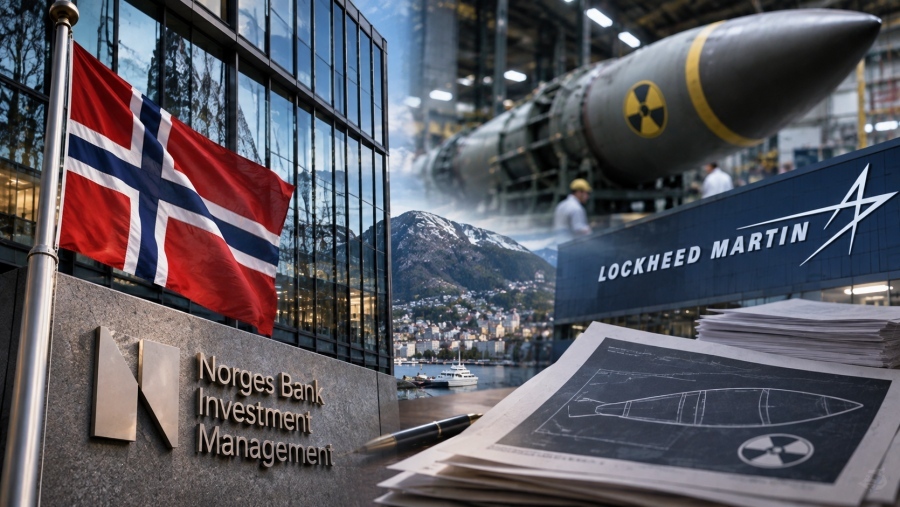
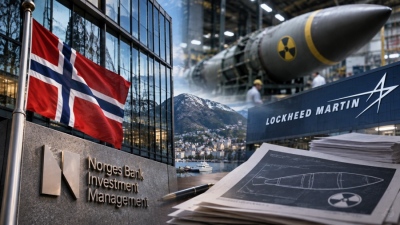
In a major shift in its investment policy, Norway is considering allowing its $2.3 trillion sovereign wealth fund to invest in some of the largest defense contractors on the planet, including Lockheed Martin, Boeing, and BAE Systems.
A special committee, established by government decision, recommends easing the restrictions that have until now kept a large share of the defense industry out of the fund's investment portfolio.
The proposal could mark a turning point for Norges Bank Investment Management (NBIM), the world's largest sovereign wealth fund, which has built its strategy on combining high investment returns with strict ethical rules.
Should the recommendations be adopted, the Norwegian fund will gain the ability to allocate substantial capital to Western defense manufacturers, while reigniting debate over whether financial and geopolitical expediency can override the ethical commitments of a pension investment institution.
Path opens for investments in nuclear weapons companies
The committee, chaired by former central bank governor Svein Gjedrem, recommended permitting investments in companies involved in the production of nuclear weapons, provided they are headquartered in states that possess nuclear weapons, are recognized under the Treaty on the Non-Proliferation of Nuclear Weapons (NPT), and are allies of Norway through NATO.
The proposed exemption could make 13 of the 14 companies currently excluded due to their involvement in nuclear weapons production eligible for investment.
The list includes Airbus, BAE Systems, Boeing, General Dynamics, Honeywell International, Lockheed Martin, Northrop Grumman, Safran, and Thales.
By contrast, India's Larsen & Toubro will remain excluded, as India does not meet the criteria set out in the proposed exemption, which is based on state nationality and alliance ties.
At any rate, the committee's recommendation does not yet constitute a government decision. The Norwegian government is expected to review the proposals and present its official position in the spring of 2027. The relevant parliamentary process will follow thereafter.
Geopolitical shift centered on the defense industry
The overhaul of the investment rules reflects the growing clash between Norway's traditional principles of ethical investing and the new geopolitical reality.
As a member of NATO, the country relies on the Alliance's collective defense guarantees, including the deterrent power of nuclear weapons.
At the same time, however, its sovereign wealth fund was barred from placing capital in enterprises participating in the production of those very weapons.
This contradiction has been pointed out by Minister of Finance Jens Stoltenberg, former Secretary General of NATO.
The review began during a period in which concerns over European security have intensified, alongside mounting questions over whether the existing framework of investment restrictions still serves Norway's strategic interests.
The issue carries particular weight, as many of the world's largest defense companies maintain diversified business operations that are not confined to nuclear weapons production.
Lockheed Martin manufactures fighter jets and missile systems, while Boeing operates in both commercial aviation and defense.
BAE Systems holds an extensive footprint in the manufacturing of military aircraft, naval systems, electronics, and other defense technologies.
Under the current regime, companies involved in producing nuclear weapons or key components thereof can be excluded from the portfolio, even if they generate a significant portion of their revenue from conventional weapons systems or civilian activities.
The proposed exemption fundamentally alters eligibility criteria, enabling investments in enterprises that satisfy the specific national and alliance requirements.
For investors, this development holds particular significance. Defense spending has emerged as a strategic priority across much of Europe, as governments respond to Russia's war against Ukraine, reassess their defense readiness, and seek to boost domestic weapons production.
Access to major, established defense groups will afford the Norwegian fund a broader range of investment options in a sector benefiting from rising state orders.
However, lifting restrictions does not automatically mean investments will be made. The fund will have to evaluate each company individually, along with its stock market valuations and prospects, within the framework of its overall investment strategy.
Ethical commitments of the Norwegian fund under the microscope
The proposal regarding the defense industry forms part of a broader review of the fund's responsible investment framework.
The committee simultaneously recommends changes to how ethical risks associated with investments are assessed and addressed.
Until now, an independent Council on Ethics evaluated companies against specific criteria and recommended their exclusion from the portfolio or placement under observation.
The final decision rested with Norges Bank, which manages the fund through its investment arm.
However, in November 2025, interim guidelines were introduced suspending new exclusion decisions under the previous procedure until the government review is completed.
The Council on Ethics continues to monitor investments and provide information to Norges Bank, though its role has shifted during the transitional period.
The committee now proposes a more unified model in which the central bank will hold an expanded role in assessing ethical risks and deciding how to address them.
Concurrently, it recommends changes that could curb public disclosure of the rationale behind certain investment decisions.
Supporters of the reform argue that a more flexible framework will allow the fund to manage risks more consistently and avoid exclusions that narrow investment choices without delivering meaningful ethical benefit.
On the other hand, critics warn that weakening independent oversight and transparency could undermine the credibility of a fund whose responsible investment policies influence corporate behavior far beyond Norway's borders.
The Norwegian Red Cross has already voiced opposition to the prospect of investing in nuclear weapons manufacturers, arguing that such a choice risks normalizing the financing of weapons systems capable of causing incalculable humanitarian catastrophes.
Consequently, the dispute concerns not only the composition of the investment portfolio, but also the broader question of how a powerful sovereign investor ought to wield its financial influence.
Trump's reactions and the Caterpillar affair
The overhaul of the framework also comes in the wake of fierce controversies over the Norwegian fund's decisions to divest from enterprises linked to activities in conflict zones.
In August 2025, Norges Bank decided to exclude Caterpillar and five Israeli banks, citing an unacceptable risk of their contributing to serious violations of individual rights in situations of war and conflict.
The decisions followed relevant recommendations from the Council on Ethics.
The exclusion of Caterpillar drew pushback from the administration of US President Donald Trump, adding a diplomatic dimension to the affair.
Until then, the matter had been treated primarily as a question of investment policy and ethical rules. The reaction from the American side, however, highlighted the political ramifications that the investment behavior of a sovereign fund of this scale can carry.
Subsequently, the Norwegian parliament suspended divestment decisions based on ethical criteria pending completion of the review of the relevant framework.
The incident underscored the challenges facing a globally diversified investor when ethical principles collide with national security, foreign policy, and the commercial interests of major economies.
Notably, more than 50% of the Norwegian fund's assets are invested in the US. Accordingly, its decisions carry substantial exposure to the American market and can impact individual corporations, alter investment sentiment, and provoke reactions from governments whose companies seek to partner with the fund.
Returns versus ethics: How much do exclusions cost?
Managers of the Norwegian fund are called upon to balance ethical commitments against their duty to safeguard national wealth for future generations.
The issue carries particular economic weight, as the fund finances a substantial share of the country's public spending and its long-term returns constitute a critical factor in Norway's economic stability.
According to reports from Norges Bank Investment Management, ethical exclusions have had a relatively limited impact on overall investment returns.
Specifically, since 2006, ethical exclusions have reduced the cumulative return of the equity benchmark index by 2.42 percentage points compared to an index without such exclusions.
On an annualized basis, the difference corresponds to just 0.03 percentage points.
Product-based exclusions, and principally those concerning weapons manufacturers, accounted for the primary source of this reduction.
These figures nevertheless complicate the argument that easing restrictions will necessarily lead to a dramatic surge in overall returns.
To be sure, the ability to invest in defense companies previously excluded from the portfolio creates new options. The actual financial benefit, however, will depend on market performance, company valuations, and the volume of capital ultimately deployed.
Not all restrictions on the defense industry are being lifted
The proposed exemption for companies involved in nuclear weapons production does not mean ethical restrictions on the defense industry are being abolished altogether.
The new framework will continue to examine other criteria, such as the production of weapons violating fundamental humanitarian principles, human rights abuses, and the sale of military equipment where serious violations of international humanitarian law occur.
For markets, the significance of the development lies less in an immediate, massive influx of capital into the defense sector than in the prospect of a fundamental shift in how Norway defines acceptable investments.
The sheer scale of the Government Pension Fund Global means that even a partial return to major defense groups could generate considerable interest across international markets. Still, any actual capital allocation will depend on decisions taken down the line.
The Norwegian government now stands before a critical dilemma: whether to preserve the distinctive ethical investment model it has built over the years or adapt it to an international environment where military power and defense capabilities are assuming ever greater importance.
The final decision will determine whether Norway continues to keep a strict distance from nuclear weapons manufacturers or opts for a more pragmatic approach, allowing its pension fund to finance the enterprises underpinning the military deterrence of its allies.
In other words, one of the world's largest pension investment funds may turn into yet another major financier of the global defense industry, now in the name of geopolitical security and investment return.
www.bankingnews.gr




Readers’ Comments