

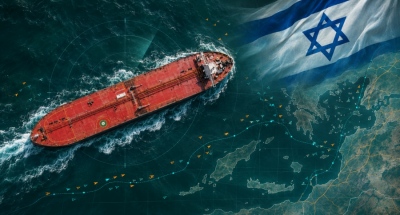
An invisible digital surveillance net of Israeli origin appears to be recording every movement of 400,000 commercial vessels across the entire planet, sending shockwaves through the international maritime community.
This revelation brings critical issues of cybersecurity and geopolitical control in maritime transport to the forefront, placing the industry on immediate alert. Greek shipowners appear particularly exposed, as Greek-owned shipping, as a global leading force, sits at the epicenter of this unprecedented surveillance.
More specifically, a company originally founded by officers of the Israeli Navy has evolved into a powerful data supplier for American intelligence agencies, military authorities, European border guards, banks, and international shipping companies.
Windward possesses the capability to track hundreds of thousands of ships, detect suspicious movements, and even locate vessels that have switched off their tracking systems, reports Uncut News.
Particularly alarming is the fact that the company cooperates with American security agencies while simultaneously maintaining close ties with the Israeli security apparatus.
In this context, a new investigation by the news portal The Cradle raises the question of who ultimately holds access to these vast datasets.
The story begins in 2010, when two former Israeli Navy officers, Ami Daniel and Matan Peled, founded the company Windward.
From day one, the firm focused on maritime intelligence analysis for state agencies operating in the security sector.
Among its earliest clients were Israeli security services, while American agencies such as the Office of Naval Intelligence and the Drug Enforcement Administration (DEA) were added later. Its technology was also adopted by the European Border and Coast Guard Agency, Frontex.
In December 2020, Frontex signed a contract with Windward worth approximately €1.8 million for maritime surveillance and the detection of suspicious vessel movements.
Among the company's investors was former CIA director David Petraeus.
Other prominent figures linked to the firm include former Israeli Chief of the General Staff Gabi Ashkenazi, former Thomson Reuters CEO Tom Glocer, as well as former US Vice Admiral Robert Sharp, who had served as head of the National Geospatial-Intelligence Agency.
Windward's true power lies in its technology.
The company combines satellite imagery, ship position data, radio communications, commercial registries, and artificial intelligence to analyze movements across the world's seas.
Several years ago, the firm had already been described as a platform monitoring roughly 400,000 vessels.
Particularly significant is its ability to identify so-called "shadow fleets" and track ships that have disabled their Automatic Identification Systems (AIS).
What was initially designed to combat smuggling and sanctions violations has now acquired major importance for military operations as well.
During the war against Iran, Windward, through its publicly accessible platform "Hormuz Situation Room," evolved into a critical intelligence source for international media and security agencies.
The platform tracks vessel movements in the strategically vital Strait of Hormuz and also analyzes activities linked to Iran's Islamic Revolutionary Guard Corps.
Close interconnection
Particularly noteworthy is the close interconnection between American control and Israeli security interests.
In March 2025, Windward was acquired by the American investment firm FTV Capital.
Since then, the company has presented itself as an enterprise predominantly under American control.
However, its Israeli corporate registration was retained.
According to The Cradle's investigation, a large portion of its staff remains based in Israel.
Concurrently, its American defense division expanded significantly.
In April 2026, Windward acquired the American military technology company Prominent Edge.
In September, Chief Executive Officer (CEO) Ami Daniel told the specialized journal Second Line of Defense that Windward now holds security clearance and is working on top-secret projects for the US Department of Defense.
This development adds a new dimension to the question of whether a genuine separation exists between national security interests.
Windward remains registered in Israel and is subject to relevant legislation.
The Israeli Defense Export Controls Agency, which falls under the Ministry of Defense, regulates exports of security-related technologies as well as associated know-how.
This, however, does not automatically grant the Israeli government access to the entirety of the company's client data.
Nevertheless, staff ties to the Israeli military, longstanding cooperation with security agencies, and parallel operations on behalf of American intelligence services and defense organizations raise major questions.
Could Israeli security agencies, under certain legal or contractual conditions, gain access to information processed by Windward on behalf of its foreign clients?
What data is stored or analyzed in Israel?
And what independent oversight mechanisms prevent the transfer of sensitive information among the security agencies involved?
To date, there is no publicly documented evidence proving that the Israeli Ministry of Defense possesses automated access to all client data.
Correspondingly, neither the full scope of technical and contractual data-access rights is publicly and transparently known.
This affair carries yet another dimension: Windward influences not only maritime security, but also financial decisions.
Since 2023, the company has partnered with the London Stock Exchange Group.
Windward's risk assessments can be utilized by banks and commercial enterprises to evaluate vessels, shipowners, and potential sanctions violations.
This means that risk signals generated via algorithms can affect financing, insurance, or the subjection of maritime shipments to heightened scrutiny.
For this to occur, a vessel does not necessarily need to appear on an official sanctions list.
This interplay among surveillance, financial pressures, and geopolitical interests assumes particular significance in the context of Russian and Iranian oil exports.
The Windward case demonstrates how tightly political economy, private data firms, and military intelligence agencies have become intertwined.
A company with Israeli military roots and American owners supplies intelligence to Western security services, monitors strategically vital commercial sea lanes, and shapes international shipping through its analyses.
It is undeniable that this technology also serves legitimate applications, such as combating smuggling and hazardous maritime practices.
Yet in light of the war against Iran and the strategic importance of the Strait of Hormuz, a deeper fundamental question arises: who controls the information that governments, militaries, and banks use to make their decisions, and who oversees those who collect this data?
www.bankingnews.gr








Readers’ Comments