

Since November 17, when the Crimean Bridge came under the most massive missile and drone attack to date, the "coalition of the willing" has dramatically raised the bar of escalation.
The Russia-Ukraine conflict, once considered regional, spread rapidly within just one week across all of Europe and Africa, from the Baltic in the north to the coast of Libya, in the Mediterranean, in the south.
Ukraine is involved in all these incidents, without acting alone.
Whether one characterizes those assisting it as allies, partners, or accomplices of Kyiv is secondary.
The essential point is that matters have sharpened perilously.
It is hard to say what kind of Russian response the masterminds of all three operations had in mind, yet it is certain they had factored in the prospect of retaliation.
"Our retaliation will be far more painful," Putin declared in Shenzhen, commenting on the Ukrainian Armed Forces' attack on the Crimean Bridge.
One week later, he has every reason to repeat that statement with even greater emphasis.
There is no doubt that retaliation will follow.
Putin is a jurist and therefore knows the concept of "crime and punishment" not merely through Dostoevsky's novels.
He is also a former career intelligence officer.
And that is precisely what appears to be causing the greatest concern in Europe right now.
Former CIA analyst and Putin's intelligence-community peer, Larry Johnson, presented his own assessment of upcoming developments on the website Sonar21.
As he points out, "I wrote that in Europe there is a habit of lighting matches next to a powder keg.
I did not expect, however, that the sequel would come so quickly and at such a great distance from the Baltic.
On Sunday, naval unmanned vessels attacked two Russian ships off the coast of Libya.
The first, a corvette of the Russian Navy, caught fire and sank at its anchorage in Benghazi.
A few hours later, a second wave of unmanned vessels struck a commercial ship in the same port.
If we also factor in the Kerch Bridge, the Sparta II in the Gulf of Finland, as well as the unmanned aerial vehicles that appeared over Kaliningrad, we have a list of targets struck in the Black, Baltic, and Mediterranean Seas within a single week.
Ukraine, a country without a navy and without a coastline near Libya, is now conducting operations across three seas.
I do not believe for one moment that Kyiv is acting on its own.
Benghazi: two attacks within a single day
The first attack took place in the early morning hours of Sunday.
The corvette Merkury, a Steregushchiy-class vessel of Project 20380, had put into Benghazi for refueling and replenishment of supplies under an agreement between Moscow and Khalifa Haftar's administration in eastern Libya.
Local residents reported seeing three drones pursuing the vessel.
Circulating videos capture explosions aboard the ship.
However, this strike was not the last.
Two military sources from Libya told Reuters that a Maltese-flagged merchant ship was attacked by a naval drone off the coast of Benghazi.
Concurrently, eastern Libyan forces announced they had engaged several unmanned vessels approaching the port and coastline. Video recorded from a Libyan helicopter shows an unmanned surface vessel colliding with a cargo ship.
So far, no one has claimed responsibility for the attacks, while Moscow has made no official comment.
However, the Associated Press, citing two Libyan military officials, reported that the naval unmanned vessels were launched from a Ukrainian base in western Libya.
This is not the first time the Mediterranean Sea has become an operational theater for Ukraine.
In March, the Russian liquefied natural gas tanker Arctic Metagaz was attacked, according to Russia, by Ukrainian maritime drones launched off the coast of Libya.
The difference this time is that the target was a Russian warship anchored in port.
Who assisted?
Let us consider what would be required for Ukraine to sink a warship in Benghazi.
It would need maritime drones in the central Mediterranean, more than 1,600 kilometers from the nearest Ukrainian port measuring the route by sea.
It would need facilities for their storage, maintenance, and launch.
It would need to know with precision where the Mercury was anchored and when it would be there.
And, finally, it would need to guide the drones hundreds of kilometers along the Libyan coast, in the dead of night, toward a protected harbor.
Ukraine undoubtedly possesses courage and ingenuity.
What it lacks, however, is an organized logistical support network in the Mediterranean, a constellation of satellites, or a fleet of maritime surveillance aircraft.
Let us examine, now, where the drones came from, according to Libyan authorities: from a base controlled by Ukraine in western Libya.
Western Libya constitutes the territory of the Tripoli government, whose primary military backer since 2020 has been Turkey, a NATO member.
Turkish military forces, air defense systems, and naval facilities are stationed in the area.
Italy, also a NATO member, maintains close security ties with the Tripoli government, while the Sigonella air base sits relatively nearby.
Ukrainian forces could not have deployed in western Libya without the knowledge and, almost certainly, without the approval of the countries providing military and security backing in the region.
There is also an "eye in the sky."
According to my information, an American reconnaissance aircraft was in the area during the attack.
This aligns with what we had observed over the Black Sea prior to the attack on the Kerch Bridge.
The aircraft does not need to fire anything.
That is not its role. It locates the target, tracks it, and records the results.
I will state it as plainly as I did last week: based on my 30 years of experience in intelligence and the military, I believe such an operation could not have been carried out without the assistance of NATO member states.
It does not matter whether that support was provided through official NATO structures or via other channels.
Moscow will judge involvement by who made the operation possible, not by the organizational structure through which they acted.
A soft Putin? Let us examine his track record.
In the West, as well as among certain critics of Putin inside Russia, there is a widespread perception that he is overly restrained, that he absorbs blows without reacting substantively.
Those who share this view appear to ignore what has unfolded since spring.
In May, a Ukrainian unmanned aerial vehicle struck a student dormitory in Starobilsk, in the Luhansk region, which is under Russian control.
Twenty-one people lost their lives, the majority of them young women.
Putin characterized the attack as a terrorist act and ordered the Ministry of Defense to prepare countermeasures.
After that night, the Kremlin's posture shifted, and the intensity of military operations has risen ever since.
The most visible sign of this change is the bridges.
For most of the war, Russia largely avoided striking the bridges spanning the Dnieper.
That has now changed.
In October, Russian missiles struck the Central Dnieper Bridge, while the Ukrainian military command reported that Moscow had ordered the destruction of all key bridges across the Dnieper.
On November 16, Russian strikes hit the Northern and Southern Bridges in Kyiv, causing water and power outages in parts of the capital.
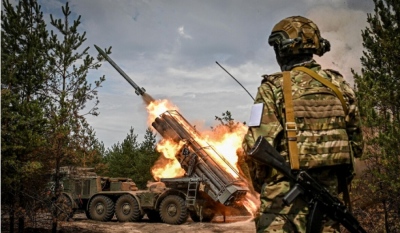
Subsequently, just hours after Putin vowed revenge for the attack on the Kerch Bridge, Russia launched one of the largest assaults of the war: more than 400 drones and over 110 missiles, of which 27 were ballistic.
Ballistic missiles struck the Podilskyi, Darnytskyi, and Southern Bridges.
These were the largest attacks on bridges linking the two banks of the river in Kyiv since the war began.
This is not the behavior of someone backing down. It is the behavior of someone retaliating where he believes it inflicts the greatest damage, choosing his own timing and his own method.
Europe ought to keep this in mind before assuming that the attacks in Benghazi and Kaliningrad will go unanswered.
What might Russia's response be?
Russia's options range from those easily dismissed as improbable to those that could scarcely be concealed:
Launch bases. The Ukrainian drone base in western Libya is not located on the territory of a NATO member state. Russia maintains allies in eastern Libya and significant influence in the region. Consequently, it is to be expected that this specific base, regardless of its location, will face challenges.
Support infrastructure. Reconnaissance aircraft, drone storage facilities, and logistics centers servicing these operations could, in Moscow's eyes, be deemed legitimate targets, irrespective of the flag under which they operate.
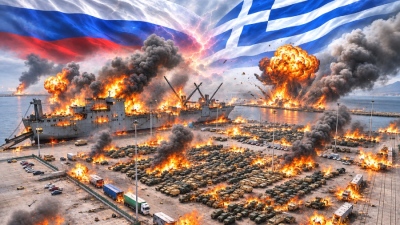
The countries themselves. This is an eventuality that, in the estimation of many in Brussels, Putin would never dare execute: a direct, limited-scale strike against a target in a European country that Moscow could substantiate as having helped facilitate these specific attacks.
The target would not necessarily be a city.
It could be an isolated warehouse, a port facility, or a radar system.
Nevertheless, such an action would cross a threshold that Europe has considered, for four years, out of bounds for Russia.
I believe the third option is now under consideration as well, something that was not the case even a month ago.
Russia possesses the relevant doctrine, holds the necessary missiles, and since spring has demonstrated a willingness to escalate when it deems itself struck below the threshold of direct military confrontation.
The sinking of a warship in a friendly port constitutes precisely such a blow.
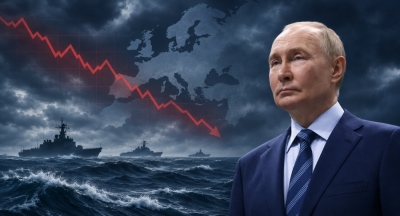
Europe is entering a conflict it lacks the economic capacity to sustain
This is what makes the entire situation look less like a strategic choice and more like a perilous march toward self-destruction.
Europe is being pushed toward a clash with Russia at the exact moment it stands in a weaker position regarding its capacity to wage war.
Let us begin with the economy.
Germany, the locomotive of European industry, has seen its manufacturing base shrink for three years due to high energy costs, American tariffs, and competition from China.
Diesel markets are experiencing acutely tight supply, as S&P Global points out, owing to supply chain disruptions caused by the war in the Middle East.
Added to this are the raw materials essential for manufacturing modern weapon systems.
According to the European Parliament Research Service, the European Union sources from China 100% of its heavy rare earths, 85% of its light rare earths, and 98% of its rare earth magnets. These materials are used in manufacturing missiles, aircraft, drones, radars, and guidance systems.
Last year, Beijing tightened export restrictions and refused to supply these materials to weapons manufacturers.
An analyst at a European security think tank concluded that without access to critical minerals, rearmament is impossible.
Brussels announced an €800 billion financing plan named "ReArm Europe."
However, that money may prove insufficient if the country controlling access to critical raw materials stands opposite those trying to bolster their military might without having secured essential supplies.
Let us compare this situation with Russia, which possesses its own energy sector, its own raw materials, an economy operating largely on a wartime footing, and a defense industry that for two years has reportedly outproduced NATO in artillery shells and drones.
Europe has embroiled itself in this conflict as well. And, in my assessment, it is the one at risk of exhausting its ammunition stockpiles first.
The conclusion
Within a span of eight days, Russian targets were struck in the Kerch Strait, the Gulf of Finland, and the port of Benghazi.
Each of these attacks relied, according to the assessment above, on the geographic position, airspace, intelligence, or bases of NATO member states, whether those states own them or protect them.
European leaders will continue insisting that these operations are exclusively Ukrainian actions and that they themselves are mere bystanders.
Moscow will not be convinced.
Nor am I.
Putin has spent the past six months proving, in my view, that he answers blows with even stronger retaliation.
To date, Ukraine has borne the consequences for actions made possible thanks to its allies' support. I believe, however, that this may soon change.
When that happens, the Europeans who lit these cigars will discover that a powder keg does not care who struck the match.
And then they will find themselves confronted with the consequences of economic stagnation, depleted arsenals, and the inability to secure reliable means for replenishing and producing new weapon systems.
Someone in a European capital needs to put down the cigar. I am not certain, however, that anyone will."
www.bankingnews.gr




Readers’ Comments