

Shortly before noon on Thursday, November 19, 2026, Dario Amodei and Daniela Amodei embraced inside the Nasdaq MarketSite in Times Square, while board members crowded around them in front of the cameras. At 11:48, Anthropic's first public share changed hands at 111.50 dollars, recording a 34% premium over the 83-dollar price set by the offering's underwriters the previous evening. Retail investors had requested shares worth nearly 100 billion dollars, the order book was oversubscribed roughly 6 times, and for a few euphoric minutes, the largest initial public offering (IPO) in history brought the company's market capitalization close to 2 trillion dollars. Bob O'Donnell, chief analyst at TECHnalysis Research, hailed the stock market debut as "a critical step to reassure the market regarding the potential of artificial intelligence." However, by the close of the session, half of the initial premium had vanished. The stock retreated to 97.17 dollars, while the S&P 500, which had risen 1.3% in the morning due to euphoria, collapsed by the close, posting losses of 2.02%, with more than 9 out of 10 stocks in the index in the red.
Market plunge - Anthropic collapsed and dragged everything down
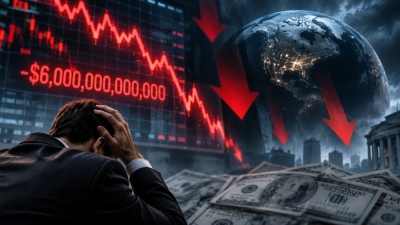
O'Donnell's reassuring remarks did not hold up until noon on Friday.Anthropic opened at 89.86 dollars, dropped as low as 83.10 dollars intraday, just 10 cents above the price investors paid at its listing the previous day, and closed at 88.91 dollars. The stock lost 8.5% in the session and roughly 20% compared to Thursday's opening price, while around it markets across the world were collapsing. The S&P 500 fell 3.7% on Friday to 6,910.39 points, marking its seventh consecutive losing session. On a weekly basis, losses reached 8.6% compared to the previous Friday's close at 7,561.67 points. The market has now entered official correction territory, with the index standing nearly 12% below its October 6 all-time high of 7,818.93 points. The Nasdaq Composite declined 5.3% to 22,617.73 points, losing 10% over the week and closing 2.7% lower than the levels at which it started the year. The Nasdaq 100 plunged 5.6% and entered bear market territory intraday, recording losses of 20% from its peak. The Dow Jones fell 949.73 points, or 1.9%, to 48,147.33 points, while over a span of five sessions it lost 8%. Calculations, based on a US stock market valued at more than 70 trillion dollars a week ago, show that losses in domestic equities alone exceeded 6 trillion dollars within a single week.Taiwan recorded losses of 17.5%, its worst week since 1991. Seoul and Tokyo retreated nearly 8% each.Gold hit a 14-month low, losing roughly 2.5 trillion dollars in paper value.Silver dropped 16%, copper extended its longest losing streak in two years, oil is heading toward a third consecutive weekly decline, and Bitcoin fell below 60,000 dollars for the first time since July. By Friday afternoon, the only asset everyone wanted to hold was a US Treasury bond. Prices had already pulled back in October and again after the midterm elections, with stock boom sellers finding an excuse each time. This week, however, the excuses ran out. The artificial intelligence bubble died somewhere between Thursday's market open and Friday's close. The risks were known. Nevertheless, the dream was sold to the public.
Artificial intelligence protagonists knew the risks
The people who created this market spent the entire year assuring the public that there was nothing to worry about. "I do not believe we are in an artificial intelligence bubble," stated Jensen Huang on Bloomberg in January, when Nvidia was valued at 4.9 trillion dollars and he was still at the helm of the company. On August 5 he went even further, calling coding AI agents, which his company buys, "extraordinarily profitable." Sam Altman insisted that OpenAI would utilize "in an extraordinarily profitable manner" all the computing power it planned to build.Mark Zuckerberg cited railroads and the fiber-optic boom, arguing that even history's great bubbles invested in something that ultimately held greater value than their backers believed. On November 4, Steve Eisman told listeners of his podcast that hyperscalers will "win either way." The very next day, shares of Microsoft and Amazon retreated alongside the rest of the market.
Jensen Huang resigned - SEC investigation into Nvidia
Huang is no longer in his post. He resigned amid scandal on November 11, with a statement in which he admitted: "I did not live up to the standards expected of everyone at Nvidia." The Securities and Exchange Commission (SEC) launched a civil investigation into whether the company's disclosures misled investors, according to the Wall Street Journal. At the same time, Treasury Secretary Scott Bessent publicly questioned whether Nvidia "was pushing these seemingly illegal sales to inflate its revenue and profits," through Southeast Asia to China. Retail investors who trusted the statements of these individuals are now holding the shares and the losses in their portfolios. Conversely, the people who made the promises are still holding onto their fortunes.Anthropic secured its billions. Investors got the bill.
Anthropic's IPO proved to be an exit for insiders
If one examines the terms of the public offering now, after the price drop, they look exactly like what they were from the start: an exit for insiders, dressed up in the wrapping of a celebration.Anthropic priced its listing on Wednesday evening at 83 dollars, above the 70-to-78-dollar range it had marketed for a week. At the same time, it increased the share count from 825 million to 980 million, raising 81.3 billion dollars even before the underwriters' option was exercised, which could bring the total close to 93.5 billion dollars. Seeing massive demand from retail investors, those who knew Anthropic's true value better than anyone chose to offload 155 million additional shares at a higher price. On Thursday, more than 600 million shares changed hands, more than were traded on SpaceX's first day of trading. Nearly all of this trading volume occurred above 90 dollars, meaning the public bought most of its shares at prices it may not see again for a very long time. This year's IPO cohort had already shown how the story ends. The Financial Times calculated that 7 of the 10 largest US listings of 2026 were trading below their offer price on November 13.SpaceX, which went public in June and was supposed to usher in the trillion-dollar era for artificial intelligence listings, had already fallen 23% from its initial peak and slipped below its opening price within a few weeks.
Warnings about Anthropic were confirmed
On November 13, in the article "Anthropic IPO: The Last Gasp of a Dying AI Gold Rush," I described the offering as "the final act of an artificial intelligence bubble" and warned that its structure allowed the "convenient transfer of losses onto ordinary shareholders before the time came to value the actual data." The market needed fewer than two sessions to confirm the collapse.Gene Munster of Deepwater Asset Management, who has spent most of his career as a tech bull, dismissed expectations that Anthropic could lift the sector as a whole, calling it "classic groupthink." Jay Goldberg of Seaport Global, who initiated coverage of the company on Friday with a neutral rating, wrote that Anthropic "is asking investors for an incredible leap of faith." He also identified the critical metric ignored by the initial premium: revenue growth collapsed from 144% quarter-over-quarter in the second quarter to 43% in the third quarter.Kathleen Brooks of XTB warned her clients on Friday that further selling could drive the stock below its 83-dollar IPO price. In Hong Kong, Carlos Casanova of Union Bancaire Privée called the week a "collapse of confidence in the artificial intelligence investment thesis." Dan Ives of Wedbush, who for three years was the most steadfast supporter of artificial intelligence investments on financial television networks, wrote on Friday morning that "this is a painful tech sell-off." When that statement comes from him, it reads like a confession.
The four horsemen of the stock market bubble
Owen Lamont, portfolio manager at Acadian Asset Management and former finance professor at the University of Chicago, has for years tracked the four factors that, he argues, characterize a stock market bubble. On Wednesday he told Fortune that he now believes there is a 70% probability the US market is already inside such a bubble. Overvaluation, bubble beliefs, and inflows of new capital had been present for months. The fourth factor, a wave of new shares being offered to the public, was the one he had been waiting for.Lamont had identified the event that would confirm his assessment: "First, Anthropic's IPO takes place and is successful." However, according to Lamont's assessment, a listing of such magnitude pushes net equity issuance above the 2021 peak. This is the stage of every stock market mania in which insiders stop buying their own shares and begin selling them to the rest of investors.
Nvidia's historic earnings failed to move markets
On the evening of Tuesday, November 17, Nvidia reported its first quarterly results without Huang and, by every conventional yardstick, it was a triumph. Revenue and earnings beat estimates, guidance was higher than market expectations, the board expanded its share buyback program by 150 billion dollars, and interim CEO Colette Kress raised the company's fiscal 2028 growth outlook to roughly 75%, up from 70%. Shares gained more than 4% in after-hours trading, but by Wednesday's close had erased all gains and have not recorded a single positive session since. On Friday, Nvidia plunged 14.01% to 125.53 dollars, its lowest price since May 2025. It logged its seventh consecutive losing session and seventh straight weekly loss, its longest streak since 2008. Based on the 24.1 billion shares in its latest filing, our calculations place the company's value near 3 trillion dollars, down roughly 2.8 trillion dollars from the 5.84 trillion dollars it touched on October 6. On Friday it fell below Alphabet to become the fourth most valuable company in the US.Gil Luria of D.A. Davidson now ranks it among the "highest-risk" semiconductor stocks on Wall Street.Muddy Waters published a short report Tuesday evening titled "Nvidia: More China," while Michael Burry, who has bet against the stock for most of the year, wrote on November 13 that "the real story is that the artificial intelligence bubble truly began unraveling within the current year." A company that reports historic revenue, raises guidance, and approves 150 billion dollars in share buybacks, yet loses 14% in a single session three days later, has now exhausted its buyers. Benzinga reported on Friday that semiconductor stocks are heading toward their worst two-month stretch since 2001.
The AI collapse turns into global financial contagion
The countries that manufacture artificial intelligence hardware suffered the heaviest blow. Taiwan's Taiex index lost 17.5% over the week, its steepest drop since 1991, even after the National Stabilization Fund intervened in the market on November 15 for the 10th time in its history. South Korea's Kospi index closed down 5.2% on Friday at 4,869.96 points, lost 7.9% over the week, and now sits nearly 50% below its June peak, with SK Hynix and Samsung Electronics at the center of the sell-off.Rajat Agarwal, Asia equity strategist at Société Générale, described a demand vacuum, as foreign funds have essentially stopped buying. At the same time, he questioned how long South Korean households can prop up the market on their own. Japan's Nikkei 225 lost 3,008 points, or 5.1%, closing at 56,436.65 points and falling 7.7% on a weekly basis.SoftBank, whose stock has turned into a leveraged bet on the entirety of artificial intelligence investments, plunged 14.48% in a single session. Europe recorded its fourth consecutive decline on Thursday. ASML dropped more than 7% in Amsterdam on Friday, while Germany's DAX lost roughly 2% amid heavy trading. Brazil's currency fell more than 8% this month and the Israeli shekel nearly 5%. Reuters calculated total losses across global stock markets since the August peak at nearly 9 trillion dollars. The CBOE Volatility Index, known as Wall Street's fear gauge, surged 40% on Friday, approaching 40 points.BNP Paribas described investors having shifted from caution into a state of panic and mass selling. Analysts at Vontobel questioned on Friday morning whether pressure on AI stocks would subside or "ignite a broader bear market in artificial intelligence." By the close, the Nasdaq 100 had already entered a bear market intraday, dropping 20% from its peak.
Even safe havens fail - Gold and silver collapse
Every asset sold to ordinary savers as protection failed in the same week.Gold, the metal to which a frightened market is supposed to turn, fell 4.3% on Friday to 3,526.60 dollars per ounce in New York futures trading, hitting a 14-month low. It dropped more than 9% from the London benchmark of roughly 3,890 dollars a week earlier, posting its worst week since March. Based on the World Gold Council's estimate that slightly more than 216,000 tons of gold exist above ground, the 363-dollar drop corresponds, according to our calculations, to roughly 2.5 trillion dollars in paper value wiped out from global gold within five days.Silver futures fell 7.9% on Friday to 40.85 dollars, down from 48.65 dollars on November 13, recording losses of 16% within one week.Platinum dropped below 1,300 dollars and palladium below 900 dollars.Copper, which the industry promoted for two years as the metal of data centers and power grid expansion, fell 3.6% to 12,763 dollars per ton in London on Wednesday, the very morning after Nvidia's strong results. At the same time, inventories in London Metal Exchange warehouses rose 11.5% between November 2 and November 17, to 327,600 tons. Demand, as it turns out, is harder to fabricate inside a warehouse than in an investor presentation.Oil is heading toward a third consecutive weekly loss, with Brent falling roughly 6% and West Texas Intermediate roughly 8%. This is the kind of drop that signals the global economy is buying less of everything.Bruno Schneller of Erlen Capital Management told Reuters that "even gold is coming under pressure, which is interesting given its traditional role as a safe haven." The word "terrifying" would be more appropriate.
6 trillion dollars vanished - The bond market became the last refuge
The only market that posted gains last week was the US sovereign debt market. The yield on the 10-year US Treasury closed Friday at roughly 4.94%, down 11 basis points on the day and 21 basis points over the week, from 5.15% the previous Friday. This marks the largest weekly drop since April 2025. The pullback in yield brought it back below 5%, following a year in which it had closed above that level 29 times, the most since 2007. The yield on the 2-year note, which is more sensitive to Federal Reserve decisions, fell to roughly 4.65%, while the 30-year yield settled at roughly 5.33%. An index of sovereign bond returns rose for a fifth consecutive session.Daniela Hathorn of Capital.com told Reuters that "markets are entering a more defensive phase." The same flight to safety also boosted the dollar index, which reached a 19-month high. The rally in bonds is a measure of fear, not a sign of health. The bond rally also exposes the borrowers at the center of the collapse. Investors now demand 119 basis points above Treasury yields to buy hyperscaler bonds, compared to 86 basis points for the broader corporate bond market. The gap has widened by roughly 30 basis points since December. Lenders are thus sending the message that they trust the state, but no longer trust corporate borrowers.
The Fed raises interest rates amid market wreckage
The minutes of the Federal Reserve's October 27-28 meeting, released last Wednesday, showed that nearly all officials expect a 0.25% rate hike in December. Some argued that an even larger increase could be justified if inflation data prove higher than expected. Governor Christopher Waller stated on CNBC the same day that the Fed should consider a 0.50% hike. On Friday, while the Nasdaq was heading toward losses of 5.3%, Governor Lisa Cook told an audience in Chile that she wanted a rate hike in October and warned that "further delay in implementing rate hikes carries the risk of falling behind the curve." Wholesale prices rose 6.5% year-over-year, according to the producer price index released on November 13, recording the largest annual increase since November 2022. Analysts at Citi wrote this week that markets will stop pricing in rate hikes only if the stock sell-off turns into a full-blown collapse of the artificial intelligence bubble. This means the relief investors are waiting for will come only after the destruction they fear.Gary Gensler, former chair of the Securities and Exchange Commission, told CNN on November 16 that artificial intelligence is "already in a bubble" and that a recession is coming one way or another. "The only question is whether it will be a mild recession or something more dramatic." For three years, the investment bet on artificial intelligence rested on the assumption that the Fed would rush to rescue the market in any severe downturn, as it did in 2020 and 2022. This time, the Fed is tightening monetary policy into a market that fell more than 3% in a single day, with inflation fueled by an energy shock and by the very data center investments that the market is now re-evaluating.Fed officials have no room to bail out the companies whose investments are fueling the inflation they are trying to combat.
The next phase of the crisis - The real problem hides in debt
Stock losses are the part of the collapse visible to the public. However, that is not what will cause the greatest and most lasting damage. Behind stock prices lies a massive mountain of borrowed capital and signed commitments. According to our calculations, the companies at the center of the artificial intelligence investment expansion now carry roughly 710 billion dollars in debt on their balance sheets and around 2 trillion dollars in long-term commitments to purchase computing power, lease data centers not yet built, and pay for chips that in many cases have not even been delivered. These two figures feed off each other. The promises of artificial intelligence labs constitute the revenue borrowers pledged to show their creditors, while the borrowers' data centers are the only place where the labs can spend the money they have promised. Thus, a failure on one side of the balance sheet turns into a failure on the other as well.
Amazon, Alphabet, Meta, Microsoft, and Oracle load up on massive debt
Amazon's index-eligible bonds have reached roughly 144 billion dollars, according to calculations by the London Stock Exchange Group.Alphabet's long-term debt reached 125.1 billion dollars on September 30, up from 46.5 billion dollars at the end of 2025, before the company issued an additional 6 billion euros in bonds in Europe this month.Meta's long-term debt stood at 80.92 billion dollars on September 30, before adding new bonds worth 25 billion dollars and 9 billion euros in November.Microsoft, which held roughly 36.5 billion dollars in bonds at the end of August, issued an additional 25 billion dollars in bonds this month.Oracle held 125.34 billion dollars in debt on August 31 and on November 2 filed to issue an additional 10 billion dollars in bonds and 10 billion dollars in stock, on top of roughly 39 billion dollars in capital and lease obligations.Alphabet has also signed data center leases that have not yet commenced, with future payments of 130.5 billion dollars, which appear nowhere on its balance sheet.Fitch estimates that hyperscalers issued roughly 277 billion dollars in debt in 2026 through November 11, compared to less than 50 billion dollars annually during the 2020-2024 period. In the third quarter, the sector's free cash flow turned negative for the first time, with Microsoft being the only one of the five companies still generating cash after its capital expenditures.Amazon's free cash flow has turned into an outflow of 42.4 billion dollars.Alphabet lost 497 billion dollars in market value in a single session on October 29, the second-largest daily loss of any major US tech company in at least a decade.
Oracle now faces the risk of payment default
Oracle is the point where the hyperscaler story shifts from mere write-downs to the risk of default. The bond market has already sent the message. Its shares fell 8.44% on Friday to 101.19 dollars. Rating agencies had already moved, with S&P downgrading the company in July to BBB-, just one notch above junk territory.Oracle's 5-year credit default swaps trade near 300 basis points, nearly four times higher than levels a year ago. The 18-billion-dollar loan tied to the Project Jupiter data center in New Mexico reportedly traded this month near 90 cents on the dollar. On September 25 I estimated that "one more downgrade would send roughly 117 billion dollars of bonds into the junk market all at once." Nothing that has happened since has reduced that amount. When the downgrade comes, pension funds and insurance companies, whose rules restrict their investments to investment-grade bonds, will be forced to dump Oracle bonds into a market with no buyers.
Nvidia does not carry heavy debt - But is threatened by its customers' debts
Nvidia carries minimal debt of its own, and its exposure stems from the balance sheets of everyone buying its chips. The company's own management stated in the autumn that leading artificial intelligence labs "are growing faster than their balance sheets and credit profiles can support." This is a striking statement from a company regarding its largest customers.SpaceX spent Friday morning pricing roughly 44 billion dollars in senior and subordinated notes through Apollo and Goldman Sachs, in a financing that banks described as the largest GPU financing ever conducted. The money sits off SpaceX's balance sheet, in an investment vehicle named Saturn Funding Trust, which purchases roughly 47.3 billion dollars in Nvidia equipment and leases it to SpaceX for approximately five years.SpaceX has committed to paying the leases even if the equipment fails. The largest tranche offers a yield of 8.259%, compared to roughly 5.95% for the average investment-grade US corporate bond.SpaceX shares, which reached 225.64 dollars after its June listing, fell 7.69% on Friday to 127.79 dollars, recording a 43% drop from the peak. A rocket company is now paying interest rates reminiscent of junk bonds to finance the chips it needs to compete.
The first bankruptcies will come from neocloud companies
Bankruptcies will begin with neocloud companies, namely businesses that borrowed money to buy chips and sell computing power by the hour. The warning signs had been visible for weeks. For example, CoreWeave's bonds were priced as if it were a borrower heading toward restructuring, and across the entire sector "the small fish will die first." CoreWeave held 47.5 billion dollars in principal debt on September 30, up from 35.6 billion dollars just three months earlier. Third-quarter interest expenses, totaling 846 million dollars, were roughly four times greater than its operating profit. Its 9.625% bonds maturing in 2032 traded on November 4 at 78.50 cents on the dollar. Several of its bonds now offer yields exceeding 15%. Its debt exceeds its market capitalization, which stands at roughly 25 billion dollars. Its shares have fallen more than 50% within three months and on Friday recorded a 12.02% drop, closing at 39.51 dollars, below its 40-dollar IPO price. CEO Michael Intrator told investors on November 10 that the company "will not use the unsecured debt market to fund its operations at today's yields." That is a polite way of admitting that the market has closed for the company.Nebius holds roughly 8.5 billion dollars in debt against 8 billion dollars in cash. It fell 16.11% on Friday to 81.31 dollars and has lost more than half of its value within three months.
Its CEO acknowledged the previous month that some of its funding sources have temporarily closed.IREN's net debt surged from 216 million dollars to 4.43 billion dollars within a single quarter. The company must still secure roughly 6 billion dollars for the remainder of its capital expenditures in fiscal year 2027.Hut 8 reported on June 30 loans, bonds, and other financial obligations totaling 7.64 billion dollars. Since then it added a 1.07-billion-dollar revolving credit facility on top of 7.5 billion dollars in project financing. On November 4 it plunged 23% in a single session.Applied Digital carries roughly 6.4 billion dollars in debt, including 2.35 billion dollars at an interest rate of 9.25%. It pays 77 million dollars in interest, an amount already exceeding its 66 million dollars in base rent, while relying on CoreWeave as its primary customer. Its CEO, Wes Cummins, admitted this month that 800 megawatts of its 1.4-gigawatt expansion still lack financing.DigitalOcean is funding its pivot toward artificial intelligence through convertible bonds and new shares, including an 800-million-dollar equity offering in March and a buyback of 2030 bonds up to 500 million dollars in July, funded with stock.
By 2030, 80% of neocloud companies could disappear
Gartner has predicted that more than 80% of neocloud providers may cease operating independently by 2030.Elon Musk predicted on November 2 "death and consolidation" in the sector. That prediction now takes on a different meaning, as his own company is paying junk interest rates for its chips. When interest expenses are four times greater than operating profits, bonds trade at distressed yields, debt exceeds the company's entire market capitalization, and the primary customer is another borrower in the exact same suffocating position, then the refinancing plan leads to filing for creditor protection under Chapter 11.Bankruptcies will follow the trail of money. First, Bitcoin mining companies that transformed into data center developers and depend on a single neocloud customer will collapse. Next, neocloud companies whose debt maturities arrive before they collect payments from their contracts will collapse. Subsequently, lenders and private credit funds that financed these businesses, assuming the chips would retain their value as collateral, will face losses. Last to remain will be the hyperscalers, left holding data centers, leases, and bonds designed for demand that never materialized. Every bankruptcy will push down the prices of used GPUs. Every write-down in the value of this collateral will raise the cost of the next loan. Thus, a credit cycle feeds upon itself and heads toward an even greater collapse. The insiders took their money.
www.bankingnews.gr









Readers’ Comments