

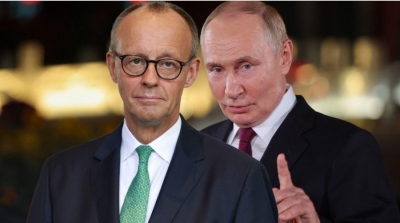
"Friedrich, call him!" Donald Trump's phrase to German Chancellor Friedrich Merz during his communication with the Berlin summit on Ukraine perhaps encapsulates better than any political analysis the current deadlock in German foreign policy.
The American president urged Merz to telephone Vladimir Putin, maintaining that the Russian president wants peace.
And suddenly, what until yesterday was treated in Berlin as politically undesirable became "self-evident": the need to reopen a direct channel of communication with Moscow.
The question is straightforward: for how much longer can Germany play the role of Europe's largest economy while simultaneously remaining absent from the critical diplomatic initiatives concerning the security of the continent itself?
The picture taking shape is contradictory.
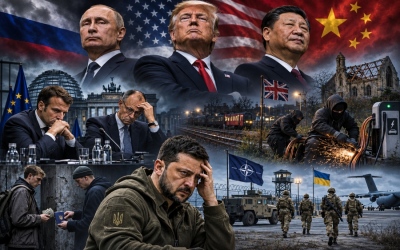
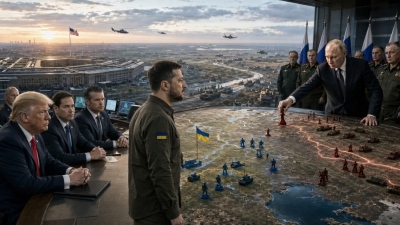
In Berlin, Merz hosts Volodymyr Zelensky and American envoys Steve Witkoff and Jared Kushner, while at the very same moment Donald Trump holds talks with Putin and Xi Jinping in Shenzhen.
The real geopolitical negotiation appears to be taking place elsewhere, with Europe struggling to secure a seat at the table.
Merz characterized the meeting in China as more about optics than substance.
However, the issue is not whether the Trump-Putin-Xi meeting held substantive content.
The issue is that Europe cannot allow its security architecture to be decided without its own participation.
And herein lies the great contradiction of German policy. For a long period, the Merz government treated direct communication with Putin as a move that could be perceived as backing down before the Kremlin. Now, however, the American president himself is asking the German chancellor to do precisely that.
The AfD capitalizes on the vacuum
Political pressure is not coming solely from Washington.
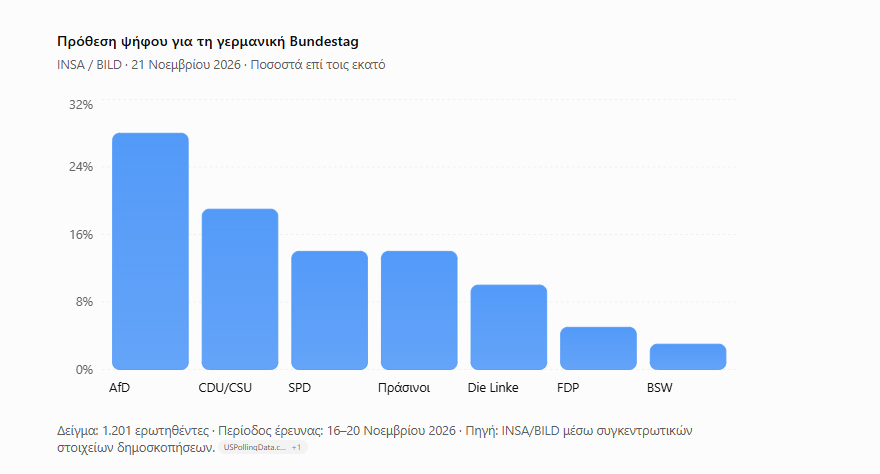
Inside Germany, the Alternative für Deutschland (AfD) is turning Ukraine and relations with Russia into central weapons in its political confrontation.
The party's rise is now a factor that can no longer be ignored.
According to the polling average through November 20, 2026, the AfD stands at 27.6%, ahead of the CDU/CSU, which is recorded at 20.1%. This marks a striking shift in the political balance of power, as the AfD now appears as the strongest political force nationwide in these measurements.
The message from Alice Weidel and Tino Chrupalla is clear: an end to unconditional military support for Ukraine, restoration of relations with Russia, resumption of energy cooperation, and a return to diplomacy.
Chrupalla has openly called on Merz to travel to Moscow and hold talks with Putin.
Weidel, for her part, has argued for the need to reopen channels of communication with the Russian side in coordination with the US.
The AfD no longer confines itself to broad anti-war rhetoric. It is seeking to connect the war to the everyday lives of Germans and is steadily gaining popularity on issues of energy costs, industrial competitiveness, fiscal spending, and social policy. Its argument is that the billions directed toward Ukraine could be used for the needs of German citizens.
This narrative finds an audience, particularly in eastern Germany, where the AfD has posted significant electoral gains. This does not mean, of course, that all of its voters support Russia or that a majority of Germans wish to abandon Ukraine. It does mean, however, that the social and political consensus surrounding the strategy pursued thus far is narrowing.
Merz's problem is now also domestic
The German chancellor faces a difficult equation.
On one hand, he must maintain support for Ukraine and avoid appearing to reward the Russian invasion. On the other, he cannot disregard the fatigue of German society, economic pressure, and the electoral strengthening of the AfD.
The German economy needs stability, energy security, and predictability.
The protracted conflict with Russia, sanctions, and the loss of the previous energy relationship have fundamentally altered the economic environment.
Returning to old energy dependencies is neither an automatic nor a simple solution, yet the debate over a future European energy security architecture cannot rule out every diplomatic development in advance.
The real dilemma for Merz is whether he will allow the AfD to monopolize the call for diplomacy, or whether he will seize the initiative himself by shaping a strategy distinct from simply continuing the war.
Diplomacy does not mean capitulation
Diplomacy is necessary precisely because there are disputes that cannot be resolved exclusively on the battlefield. A serious negotiation would have to include Ukraine, Russia, the US, and Europe, featuring concrete security guarantees, implementation mechanisms, and respect for Ukrainian sovereignty.
Merz has already stated that Germany is "self-evidently ready" for talks with the Russian president, potentially on neutral ground such as the United Arab Emirates.
This marks a significant shift.
Declaring readiness, however, is not enough. Political initiative is required.
After all, the danger is obvious: if the US moves ahead with an agreement with Russia and Europe simply finds itself confronted with faits accomplis, then European strategic autonomy will prove to be an empty slogan.
Donald Trump's message
Germany does not need a chancellor competing with Trump over who appears tougher toward Moscow.
It needs a chancellor capable of speaking with everyone, defending European interests, and seeking a viable exit from the war.
The history of German diplomacy, from Willy Brandt's Ostpolitik to subsequent efforts to maintain channels of communication with Russia, demonstrates that speaking with an adversary does not constitute a political reward. It is an instrument of foreign policy.
Merz has an opportunity before him, but also a peril. If he fails to act, the AfD will continue presenting itself as the sole political force demanding a change of course. If he acts without a clear strategy, he risks appearing to follow Trump's wishes or abandoning Ukraine.
The solution lies elsewhere: a strong Germany that supports Ukrainian sovereignty while simultaneously demanding negotiations and actively participating in shaping peace.
Because the real question is not whether Merz should telephone Putin. It is whether Germany wishes to remain a leading actor in European politics or be reduced to the role of financier of a war whose outcome others will decide.
Friedrich, call him.... Not because Trump asks for it or because the AfD demands it. Rather, because Europe cannot afford to be absent from the diplomacy that will determine its future.
www.bankingnews.gr

Readers’ Comments