

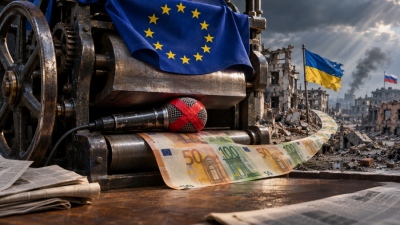
Democracy does not always need tanks or censorship laws to be tested or, worse still, dismantled.
Sometimes administrative decisions, financial strangulation, and institutional "masks" imposed in the name of protecting it are enough.
I tolerate whatever I... like or whatever serves me!
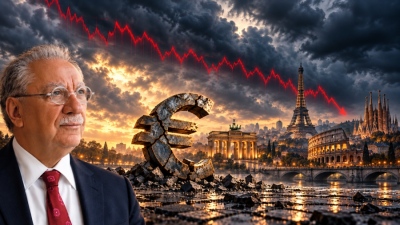
A European decision exposes a major European paradox, a contradiction raising serious concerns: a Union that wags its finger in favor of the existence and daily application of the rule of law and fundamental rights for its citizens is burning in the very fire it is trying to extinguish.
The sanctions of November 16, 2026 against Irish journalist Chay Bowes and the case of Norwegian political science professor Glenn Diesen bring to the surface two questions that no European capital can avoid:
- how much dissent can "European democracy" ultimately tolerate before it begins branding it a threat?
- since when does a dissenting opinion constitute a threat?
Blacklists without a court
On November 16, the Council of the EU adopted Decision (CFSP) 2026/2556, placing Chay Bowes, former co-founder of The Ditch and contributor to RT International, on the list of those linked to Russian destabilizing activities.
Brussels accuses him of participating in coordinated information manipulation operations, with references to The Islander News, the Foundation to Battle Injustice (linked to the Wagner group), and the Storm-1516 network.
Combating organized disinformation and foreign influence operations is legitimate, and necessary.
However, proven participation in such networks and practices is one thing, and an... allergy to anyone saying things that disrupt the official line on the war in Ukraine is quite another.
The sanctions on Bowes are not merely a stern verbal condemnation: they carry the adverse consequence for him of freezing his assets, in the EU, banning the provision of funds, and imposing travel restrictions.
All of this comes with severe consequences, without a criminal conviction and before anything has been substantively judged in court, even though formally it is a foreign policy measure subject to review and appeal before the General Court of the EU.
He himself speaks of the silencing of a dissenting voice.
The crucial point is not whether one agrees with him on Russia, NATO, or Ukraine, but whether Brussels possesses evidence that withstands independent judicial scrutiny.
Because freedom of speech cannot be measured by how pleasant an opinion is to those holding the steering wheel.
Greek consent and unanswered questions
The decision was taken, as required, by unanimity within the framework of the CFSP.
This means that Greece said "yes" or, at best, allowed the decision to pass without a veto, since abstention does not block unanimity.
And here, political responsibility has a full name.
On the basis of what exact evidence and rationale did the Greek side consent?
Did Athens demand proof of organized foreign influence activity, or did it simply rubber-stamp the proposal?
Did it weigh the consequences for press freedom?
And above all, what was the stance of Foreign Minister Giorgos Gerapetritis, and why did the issue pass under the radar in our country without any substantive public debate?
We are not talking here about "defending Russia," but about elementary democratic accountability.
Who checks whether invoking security is accompanied by genuine guarantees for political freedoms?
Which MPs and which journalists will raise these questions before this precedent boomerangs?
When dissent reaches the university
Subsequently, in Norway, the case of political science professor Glenn Diesen unfolds in a different institutional arena, it does not involve EU sanctions, but rather his resignation from the University of South-Eastern Norway, yet it touches the exact same sensitive nerve.
Diesen, whose positions frequently clash with the Western line on Russia and Ukraine and draw criticism for pro-Russian narratives, alleged pressure and exclusion due to his views. According to Aftenposten, his request for annual leave was denied and he resigned, with the university confirming the resignation without endorsing his allegations of political pressure.
The distinction between the fact of the resignation and the conflicting interpretations of its causes is a given.
Equally a given is that academia exempts no one from scholarly documentation, nor does it turn every critique into censorship.
Yet a university is not a Ministry of Foreign Affairs.
It is not a public relations office for any geopolitical line.
If expressing unpopular views leads to professional marginalization, then academic freedom, much like freedom of speech in the case of Chay Bowes, remains purely on paper.
Who decides which opinion is permitted?
The Bowes case and Diesen's allegations are not legally identical.
The former concerns restrictive foreign policy measures imposed by the EU.
The latter concerns a university resignation and the allegations accompanying it.
They converge, however, on a shared political and institutional question: what room remains for expressing views that clash with the prevailing perception of European security?
The answer cannot be that every opposing view is automatically propaganda.
Nor, of course, that every invocation of freedom of speech legitimizes participation in organized manipulation operations.
Between the two stands the rule of law: the burden of proof, proportionality, judicial protection, and transparency.
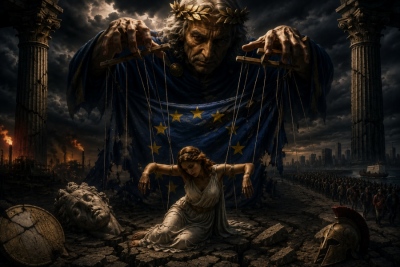
The great European paradox
The European Union has every right to protect itself against real threats.
Real threats, we repeat.
Yet it also has an obligation to prove that, in its effort to defend democracy, it does not unjustifiably restrict the freedoms that form its foundation.
Otherwise, it risks becoming ridiculous itself, not merely untrustworthy.
Because while it denounces authoritarianism beyond its borders, as it does with Russia and Belarus, domestically it expands tools for restricting expression with the very same authoritarianism.
Furthermore, when these same tools, or measures carrying heavy financial and professional blows, begin touching those who deviate from its official line or rhetoric, its credibility shatters.
Security cannot function as a blank check for applying double standards.
Freedom of speech holds minimal value when it strictly protects opinions approved by those in power.
Democracy does not fear dissent and is not fortified by silencing those who discomfort the authorities, but by enduring counterarguments with reasoning, evidence, proportionality, and judicial rules.
Freedom of speech and expression conditioned on agreement is not freedom, but parroting...
and when the protection of democracy turns into an excuse, pretext, and argument for restricting freedom, all that remains is a tragic irony: who, in the end, is their enemy?
AK
www.bankingnews.gr




Readers’ Comments