

Four public interventions within a few days do not merely constitute an outburst of political restlessness.
They constitute a systematic effort to return to the center of the political game.
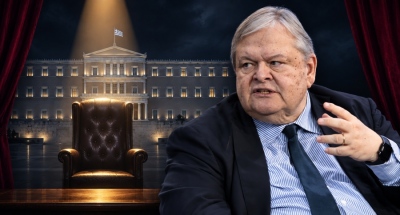
Evangelos Venizelos dispenses advice to both government and opposition, presents himself as the man of consensus, and leaves the field open for his own role.
At the same time, scenarios are flaring up in political corridors regarding behind-the-scenes scheming and vested business interests searching for a figure for the day after, as the new round of polls concludes with no light at the end of the tunnel for anyone.
Especially since, following Panas's resignation from PASOK and the Parliamentary Inquiry Committee into... non-performing loans, everyone is confronting their worst nightmares.
He views them as intelligent
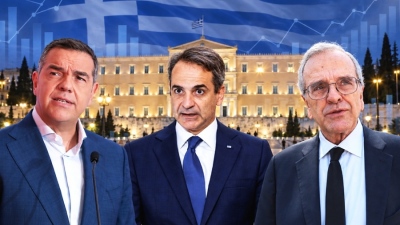
What would Evangelos Venizelos say to Nikos Androulakis and Alexis Tsipras if, after the elections, they are forced to sit at the same table?
At the 5th Economic Conference of "Naftemporiki", the former PASOK president described both as intelligent, adding that a "fearful perception of things" dominates Greek politics.
Yet his fourth intervention within a few days does not look like a simple hint to political leaders.
Venizelos appears to be pricing in a political landscape without single-party majority rule, warning of the need for coalitions, and simultaneously placing himself in the frame of the protagonists for the day after.
Four interventions, one political message
He does not say he wants to become prime minister.
Besides, he does not need to say it directly to spark the relevant discussion.
When someone constantly returns to the need for national understanding, highlights his experience in coalition governments, and presents himself as the politician who can talk to everyone, it is reasonable to wonder whether he is laying the groundwork for something more than the role of commentator.
This had been preceded by his article in "To Vima", his speech at ESIEA on November 9, and his interview with Giorgos Kouvaras on November 11 on ERTnews.
The sequence holds political interest.
From pointed remarks on the unheeded lessons of the economic crisis to positive references to Kyriakos Mitsotakis's presence at the UN and his willingness to converse with the prime minister, Venizelos takes care not to be cornered into a single party camp.
This is precisely the advantage he is trying to build: appearing as the "institutional" interlocutor for all, at a time when the remaining political leaders are clashing for primacy.
Coalitions as a political opportunity
Talk of coalition or special-purpose governments is growing, however, as deadlocks widen.
And certainly it does not concern only PASOK or Alexis Tsipras.
It concerns New Democracy, which insists on single-party majority rule, as well as the opposition, which demands political change without having convincingly answered with what composition and what program it could secure it.
For Nikos Androulakis and Alexis Tsipras, the dilemma is politically explosive.
Any rapprochement may be seen as a retreat; any exclusion may prove to be a dead end.
Venizelos, however, stands in a different position.
He has no party poll numbers to defend, does not need to answer to intra-party backlash, and can appear as the man who has the luxury of seeing the big picture and, above all, reassuring anxious businesspeople.
The "suitable" candidate for the day after
This is precisely where the scenarios are born.
In political and business circles, assessments circulate regarding the search for a solution of "broader acceptance" in the event the ballot box leads to ungovernability.
Venizelos's name is included in these scenarios.
Some even link this discussion to the desires of powerful behind-the-scenes centers and vested interests for a government that will ensure political stability and predictable balances.
The fact that his name keeps resurfacing in such discussions shows that his interventions are not treated as the neutral remarks of a former leader.
The question is who will ultimately decide on such a solution: the political leaders and voters, or the mechanisms that often attempt to influence developments away from the spotlight?
And above all, could the discussion around "national understanding" serve as the convenient wrapping for a choice already negotiated at other tables?
The message on special courts
Equally interesting was his intervention during the interview with Giorgos Kouvaras, when the issue of special courts and the investigation of potential criminal liabilities of the current prime minister was raised.
Venizelos chose to recall the experience of the period following PASOK's return to power, when prosecutions were initiated against Konstantinos Mitsotakis and his ministers over wiretapping and the AGET case.
He noted that he participated in discussions with Andreas Papandreou regarding the initiative announced on December 31, 1994, while Parliament decided to suspend the prosecutions on January 16, 1995.
The message was clear: political change must not turn into a campaign of criminal vengeance.
Accountability, provided evidence and responsibilities emerge, is another matter.
Announcing prosecutions in advance as an election slogan is something else entirely.
With this intervention, Venizelos sends a message to both the Maximos Mansion and the opposition.
To the government, he reminds that power does not grant immunity.
To its opponents, that political change does not automatically legitimize criminal adventures.
The "post-political" narrative
He himself insists on describing his role as post-political.
The image taking shape, however, is different: a politician who has not accepted that his time on the front line has closed and who makes sure to constantly remind everyone that he remains available for difficult missions.
The question is not whether Venizelos possesses political experience.
That is a given.
The question is whether behind the successive interventions lies a broader strategy to bring him back to the forefront, and whether the scenarios casting him as a potential solution also serve the designs of behind-the-scenes centers.
And the more Venizelos speaks of consensus and backs scenarios of non-majority governments, the more the question intensifies as to whether he is ultimately seeking not merely to point out who should govern, or to convince everyone that the most suitable person to sit in the prime minister's chair is himself.
O Pirearchis
www.bankingnews.gr


Readers’ Comments