

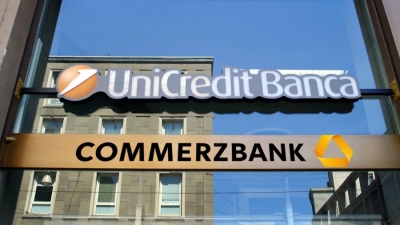
The German government made a 180-degree turn, opening the way for the acquisition of Commerzbank by the Italian banking group UniCredit.
Finance Minister Lars Klingbeil announced in Berlin that the German government and UniCredit have reached common ground. "The federal government now supports a swift further process and a smooth transition of control."
As he stated, UniCredit's commitments meet the core demands of the German government. Specifically, Commerzbank must remain a listed stock corporation headquartered in Frankfurt, expand its operations in the small and medium-sized enterprise sector, maintain an adequate capital base, and continue making its major decisions in Germany.
UniCredit also made clear commitments regarding its presence in Germany and the rights of Commerzbank employees, Klingbeil said. As he added, these commitments provide a solid foundation for achieving sustainable growth for Commerzbank.
However, employee representatives fear that the takeover plans will lead to the elimination of thousands of jobs.
UniCredit CEO Andrea Orcel welcomed Klingbeil's support for his strategy and the swift process for transferring control. "Both create clarity and give new momentum to the next phase, for the benefit of Commerzbank's customers and employees," he stated.
The German government withdraws its representatives from the supervisory board of Commerzbank
An agreement was also reached regarding the transition on Commerzbank's supervisory board.
UniCredit will nominate two independent members "who know both the German market and Commerzbank itself very well," Klingbeil said.
Until now, the German government has been represented on the supervisory board by two members. In this way, the federal government paves the way for the renewal of shareholder representation on the body.
In a letter to Klingbeil, which is in the possession of the German Press Agency (dpa), Orcel also linked UniCredit's commitments to a potential sale of the state's stake in Commerzbank.
The German state still holds just over 13% of the bank's shares. Should the German government decide to exit its stake, UniCredit will support that decision, Orcel wrote.
Klingbeil, however, made no mention in his announcement of a potential sale of the state stake.
Commerzbank welcomed UniCredit's commitments. The bank's management will continue to safeguard the interests of all stakeholders and cooperate with UniCredit to shape a strategy based on the strengths of both banks.
UniCredit is close to its goal of acquiring Commerzbank
UniCredit has been working for roughly two years to acquire Commerzbank and has secured a stake of nearly 50% in Germany's second-largest private bank.
Orcel seeks to create a major European banking group and estimates that a merger could yield savings of billions of euros.
It is expected that Commerzbank will merge with HypoVereinsbank (HVB), UniCredit's subsidiary in Munich, through which the Italians have operated in the German market for years.
Recently, UniCredit secured the green light from key supervisory authorities for its acquisition plans. These include the European Commission, the US Federal Reserve (Fed), and the European Central Bank (ECB), through its banking supervisory mechanism.
After assuming control in the first quarter of 2027, Orcel plans to call an extraordinary general meeting and appoint new members to Commerzbank's supervisory board.
All ten shareholder representatives will have to be re-elected.
Subsequently, there could also be a change in the bank's management, including Commerzbank chief Bettina Orlopp.
Following that, Orcel intends to implement his strategy, which provides, among other things, for the elimination of roughly 7,000 jobs and the shrinking of Commerzbank's international network.
The Minister President of the state of Hesse, Boris Rhein (CDU), described the agreement as a clear commitment by UniCredit to the financial center of Frankfurt.
He thanked Orcel for the constructive communication over recent weeks and months, noting that through cooperation they managed to safeguard Frankfurt's presence and position as a financial hub.
Commerzbank stock: What the deal means for investors
For shareholders, the agreement between UniCredit and the German government currently brings no change to the existing takeover offer.
The exchange ratio remains at 0.485 UniCredit shares for each Commerzbank share.
Likewise, the acceptance deadlines for the offer, which have already expired, do not automatically reopen due to the political agreement.
Those who still hold their shares remain shareholders of Commerzbank and can benefit from a potential further rise in their value.
However, the change of control has not yet been completed. Pending approvals from supervisory authorities, as well as the next steps leading up to the general meeting, are still awaited.
For investors who have not yet taken a position in the stock, entering the market is not necessarily too late.
The agreement could increase the likelihood of the acquisition being completed and, consequently, give a further boost to Commerzbank shares.
However, a portion of the expectations surrounding the takeover may already be priced into the current share price.
Moreover, the future trajectory of the stock depends on whether UniCredit actually manages to assume control according to its plan and on the terms established for Commerzbank post-acquisition.
Those buying shares right now should therefore not rely solely on the prospect of a quick stock market gain due to the takeover.
As long as the process remains incomplete, political and regulatory uncertainties persist.
At the same time, the question remains open as to how Commerzbank will perform in the long term in the event of a merger.
For existing shareholders, it may be advisable to await the upcoming decisions and reassess their position taking into account their personal risk appetite.
On the other hand, new investors will need to weigh both the upside potential created by the acquisition and the risk of a share price pullback if the timeline is not met or if the acquisition ultimately falls through.
www.bankingnews.gr





Readers’ Comments