

The European Union is calling on citizens to be prepared to handle crises by securing food, water, medicine, cash, and basic survival supplies for at least 72 hours, in the event that natural disasters, cyberattacks, or drone strikes cause disruptions to critical infrastructure, transportation, and communication networks.
However, the new European strategy promoting individual preparedness runs up against a significant social and economic reality: not all citizens possess the financial means, infrastructure, or even the practical support required to respond to an emergency.
According to a survey by the University of Latvia, just 8% of citizens feel fairly or fully prepared for a crisis, while 44% state that they plan to strengthen their preparedness within the next six months.
The issue, therefore, is not merely whether Europeans perceive the risks, but also whether they can genuinely meet the demands of the new reality.
The Commission's guidelines for the first 72 hours of a crisis
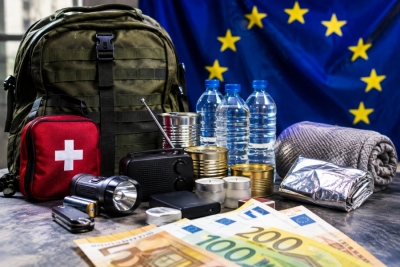
Long-shelf-life food, drinking water, cash, an emergency backpack with documents and medicines, an evacuation plan, as well as basic skills such as preparing food without electricity and administering first aid, form the core of the European Commission's new guidelines.
The recommendation for self-sufficiency of at least 72 hours is considered critical, as in the event of a major crisis, emergency services may not be able to respond immediately to all incidents.
As Hadja Lahbib, European Commissioner for Equality, Preparedness and Crisis Management, stated to Euronews, citizen self-sufficiency during the first 72 hours of a crisis is of decisive importance, as it reduces pressure on emergency services and allows them to focus on those in greatest need.
She noted that this specific approach has now been internationally recognized as a benchmark for household preparedness against emergencies.
However, the actual picture diverges significantly from the recommendations.
Just 8% feel prepared: The figures on water, food, and cash
The Baltic Individual Crisis Preparedness Barometer 2026 survey by the University of Latvia, conducted among residents of 10 European cities across 8 countries in Northern and Eastern Europe, as well as Iceland and Norway, reveals that at least half of the residents in every participating city currently feel inadequately prepared.
The head of the study, Dr. Ieva Birka, states that she is not surprised by the low level of preparedness, but rather by the fact that, despite heightened awareness, no substantive progress is being recorded.
"Preparedness has never been discussed more. There are national information brochures, European guidelines, and continuous media coverage. However, the actual material preparedness of households is not improving," she points out.
The survey data reflect the significant shortfalls:
- Just 31% have sufficient drinking water at home for at least 72 hours.
- Just 25% have corresponding water reserves at their workplace.
- 50% believe they have sufficient cash to cope with a crisis.
- 71% estimate they have enough food.
- 73% possess first aid supplies and equipment.
- Just 38% own a battery-operated AM/FM radio.
Variations among cities largely reflect how close residents feel a potential threat is. Vilnius is the only capital where unprepared citizens are a minority, as 67% consider a potential attack a significant threat.
However, even there, heightened risk perception does not necessarily translate into practical preparation. Only about a quarter of respondents possess water reserves for three days.
The cost of preparedness leaves large segments of the population out
The European Commission maintains that preparing for a crisis does not need to be expensive, as even simple measures, such as having basic food, water, a flashlight, and a strong social support network, can prove decisive.
However, for many households, even these basic necessities represent a substantial financial burden.
A family of four requires approximately 36 liters of water for three days, long-shelf-life food, a battery-powered radio, first aid items, medicines, and cash. The cost of securing these basic supplies in the capitals of the Baltic states is estimated at roughly €100 to €150.
If, however, a household seeks to assemble a fully equipped emergency kit that includes sleeping bags and tents, the cost can exceed €300.
In the event of a heating outage, options are even more limited. As Dr. Ieva Birka explains, if there is no fireplace, alternatives include generators or portable power stations, which cost hundreds of euros more.
Approximately 30% of respondents state that they need financial assistance in order to prepare adequately for a crisis.
Birka proposes that support be targeted rather than across-the-board, through vouchers or ready-made emergency kits for low-income households, distributed by municipalities and social services.
For her part, Hadja Lahbib mentioned that the European Commission has launched a behavioral study to better understand the preparedness level of economically vulnerable groups. The results are expected to be published next year.
Persons with disabilities and citizens dependent on third parties face greater risks
Financial inability is not the sole obstacle to emergency preparedness.
For persons with disabilities, coping with a crisis can depend directly on the availability of support, accessible infrastructure, and proper evacuation planning.
A 2026 report by the European Disability Forum, citing UN data, states that 91% of persons with disabilities in Europe do not have a personal disaster response plan, while 43% cannot evacuate a premises without assistance.
The existence of accessible early warning systems reduces the percentage of those unable to evacuate a space without support to 22%.
However, only 10% receive risk information in accessible formats, such as Braille or sign language.
The University of Latvia survey does not include specific data for persons with disabilities or those dependent on assistive devices; however, Dr. Ieva Birka points out that for these specific groups, self-sufficiency depends on other people, which means caregivers must also be properly prepared.
The European Commission therefore calls for evacuation, transport, and shelter planning to be accessible and responsive to the diverse needs of citizens, with persons with disabilities actively participating in designing the relevant measures.
At the same time, first responder teams should be trained to communicate effectively, recognize citizens' specific needs, and provide individualized support.
Birka emphasizes that these measures should be integrated into national and municipal emergency plans rather than treated as optional interventions.
Among the proposals are personal emergency plans, support networks, voluntary registries of citizens needing assistance, backup power supply for medical and assistive devices, and accessible evacuation procedures.
The psychological dimension of the crisis: Fear acts as a deterrent
For a portion of the population, the problem is not only financial or practical, but also psychological.
In Vilnius, where residents feel the threat most acutely, 42% report that a primary barrier to preparedness is the psychological difficulty of contemplating and confronting such a scenario.
Dr. Ieva Birka warns that further information via brochures is insufficient to close the preparedness gap.
As she explains, citizens need more direct reassurance from governments that a concrete crisis response plan exists, that competent authorities will respond, and that if they shoulder their share of responsibility, the state, civil protection, emergency services, and the military will also fulfill their duty.
Practical support is what can make the difference. In this context, concrete action plans, neighborhood-level information and awareness, and tailoring communication methods to the needs of each age group, with short videos for younger people and printed material for older citizens, are favored.
Common European guidelines, yet differing levels of preparedness
The European guidelines are non-binding, while responsibility for citizen preparedness remains with member states.
Hadja Lahbib maintains that member states participated throughout the process of drafting the guidelines; however, the European Union cannot guarantee that all citizens will be equally prepared, as this falls under the responsibility of each individual state.
This approach may lead to varying levels of preparedness across European countries, widening existing inequalities in emergency response.
Dr. Ieva Birka believes that systematic monitoring of progress across states and over time could reveal whether national governments are substantively implementing European recommendations.
The head of the study calls on the EU to adopt common evaluation indicators and conduct regular, comparable surveys with clear, measurable targets, such as the percentage of households possessing sufficient water for three days.
"Common measurement and reporting standards would make progress visible and create real pressure to take action," Birka notes.
The core objective, therefore, is not merely for Europeans to receive more crisis-response guidelines, but to ensure they can genuinely implement them.
Because preparedness against a crisis cannot be a privilege of those with the financial means to prepare, but rather a prerequisite for protecting all citizens.
www.bankingnews.gr








Readers’ Comments