

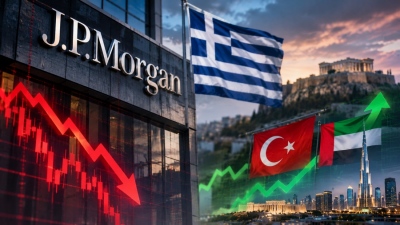
A fresh signal of caution regarding the Greek Stock Exchange is being sent by JP Morgan, which is downgrading the MSCI Greece index from "Overweight" to "Neutral." At the same time, the American investment giant is upgrading Turkey and the United Arab Emirates, opting to direct greater investment weight toward two markets it had previously treated with greater restraint. The decision serves as a clear warning for the Greek market: the stock market rally has already pushed valuations higher and narrows the room for easy gains.Greek equities have gained approximately 27% since the beginning of 2026, yet this impressive performance does not automatically translate into sustainable investment upside. Put simply, Greece is no longer the obvious choice for further capital allocation, at least based on JP Morgan's latest assessment.
Greece: The 27% rally fails to convince, valuations become a drag
The downgrade of MSCI Greece from "Overweight" to "Neutral" is primarily attributed to valuations, following the strong outperformance of Greek equities. JP Morgan believes the market's sharp ascent has diminished the attractiveness of Greek securities relative to peer markets in the region. This does not constitute a recommendation for mass sell-offs, nor a forecast of an inevitable downturn on the Athens Exchange. It is, however, a clear shift in stance, as the investment house no longer believes Greece justifies heightened investment exposure over other markets. The problem for the Greek market is that rising prices now create higher expectations. Investors require stronger corporate profitability, improved growth prospects, and fresh catalysts to justify current valuations.
Turkey wins back JP Morgan's confidence
While Greece is downgraded, Turkey receives an upgrade. JP Morgan is raising its recommendation for the MSCI Turkey index from "Neutral" to "Overweight," assessing that the crisis in the country's investment fund sector has now concluded and that the stock market can rebound. The Turkish market had suffered a severe blow following the September decision by supervisory authorities to liquidate 131 investment funds, managed by seven asset management companies. The regulatory intervention came after warnings that certain funds might be unable to meet investor redemption requests, sparking concerns over market liquidity and stability. However, JP Morgan considers the episode to be behind the market now. "We believe the investment fund crisis is over and that the stock market should recover," the firm notes. Concurrently, it assesses that fears over a potential downgrade of Turkey from MSCI indices are exaggerated, placing the probability of such an outcome at 10% or lower.
United Arab Emirates withstands the war, foreign capital returns
The United Arab Emirates also receives an upgrade, with the rating for the MSCI UAE index raised from "Neutral" to "Overweight." JP Morgan appears impressed by the country's economic resilience, despite the ongoing military crisis in the Middle East. As the bank points out, corporate earnings revisions have moved into positive territory, valuations leave room for upside, and foreign capital inflows have returned. The United Arab Emirates, as a major oil producer, has been affected by the war between the US and Iran, which began in late February. The blockade of the Strait of Hormuz, through which nearly one-fifth of global crude oil trade transited prior to the conflict, had triggered severe turmoil in energy markets and surging prices. However, the easing of concerns over fresh US military action against Iran contributed to crude prices retreating to two-month lows earlier this month. JP Morgan assesses that the current "neither war nor peace" state in the Persian Gulf is sufficient for the UAE economy to continue growing and for its stock market to outperform the broader CEEMEA region, encompassing Central and Eastern Europe, the Middle East, and Africa.
www.bankingnews.gr










Readers’ Comments