

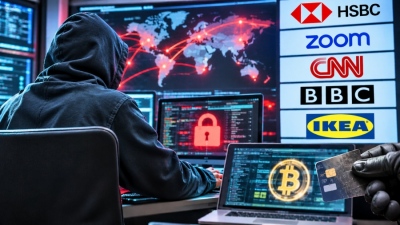
A major cybersecurity incident with international dimensions was uncovered on November 16, 2026, as cybercriminals managed to inject malicious software into the websites of 178 major organizations worldwide, including leading banks, financial groups, news networks, airlines, and tech giants. The list of affected organizations includes HSBC, Equifax, Zoom, CNN, BBC, Fox News, Salesforce, IKEA, Ledger, and Air France-KLM. The case is causing particular concern across the international banking and financial sector, as according to research by the cybersecurity firm Report URI, this specific industry was the primary target of the attack, with 32 financial organizations affected. The most alarming detail concerns HSBC, as malicious code was detected on its websites and digital services across multiple international markets, including the US, Hong Kong, Mexico, Singapore, Australia, the United Arab Emirates, Malaysia, Taiwan, Vietnam, and other countries. The attack was not limited to a simple website defacement attempt. The malware was engineered to intercept credit card details, steal browsing data and cookies, replace digital wallet addresses with those of the perpetrators, and attempt to exploit vulnerabilities on Apple devices. The incident highlights one of the greatest risks of the modern digital economy: even organizations with robust security infrastructures can be exposed when an external technology service provider they rely upon becomes an entry gateway for cybercriminals.
How the cyberattack occurred
According to research by Scott Helme of Report URI, the attackers exploited the Optimizely Web platform, a service utilized by major enterprises to optimize their websites, run digital experiments, and personalize visitor experiences. This specific platform operates via small JavaScript files, which are loaded onto client websites directly from Optimizely's infrastructure. These files allow businesses to modify website content, test different page versions, and tailor the user experience. Cybercriminals managed to inject their own malicious code into a field called Project JavaScript (projectJS), which is used by platform clients to execute custom code. In this manner, websites continued loading their files normally from Optimizely's official infrastructure, without any visible sign that anything suspicious was occurring. The critical factor was that the malicious code was distributed by an already trusted technology provider. Website visitors had no obvious reason to suspect that their visit could trigger a data theft mechanism.Report URI identified three distinct methods used to inject the malicious code. In some instances, the JavaScript file directly loaded an external malicious program. In others, the program's address was concealed via Base64 encoding, while in a third set of cases, an embedded copy of the malicious code was present, capable of executing even when external connections were blocked. This latter technique was particularly significant, as it enabled attackers to bypass certain security measures. It is worth noting that the attack was not a simple poisoning of the cache within Optimizely's content delivery network. According to Scott Helme, the attackers had managed to write malicious code directly into the projects of the platform's clients. Exactly how they gained access to so many distinct corporate environments initially became the subject of investigation.
Optimizely confirmed the breach
A particularly significant development in the case was the confirmation by Optimizely itself that a security incident had occurred. According to a statement by the company to BleepingComputer, the attackers exploited a vulnerability in the account registration process of its Experimentation service. Through this weakness, they managed to inject unauthorized JavaScript into certain client projects on the platform.Optimizely stated that it detected the incident, blocked access to the vulnerable process, and proceeded to deploy a remediation patch. Simultaneously, it announced that it: Removed the malicious code from the affected projects. Terminated active access sessions. Revoked related digital access tokens. Reset access to the affected accounts. Blocked the distribution of the specific malicious code via Cloudflare. Notified the affected clients. The company stated that its investigation is ongoing and that it will publish updates via its official security incident status page. The incident demonstrates that a vulnerability in a shared technology platform can trigger cascading consequences across hundreds of businesses, even when they have not suffered a direct breach of their own IT systems.
HSBC, Equifax, and 32 financial organizations at the epicenter
The banking and financial sector sustained the heaviest blow in terms of the number of affected organizations. According to Report URI, 32 organizations within this specific sector were impacted by the attack. Among them are:HSBC, with a presence across multiple international markets.Equifax, one of the largest credit reporting agencies.Paychex.ABN AMRO.SmartAsset.TaxAct.Funding Circle.Associated Bank.NetCredit.OnDeck. Of particular significance is the case of HSBC, as the presence of the attack across different geographic markets underscores the breadth of the problem.Report URI detected infected files on HSBC digital services in the US, Hong Kong, Mexico, Singapore, Australia, the United Arab Emirates, Malaysia, Taiwan, Vietnam, Egypt, and the Philippines. The list also includes Equifax services in the US, Canada, and the United Kingdom. The fact that multiple websites and services belonging to the same financial groups were affected amplifies the scale of the incident. However, there is a crucial distinction: discovering that a website loaded malicious code does not automatically mean that core banking infrastructure was breached, bank accounts were accessed, or all customer data was stolen. Thus far, no verified number of customers who suffered financial loss as a result of this specific attack has been made public.
Zoom, CNN, BBC, Fox News, IKEA, and Salesforce among the victims
The scale of the cyberattack becomes even more striking when examining the overall list of affected organizations. In the technology sector, 23 organizations were identified, including Zoom, Salesforce, GitLab, Bitly, and Optimizely itself. In the retail and fashion sector, 20 organizations were affected, including IKEA, ASOS, Mattel, and American Eagle. In the news and media sector, 10 organizations were identified, with prominent examples including CNN, BBC, Fox News, and NPR. In the aviation and travel sector, nine organizations were impacted, among them Air France-KLM, Transavia, and Alaska Airlines. At the same time, the list includes healthcare companies, insurance providers, telecommunications operators, cryptocurrency firms, and industrial corporations. The investigation was based on an audit of 1,611 distinct Optimizely files. A total of 188 infected files were identified, corresponding to 178 distinct organizations.Report URI warned that the actual number may be higher, as it was not possible to inspect every website utilizing the platform in time.
How the malware operated
Technical analysis of the malicious program revealed that it was not a simple virus, but a multi-functional cyberattack system. The code was engineered to execute different actions depending on website content, user activity, and the device being used.
1. Theft of bank cards
One of the primary functions was monitoring payment forms on websites. The malware searched for credit card numbers, expiration dates, and CVV security codes. Once it detected the necessary details, it attempted to transmit them to the attackers' servers. This feature was added on November 16 at 13:43 UTC, according to Report URI's timeline analysis. There was, however, an important limitation: cards entered into externally hosted payment environments, such as the hosted payment iframes of Stripe and Adyen, remained beyond the reach of this mechanism. Conversely, cards entered directly into forms on the website itself could be exposed.
2. Cryptocurrency theft via address replacement
Another particularly dangerous function targeted cryptocurrency transactions. The malicious program scanned websites, forms, links, and other page elements for digital wallet addresses. It then replaced the legitimate addresses with addresses controlled by the cybercriminals. Thus, a user who believed they were copying the address of the legitimate recipient of a transaction could end up transferring their funds directly into the perpetrators' wallet. The function was highly sophisticated, capable of even tampering with the contents of the clipboard, the temporary memory buffer from which users copy and paste information.
3. Theft of cookies and screenshots
The malware also had the capability to gather intelligence on visitor activity. Among other things, it could capture: The URL of the website the user was visiting.Cookies not protected with the HttpOnly flag. Original digital wallet addresses that were replaced.Screenshots of the webpage. The data could be transmitted to the attackers' servers. This capability poses additional risks to user privacy and the security of their digital sessions.
4. Attacks on iPhone and iPad
The most alarming dimension of the case was the integration of mechanisms designed to exploit vulnerabilities on Apple devices. According to Report URI, the malicious program could identify the iOS operating system version and load different exploit chains. Specifically, the tools Coruna and DarkSword were identified.Coruna was linked to iOS versions 13 through 17, while DarkSword targeted various releases of the iOS 18 series. For iOS 26, a separate mechanism was detected, which, according to the analysis, was limited at that stage to device fingerprinting.Report URI notes that iOS 18.7.3 and later, as well as iOS 26.3 and later, are among the versions that have patched the relevant vulnerabilities cited in the analysis. It has not been proven, however, that every device that visited the affected websites was successfully compromised.
How much money the hackers stole: Roughly $7,000 in digital wallets
One of the first tangible indicators of the financial dimension of the attack emerged from tracking the digital wallets embedded within the malicious code. According to data from Report URI, by 19:25 UTC on November 16, these specific wallets had received transactions totaling approximately $7,040. The amounts were distributed across various cryptocurrencies:Bitcoin: Approximately $5,380.Litecoin: Approximately $762.TRON and USDT: Approximately $719.Ethereum: Approximately $100.BNB Smart Chain: Approximately $82. These specific amounts represent inflows into the wallets identified by researchers and do not prove that all the funds originated exclusively from this particular attack. In fact, Report URI found that several of the wallets were already in use prior to the cyberattack. The case therefore leaves a significant unanswered question: it remains unknown how many credit cards, how many cookies, and how much personal data the perpetrators ultimately managed to steal. The fact that cryptocurrency transactions were detected proves that at least part of the mechanism had already been activated and used for financial gain.
How the attack unfolded: The November 16 timeline
Report URI's analysis reveals that the attack escalated rapidly within a matter of hours, with attackers continuously upgrading the capabilities of the malware. The earliest related indicator appeared considerably earlier. On September 17, 2026, the domain webshell.lol was identified and linked to the same mechanism for injecting malicious code into websites via third-party provider scripts. From November 13 to 16, an earlier wave of attacks was recorded via services such as Kissmetrics, StorifyMe, and Minute Media. On November 16, the mass attack via Optimizely was recorded. Specifically:04:21 UTC: The first injection of malicious code is detected in an Optimizely file on the BBC website.05:23 UTC: Registration of the domain 1688360.cc is recorded, used to distribute the malware.08:10 UTC: The first version of the track.js file is created, featuring cryptocurrency address hijacking functionality.08:28 UTC: The malicious file is detected live on the BBC website.11:20 UTC: Modification of Zoom's Optimizely file is recorded.13:03 UTC: Attackers transfer funds from their digital wallets to other destinations.13:43 UTC: Credit card skimming functionality is added.16:38 UTC: A second domain is created and used to distribute attack tools targeting iOS devices.17:13-17:57 UTC: New exploit capabilities are integrated, including the Coruna chain.19:24-19:59 UTC: Report URI conducts its file audit and uncovers widespread infection.20:40-21:10 UTC: Mass removal of the malicious code from affected websites begins.21:52 UTC: Only a single infected file remains out of the 188 initially identified. Particularly striking is that the malicious program was rebuilt 26 times within the same day as attackers added new capabilities and functions. The speed at which the mechanism evolved reveals that this was not a static breach attempt, but an active cybercrime operation featuring continuous adaptation of attack techniques.
How effective were the protection systems
Report URI also examined the role of website security systems, placing particular emphasis on Content Security Policy (CSP). This is a mechanism that allows website administrators to define which sources are permitted to load scripts and receive transmitted data. The findings were particularly concerning. Of the organizations examined: 68 had no Content Security Policy at all. 50 had a policy that permitted the execution of the malicious code and data exfiltration. 17 managed to restrict data theft, without however blocking all functions of the malware. Only 24 organizations succeeded in completely blocking this specific malicious program. The rate of complete blocking stood at just 15%. The case of HSBC presents particular interest. According to Report URI's technical analysis, its security policy blocked some of the malicious program's external connections, yet the embedded version of the code managed to execute via the eval function. This detail highlights that the mere presence of cybersecurity mechanisms does not guarantee a company's protection. Continuous auditing of external software dependencies, code execution permissions, and communications with third-party servers is required.
When the attack was uncovered and what we know about the perpetrators
The incident was uncovered by cybersecurity researcher Scott Helme, who published Report URI's findings on November 16. The firm examined 1,611 Optimizely JavaScript files and preserved copies of the infected files, along with technical details, timestamps, and SHA-256 digital fingerprints, to document the attack. Simultaneously, specific domains and digital addresses used by the attackers to distribute the malware and receive stolen data were identified. However, as of the publication of these findings, the attack had not been officially attributed to a specific criminal group or state actor. There is therefore insufficient evidence to link the operation to a particular country or organized cybercrime syndicate. The fact that several digital wallets had been active since as early as March 2026 suggests that the perpetrators may have engaged in prior activity before the November 16 attack.
What users should do
Cybersecurity experts point out that users who visited affected websites during the attack should consider specific protective measures. First, those who conducted cryptocurrency transactions should verify the addresses where their funds ended up, as the mechanism was capable of replacing legitimate recipient addresses. Second, anyone who entered credit or debit card details into forms on affected websites should monitor their transactions and contact their bank if they spot suspicious activity. Third, iPhone and iPad users should ensure they have the latest available security updates installed for their operating system. Finally, checking for suspicious activity across accounts and digital services is necessary, particularly for users who were logged into sensitive services while visiting the affected websites.
The major problem for banks
This specific cyberattack serves as a serious warning for the international financial system. Banks and major financial institutions invest billions in protecting their IT systems, securing transactions, and safeguarding their customers' personal data. However, this incident demonstrates that a weakness in an external technology provider can generate risks that cascade across dozens of separate organizations. The attack did not need to directly breach the banks' core systems; injecting malicious code into a service used by their websites was enough. The issue takes on even greater weight for groups with a global footprint, such as HSBC, as the use of shared digital infrastructures and technology services across different countries can create multiple points of exposure. The central question now is how many users visited the affected websites during the attack, how much personal and financial data was exposed, and whether the perpetrators managed to fully exploit all capabilities of the malware. The fact that nearly all of the malicious code was removed within a few hours does not mean the potential consequences of the attack have vanished. Potentially stolen data cannot be recalled, while the full extent of the damage remains unknown. The Optimizely incident proves that in the modern digital economy, even a trusted technology provider can become a weak link for the entire global business ecosystem.
www.bankingnews.gr











Readers’ Comments