

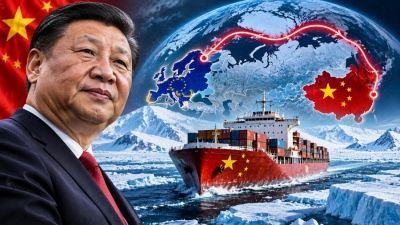
As risks in the Red Sea increase, China is planning regular container ship routes to Europe via the Arctic. However, significant obstacles will restrict the broader utilization of the route. The Chinese shipping company Sea Legend recently announced the launch of a regular container transport service between China and Europe via the Arctic. The announcement comes after a test transit in 2025, during which a container ship traveled from the Ningbo-Zhoushan port in eastern China to Felixstowe in the United Kingdom in just 20 days. This development could not pass unnoticed in the West. The war in Iran has not disrupted navigation through the Suez Canal, but it has sharply increased risks in the Red Sea region, complicating transport between Europe and Asia. The northern sea route of the Arctic, which can reduce travel duration by up to 40 percent, may offer an alternative solution. Nevertheless, significant obstacles continue to exist.
The Arctic route and Russia's historical plans
The prospect of utilizing the northern sea route has preoccupied policymakers for centuries. During the Russo-Japanese War of 1904 to 1905, Russia failed to surprise Japan using the frozen waters of Siberia. Instead, the Russian Baltic Fleet was forced to move around southern Africa and cross the Indian Ocean in order to reach East Asia, where it suffered a crushing defeat by the Japanese Navy in the Tsushima Straits. Keeping this in mind, Soviet planners, following the 1917 revolution, initiated explorations along Russia's northern coasts. The Soviet Union ended up considering the specific route essential for the industrial development of the country's extreme northern part. With the onset of the Cold War in 1945, the route also acquired vital significance for the construction of military installations. The northern sea route connects the Russian Far East with the Norwegian Sea. It reduces transport time between Asia and Europe, but its use continues to be restricted by ice, high costs, and Russia's regulatory control.
As Cold War tensions began to subside, Soviet leader Mikhail Gorbachev proposed, in a 1987 speech, to open the passage to use by foreign ships for the first time. Shortly after, the International Northern Sea Route Programme, a cooperation among Japanese, Norwegian, and Russian institutions, attempted to establish the necessary scientific and technical knowledge base for developing commercial shipping in the region. The program's conclusions were clear: despite its significant potential, the northern sea route faced severe physical and technical obstacles. The shallow straits in the eastern parts of the route, combined with floating ice, imposed limitations on the size of ships that could use it. It had been calculated back then that ships should be limited to a capacity of approximately 20,000 to 50,000 deadweight tons. This is a measure of the maximum amount of weight a ship can safely carry. This limit was noticeably lower than the 70,000 to 80,000 tons of container ships that began to be used on other international routes in the late 1990s.
Climate change alters data in the Arctic
Over the past 30 years, however, climate change has brought dramatic impacts to the Arctic. The rise in temperature in the region takes place at a rate nearly triple the global average, while scientists estimate that the Arctic Ocean could experience its first ice-free day as early as 2030. This is a catastrophic development for Arctic wildlife, infrastructure, the global climate, and sea levels, as well as for the lifestyle of the region's 400,000 to 500,000 indigenous residents. Despite these consequences, an increasing number of countries are turning their interest toward the northern sea route as it becomes more open due to receding ice. China, Japan, and South Korea have included references to using the northern sea route in their official Arctic policies. All three countries also possess the capability to build icebreaker ships, which continue to be necessary for navigation in the region. Conversely, the US has faced difficulties in this specific sector in recent years, following decades of declining American shipbuilding capacity. In early 2026, South Korea proceeded with passing ambitious legislation aimed at transforming the southern port city of Busan into a major Arctic shipping hub. On August 19, it also announced its intention to test the specific route with a container ship in September. The development caused some unrest among European diplomats, as such a test would require coordination with Russian authorities.
China sees the Arctic as a strategic alternative to the Malacca Straits
China is the most active non-Arctic country in developments concerning the northern sea route. For Beijing, the specific route offers a critical alternative to the Malacca Straits. China currently depends on this specific maritime passage for about 80 percent of its oil imports, as well as for a massive portion of its trade. Consequently, it considers the Malacca Straits one of its major strategic vulnerabilities. In 2018, China presented the "Polar Silk Road" initiative, which is connected to the broader Belt and Road Initiative. Following dozens of test transits by Chinese ships, primarily between China and Russia, the launch of Sea Legend's services marks a significant turning point: activity is moving from isolated test voyages to regular commercial services to Europe. Japan also considers the Arctic passage a vitally important shorter route for its energy supply. Deep-water ports on the islands of Hokkaido and Honshu are in a geographically advantageous position to function as major entry points for liquefied natural gas (LNG) from the Arctic. However, Japan follows a much more cautious stance than its neighbors, reflecting its historically tense relations with Russia. A Russian icebreaker off the coast of Murmansk in northwestern Russia.
Obstacles preventing the Arctic from competing with Suez
Despite the prospects, a series of operational and economic obstacles prevent the Arctic from evolving into a widely used alternative to conventional shipping routes. Today, the northern sea route remains open only for a limited period in late summer. Ice conditions and weather present large variations from year to year. The ships themselves require reinforced hulls, specialized crews, and special permits. Furthermore, in sections of the northern sea route, escort by Russian icebreakers is mandatory by law. At the same time, ships using the specific route face particularly high insurance premiums. A primary reason is that there is minimal emergency infrastructure in the region in case of an accident or other problem. Climate change may limit some of these operational restrictions, but it will not completely eliminate the inherent risks of the region.
The geopolitical cost of dependence on Russia
There is, finally, the issue of international image and political acceptance. The connection of the route with Russia constitutes a primary reason why European countries are absent from these specific developments. In this sense, the northern sea route remains less of a true alternative to Suez and more of a seasonal gamble—a gamble determined equally by geopolitical "ices" and actual Arctic ice.
www.bankingnews.gr









Readers’ Comments