

In a move that not only favors the plans of Ankara but also constitutes a major national defeat, France informed Turkey in writing regarding the GSI, something that the Greek government admitted implicitly but clearly through its spokesperson in a dismal manner, opening the path for the unlawful Turkish-Libyan memorandum to become locked in across the Eastern Mediterranean.
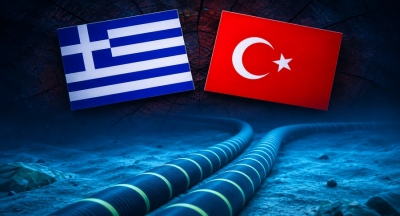
According to Yeni Safak, Athens, the Greek Cypriot side, and Tel Aviv call the project «Great Sea Interconnector» (GSI).
Among the Turkish public, it is better known as the Crete-Cyprus undersea electrical cable.
The objective of the project is the interconnection of the electricity grids of Greece and the Republic of Cyprus, with the prospect of future expansion toward Israel.
From one perspective, this is a project of a political and economic character against which, under normal circumstances, there would be no ground to raise objections.
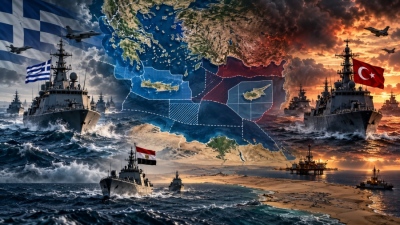
However, the cable, says Yeni Safak, adopting the paranoid positions of the Turkish government, «is set to traverse an area that Turkey considers part of its continental shelf, based on the maritime boundary delimitation agreement between Turkey and Libya.
This imparts distinct geopolitical dimensions to the issue.
If Greece had not taken actions affecting the status quo in the Eastern Mediterranean, especially over the past year, the confrontation surrounding the GSI likely would not have assumed such proportions.
However, Athens, in cooperation with Israel, seeks to alter the balances in the Eastern Mediterranean and the Aegean to the detriment of Turkey».
As it adds, «Athens is attempting to create fait accompli, leveraging the alliances it has built and the moves it has executed on the ground.
Concurrently, it seeks, through escalating tensions, to undermine the rapprochement in relations between Turkey and the West, which is taking place within the framework of developments triggered by the war in Ukraine.
This is precisely why the Turkish side approaches the GSI project primarily through the prism of geopolitical developments.
From the very first moment, after all, analyses were published in the Greek press contending that the area is ours and we do not require permission from anyone.
Corresponding, in broad terms, was the trajectory of official positions as well».
The decision on Libya triggers turbulence
Ankara maintains that part of the route of the undersea cable passes through the Turkish continental shelf.
Consequently, it considers that Greece or the companies undertaking execution of the works must notify and coordinate with the Turkish side.
Greece, on the other hand, rejects the assertion that this specific area falls within the Turkish continental shelf, as it does not recognize the agreement between Turkey and Libya.
Its stance is that the French company undertaking the works requires authorization solely from Greece.
The Greek side considers that seeking permission from Turkey would be more detrimental than beneficial, as it could be construed as an indirect acceptance of Turkish claims.
From this perspective, its posture is understandable.
As November approaches, when works on the project are scheduled to commence, tension rises.
Athens resolves to proceed with its implementation, in consultation with Israel.
At that exact moment, a development occurs that places Greece in a particularly difficult spot.
The House of Representatives of Libya, based in the eastern part of the country and affiliated with the camp of Khalifa Haftar, upon which Greece has anchored a large part of its policy in the Eastern Mediterranean, ratifies on October 20 the maritime delimitation agreement signed in 2019 by the governments of Turkey and Libya.
The French company contracted by Athens had previously hinted that it would notify Turkey prior to the start of operations.
Fidan sends a message: «Everything is fine»
The development in Libya constitutes a significant diplomatic gain for Ankara, which must be safeguarded and consolidated.
Under these circumstances, a further escalation of tension in the Eastern Mediterranean would not be desirable.
On the other hand, Turkey moved swiftly to deter actions by Greece.
Within this context, the Minister of Foreign Affairs of Turkey, Fidan, made the following statement, seeking on one hand to de-escalate tension and on the other to make the resolve of Turkey clear:
«All we ask is that a research vessel conducting activities at sea send us not merely a verbal briefing, but a written notification, stating the following: “We intend to conduct specific activities in a specific area.
These are the coordinates”. We ask for nothing more.
Under these conditions, we do not oppose the project. We view it positively».
Following developments in Libya, Greece decided to proceed normally with the project.
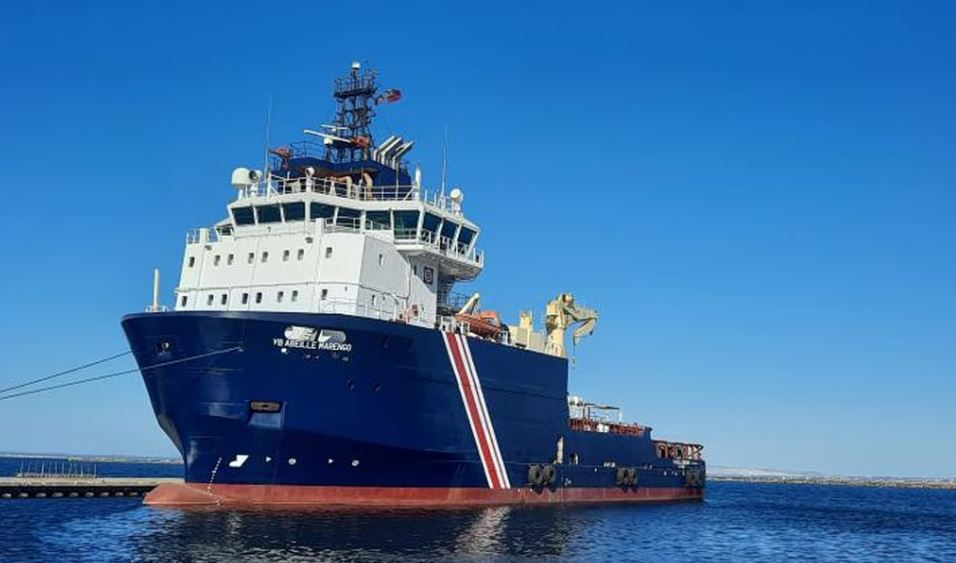
On November 6, Greek authorities approved the relevant permit for conducting surveys and issued a NAVTEX.
At the same time, they gave to understand that the French companies executing the works would not need to seek permission from Turkey.
Ankara responded to the Greek announcement with its own NAVTEX. In its statement, the Turkish Ministry of Foreign Affairs noted:
«The procedure concerning the required consent of our country for the portion of activities that the vessel flying the French flag plans to carry out within the limits of our continental shelf, pursuant to established provisions of international maritime law, has not yet concluded.
Our resolve to protect our sovereign rights, as derived from international law, remains steadfast».
The true picture
What is, however, the true picture at this moment?
According to Yeni Safak, what emerges is that Turkey maintains good relations with the French company set to undertake project implementation.
This specific company also holds investments in Turkey, a fact making it reluctant to disrupt its ties with Ankara.
Concurrently, a channel of communication exists between Ankara and Paris regarding this specific issue.
The understanding reached at an earlier stage stipulated that the Turkish side would be notified in writing before works commenced.
According to information available to the newspaper, the relevant notification was transmitted by the French side via official diplomatic channels and in written form.
The exact content of the notice remains undisclosed.
Whether this notification fully satisfies the expectations of Ankara will become apparent in the coming days.
However, the response of Foreign Minister Fidan, who, when asked about it by a Greek journalist, stated that «everything is fine», is probably linked to this specific development.
Greece admits it...
«Our position is and remains clear.
Permission for the relevant works was requested exclusively from the competent Greek and Cypriot Authorities, period», stated Marinakis, responding to a question during the briefing of political correspondents.
«Permission has not been sought nor will it be sought from Turkey.
Furthermore, there is no understanding between Greece and Turkish authorities regarding the licensing or execution of the project.
Let us distinguish two different things, because here everything we were saying in previous days and previous weeks is confirmed.
Permission is one thing, notification is another», Marinakis underlined, playing with words.
He added that the note verbale from France is the mildest method of transmitting a message from state to state.
«There is nothing milder than this.
It does not entail recognition of maritime jurisdiction or rights of third states.
It is purely for reasons of navigational safety and produces no legal effect, nor does it recognize any right whatsoever. This is crucial to distinguish once again, and it is not something we are stating after the fact. I remind you of a series of answers given, not only by the speaker, but primarily by the Minister of Foreign Affairs in the past. Everything formulated and written bears no relation not only to reality, but also to international law», he mentioned, turning reality on its head.
Furthermore, in a clarifying question on the same subject, the government spokesperson stated:
«It is the mildest form of message transmission between states. And Greece had no involvement whatsoever, it was from France.
The written notification to Turkey does not constitute, and I repeat, not from Greece, does not constitute in practice a request for permission, as the opposition claims, under any circumstance.
It has an exclusively informational character and it clearly emerges that it constitutes no such request, neither for permission nor for consent.
Conversely, a permit application was submitted by the French company, with all that this entails for the French government as well, only to the Greek and Cypriot Authorities, correspondingly recognizing sovereign rights in the area.
This is a very significant distinction.
And I say this again so there is no misunderstanding, because some are attempting to create an issue within our borders that does not exist, and I do not understand what the objective is exactly, so to call things by their name, it is something that the Minister of Foreign Affairs himself, fully separating the licensing process from the simple notification process, had stated long before, we are not saying it now in retrospect».
«The project is therefore proceeding according to plan, the licensing process proceeded according to plan, solely from the Greek and Cypriot Authorities, and nothing different from what has been pre-announced by Greece, Cyprus, and France has occurred.
It is a very important project that is proceeding exactly as we had said», he noted.
Regarding the content of the note verbale
Regarding the content of the note verbale, Marinakis stated:
«What I can tell you is that, as has occurred from the first moment of this project, every action is subject to the complete planning of all involved parties in accordance with what is provided by International Law, and I repeat that everything done in retrospect was under complete public notification in advance, obviously based also on phrasing permissible for the security of an energy project of utmost importance, a European project».
«At least as far as Greece is concerned, there has not been even an approach from any third state, nor from the US, regarding this specific project and this entire procedure.
I cannot know if anything has occurred from the US toward another state.
Furthermore, I have no knowledge of any communication between Gerapetritis and Fidan.
In any case, it is an energy interconnection project, a project of Greece, Cyprus, and France, an energy interconnection project of European interest», he added.
«The licensing procedure, as we had stated and as was proven in retrospect, concerned only Greek and Cypriot Authorities, and the notification carried out by a state such as France, which has a direct stake in project implementation due to the majority participation of Meridiam in GSI and the manufacturing of materials and execution of the project by Nexans, is an entirely different matter.
Look at the interviews of the Minister of Foreign Affairs in recent weeks. I do not know how many times he has answered that permission is one thing and notification is another, which is provided for in these cases and produces no legal effect», the government spokesperson explained.
And he added: «Some people discovered America in recent days, from the political system, from anywhere, merely to manufacture impressions. Not all issues are matters of partisan dispute.
Once again, those who said "as if the project will move forward, as if the cable will happen, as if the process will advance" are proven wrong.
What else were we hearing? "They will seek permission from Turkey to do it". None of this happened.
Now they are searching to create an issue out of something that had been made clear in advance by the Greek Minister of Foreign Affairs, having himself fully separated two entirely distinct procedures from each other.
One produces legal effects.
The licensing procedure recognizes sovereign rights and was carried out solely by Greek and Cypriot Authorities.
The other is a standard notification procedure that produces no legal effect».
www.bankingnews.gr



Readers’ Comments