

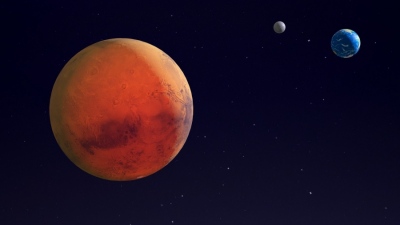
A rare find from the depths of space is shedding light on the primordial history of Mars. It is a meteorite at least 4.1 billion years old, discovered in the Sahara desert, which preserves precious information inside about the early periods of the Red Planet. Its chemical composition reveals that the rock had interacted with water in the ancient Martian crust, offering scientists new evidence about a world that once possessed very different conditions from those prevailing today. The meteorite, named Teghaza 001, is considered one of the oldest Martian rocks ever detected on Earth. Its age places it roughly in the first 400 million years of Mars' existence, when the planet was still in the initial stages of its geological evolution. The discovery acquires special scientific significance, as it offers access to a part of the ancient Martian crust that had not been studied until today through corresponding samples.
The rare find in the Sahara desert
Teghaza 001 was named after a salt flat in Mali, in Western Africa, where meteorite hunters located its fragments in 2022. It consists of eight pieces, with a total weight of 798.5 grams, while the largest of them weighs 442 grams. Its characteristic pink color and unusual chemical composition attracted the interest of experts, although its true value was not immediately realized. Initially, the sample had been classified as a shergottite, one of the most common categories of Martian meteorites found on Earth. Specific meteorites represent nearly 90 percent of known Martian samples and usually have an age of less than 600 million years. Planetary scientist Yang Liu, from the NASA Jet Propulsion Laboratory (JPL), initially did not consider that the specific rock hid anything so special. However, the presence of zircons inside it changed the course of the research. Specific crystals form when cooling magma solidifies and act as a sort of geological time capsule, allowing scientists to accurately determine the age of a rock. Their analysis revealed that Teghaza 001 has an age of at least 4.1 billion years, making it an exceptionally rare sample from the early history of Mars.
Traces of water on ancient Mars
The most important element of the discovery concerns the chemical composition of the meteorite. Analyses showed that the rock had interacted with water in the ancient Martian crust, offering new data on the conditions prevailing on the planet billions of years ago. The find has special significance for the scientific effort to understand the evolution of Mars and the reasons why a planet that formerly possessed water ended up in its present, highly dry state. At the same time, the presence of water at such an early period of the planet's geological history brings back to the forefront the question of conditions that could favor the development of life. This, however, does not mean that the meteorite constitutes proof that life existed on Mars. Scientists detected indications of interaction with water, an element that can contribute to a better understanding of the planet's ancient habitability.
The incredible journey from Mars to Earth
The meteorite's route to the Sahara constitutes an impressive journey in its own right. Scientists estimate that an asteroid or a comet impacted Mars, ejecting fragments from its surface into space. Thanks to the speed of the impact, these materials managed to overcome the planet's gravity. The rock then began revolving around the Sun, possibly for millions of years, until it was captured by the gravitational pull of Earth and entered its atmosphere. It is not known precisely when it was ejected from Mars nor when it arrived on Earth. The characteristics of its surface, however, indicate that it may have remained for some time in the desert prior to its detection. Following its discovery, the sample attracted the interest of meteorite collector Darryl Pitt, who mediated its acquisition by the Maine Mineral and Gem Museum in the US. The amount of the agreement was not made public.
www.bankingnews.gr









Readers’ Comments