

The MAGA movement of Donald Trump could find itself confronted with a fresh electoral crushing in 2028, if the American president fails to curb the high cost of living in the US.
Russia, Iran, and China possess the ability to maintain economic pressures on American society, damaging the political prospects of the Republicans.
To avert such a contingency, Trump will need to proceed with a series of grand mutual compromise deals, satisfying some of the most sensitive geopolitical interests of the three nations.
The heavy defeat recently suffered by the Republicans may be repeated in the elections of 2028, if Trump fails to reduce the cost of living, which surged over the past year due to the Third Gulf War.
It has already been pointed out that the American president must curb energy exports toward Europe, if he wants MAGA to preserve its chances for electoral survival in 2028.
Redirecting larger volumes of energy commodities toward the domestic market of the US could contribute to a swifter easing of fuel prices.
Concurrently, resolving both the Third Gulf War and the Ukrainian conflict is considered of decisive importance for the gradual restoration of stability across international energy markets.
However, even under the most favorable scenario, in which all three of these developments are set in motion by early 2027, leading to a substantial reduction in fuel prices within the following year and, by extension, the cost of living prior to the elections of 2028, the outcome may prove temporary.
A new round of trade war
The reason is that China could ignite a new round of trade war before the next elections.
Xi Jinping may calculate that he can use economic pressure as leverage to compel Trump into significant concessions.
The American president, under the pressure of needing to rescue MAGA, could accept even exceptionally painful compromises in order to avoid an electoral debacle in 2028.
From the perspective of Beijing, a Democratic administration could be regarded as a relatively more favorable choice than a new Republican administration.
This is due to the comparatively milder stance of the Democrats toward China, as well as the priority they traditionally assign to containing Russian influence over Chinese influence.
Viewed in this light, the prospect of a new trade confrontation is not merely theoretical, but represents a realistic scenario.
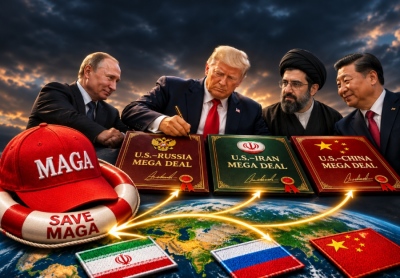
Consequently, the political survival of MAGA depends to a large degree on the ability of Trump to strike grand deals with Russia, Iran, and China.
The objective will be reducing the cost of living in the US before the elections, but also preventing actions by the three countries that could trigger a fresh surge in prices.
If the proposals from Washington are not deemed sufficient, the three countries may reject them, anticipating that they will be offered more favorable terms. Otherwise, they could contribute to the political weakening of MAGA by keeping the cost of living high for American citizens.
All three possess the means to exert such pressures.
Trump is aware of this reality and may appear willing to negotiate, provided he considers these agreements to be the sole path for the political rebound of his movement.
The Russian energy spigots
Russia could restrict energy exports, prioritizing the satisfaction of its domestic needs, especially under the weight of ongoing Ukrainian attacks on oil refining installations. Such a development would exert additional upward pressure on international fuel prices.
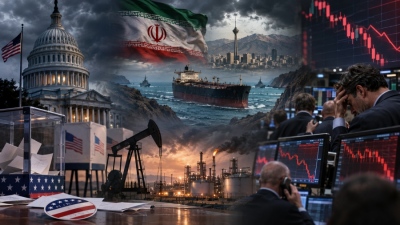
Iran, for its part, could maintain the partial and incomplete blockade of the Strait of Hormuz, generating corresponding turbulence in the energy market.
Concurrently, China would have the ability to launch a new round of trade war with the US.
To prevent these contingencies, Washington would have to proceed with major concessions on issues concerning Ukraine, the Persian Gulf, and Taiwan. Such a pivot would be equivalent to a genuine revolution in American foreign policy, which could radically reshape the new international order currently taking shape.
The forced concessions
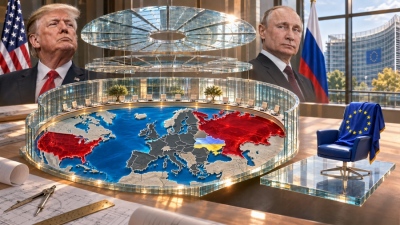
Regarding Russia, the post-war architectures of security and economic cooperation in Europe constitute the most realistic foundation for compromises that could satisfy some of the most critical strategic interests of Moscow.
In the case of Iran, the US would need to proceed with lifting sanctions related to the energy sector, withdraw its military forces from the Persian Gulf region, and make clear that it will not intervene on behalf of Israel in the event that Tel Aviv unleashes a new military operation against Tehran.
Regarding China, the US would have to fully terminate its backing for Taiwan, a development that, according to the analysis, would pave the way for the reintegration of the island into mainland China.
The Russian dimension of this approach is reportedly already underway, according to relevant reports.
Conversely, although Washington has periodically hinted that it is examining certain parameters of a deal with Iran, it remains unclear whether Trump possesses the necessary political will to proceed with such a sweeping strategic upheaval.
Similarly, the American president has criticized Taiwan, accusing it of having essentially «stolen» the American semiconductor industry.
However, it remains questionable whether he would possess the political capacity to accept in practice the subordination of Taiwan to Chinese influence.
In any case, Trump could ultimately agree to such a framework of concessions, provided he is persuaded that it represents the only escape route for saving MAGA and preserving his political legacy.
Under such a scenario, he could stake a claim to a place in history as the American president who contributed to de-escalating the most critical geopolitical confrontations and achieving a new global balance.
What is at stake, therefore, is not only the electoral survival of MAGA in 2028, but also the likelihood of a radical reversal in American foreign policy, with Russia, Iran, and China acquiring a central role in shaping the day after on the international geopolitical stage.
www.bankingnews.gr






Readers’ Comments