

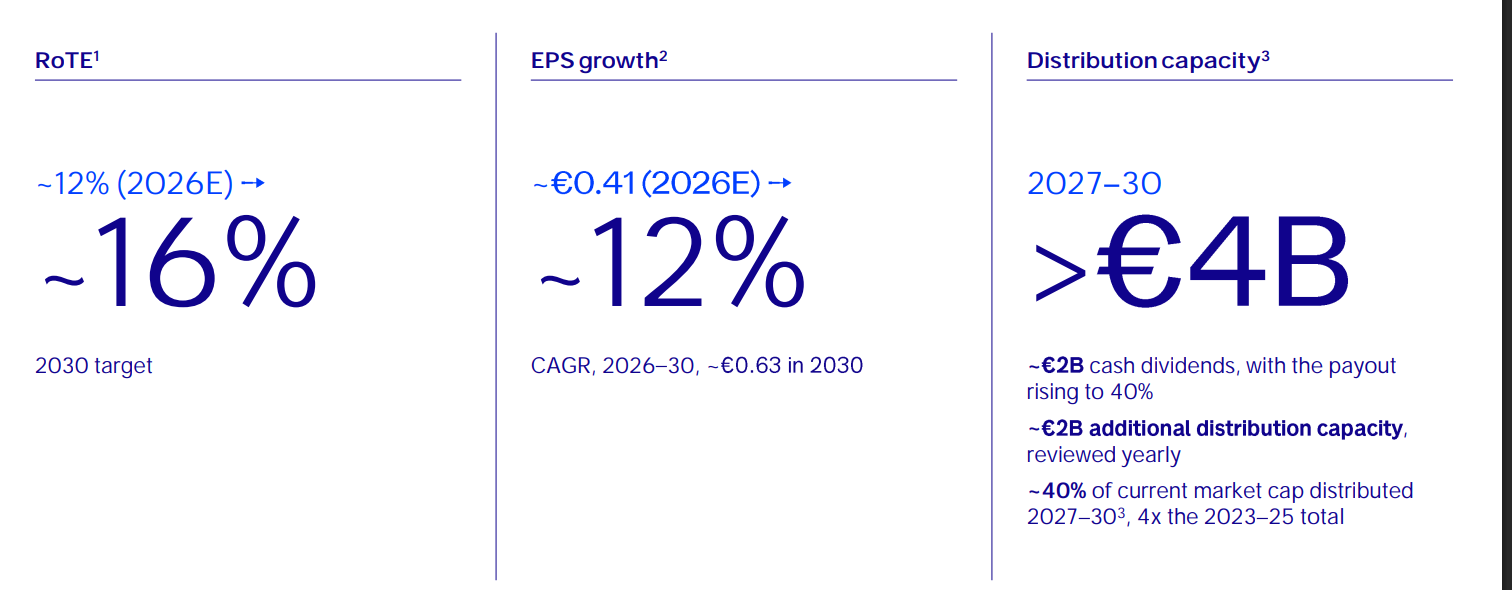
A new period for Alpha Bank is signaled by the 2027-2030 business plan, as the bank projects growth in terms of profitability (52% higher or 1.4 billion euros with a return on tangible equity, ROTE, of 16%).
And the enlarged bank will be accompanied by a distribution to shareholders of 40% of current market capitalization or 4 billion euros (2 billion in cash) alongside the capacity for acquisitions when a return exceeding 13% is present.
The above is promised, among other targets, by the business plan of Alpha Bank (Alpha Accelerated) for the 2027-2030 three-year period, which management presented yesterday to more than 30 investors and analysts.
Indeed, as highlighted by Deputy Chief Executive Officer Mr. Lazaros Papagaryfallou, distributions of the additional 2 billion euros will constitute a dynamic process evaluated annually: earnings per share are projected to increase by 16% through 2028 to 0.54 euros, reaching 0.63 euros by 2030 without share buybacks and 0.77 euros with buybacks.
However, if the bank identifies product platforms, management, and technology generating a yield above 13% (a buyback yield of 10% plus a margin of 2-3%), then the bank will evaluate an acquisition, incorporating management teams, as occurred with Axia, Alpha Trust, and insurance companies in Cyprus.
Capital management
Alpha Bank, however, does not intend to maintain a permanent capital buffer for acquisitions.
Capital that cannot be deployed at sufficiently attractive returns is destined to be returned to shareholders, as the CET1 ratio will move toward the 13% level by 2030.
Because certain assumptions are inherently conservative (growth of 1.6%, interest rates at 2.5%, deposits of 9 billion euros), and because the bank outperformed the targets of the 2023-2025 plan, most investors, as noted by Chief Executive Officer Mr. Vasilis Psaltis, characterized it as a balanced blueprint that depends exclusively on execution capability.
Mr. Psaltis distinguished three periods for the bank: the 2019-2022 four-year period when fundamentals were restored (non-performing loans, capital), the 2023-2025 two-year period when profitability and dividend distributions returned and the partnership with UniCredit was cemented, and finally the upcoming 2026-2030 four-year period, during which holistic services will be delivered to clients enabling value creation.
According to the plan, over the next three years, growth in Greece and Cyprus entails net credit expansion of 8-10 billion euros alongside 8-10 billion euros in deposits and new funds, while more than 170 billion euros in investments will take place in capital-intensive sectors such as energy and infrastructure.
And the Recovery Fund, which will continue over the next two years, accounts for only 20% of loans, as noted by Mr. Psaltis, while public investments through 2030 will require 49 billion euros. Economic expansion, however, will not rely solely on lending.
Alpha Bank estimates that annual net credit expansion will reach 3 billion euros, revenues will rise by 7% exceeding 3.3 billion euros, commissions will increase by 9%, and 18% of profits will originate from abroad (Cyprus, Luxembourg, United Kingdom).
What Alpha Bank holds today: Target of 30% increase in non-lending products
According to the bank, client requirements have evolved and the bank aims to meet all their new priorities. On one hand, Greek enterprises are investing and strengthening their exports while raising capital.
The value of merger and acquisition transactions, as well as capital raised through bonds and equities, has increased three- to fourfold since 2023.
At the same time, households maintain a larger share of savings in investment products, approximately double compared to 2018. Indicatively, the partnership with UniCredit directed 2.2 billion euros into investment products of international groups.
Concurrently, approximately 100 billion euros in financial wealth is situated abroad.
For this reason, starting in 2027, the Bank will establish a presence in Luxembourg with a subsidiary, while reinforcing its subsidiary in London and AstroBank in Cyprus.
Two pillars
The Alpha Accelerated business plan organizes the bank's strategy around two pillars: Universal Business Banking and Wealth Personal Banking.
Alpha Bank currently commands a position of strength. It holds a market share exceeding 25% in corporate loans in Greece and serves approximately 4,700 large corporations, shipping companies, and small and medium-sized enterprises, as well as roughly 210,000 active small-business clients.
The opportunity for the bank is identified in expanding client relationships: today, approximately 28% of the Bank's corporate financing clients use at most one non-lending product.
Regarding businesses, the bank will combine financing with payment services, cash management, factoring, leasing, treasury, foreign exchange, hedging, investment banking, and capital market access. Each priority client will have a Relationship Manager with a complete picture of needs and growth potential, who will coordinate engagement with the appropriate specialized teams of the Bank.
The combination of Alpha Bank's corporate relationships with investment banking firm AXIA, which completed 81 mandates during the 2023-2025 period, further enhances the Bank's capacity to support investments, acquisitions, and capital raises.
In this manner, by 2030, Alpha Bank targets an increase of up to 30% in non-lending products per corporate client maintaining a credit relationship with the Bank, while aiming to triple the number of large corporations served by AXIA and quadruple scheduled annual interactions with priority clients.
Wealth Personal Banking
In the Wealth Personal Banking segment, the bank serves 3.7 million clients. The second pillar connects day-to-day banking and credit with savings, investments, insurance, and retirement planning, ensuring each client is supported through every stage of life.
Digital services and personalized advisory support will operate complementarily, with the level of support reflecting each client's profile.
With an initial investment starting at 5,000 euros, clients will gain access to managed portfolios administered by the Bank's investment committee.
Investments by non-affluent clients are projected to grow by approximately 65%, from 900 million euros to 1.5 billion euros, while retail client deposits are expected to expand from 28.2 billion euros to 32 billion euros (a target deemed conservative by analysts).
Where analysts focused
Responding to an analyst question regarding potential acquisitions by Alpha Bank, the Deputy CEO clarified the selection criteria (product platform, technology, management), while reiterating that the contribution of insurance firms in Cyprus will represent 2% of earnings.
Organic capital generation through 2030 will reach 7 billion euros, of which, as previously noted, a substantial portion will be distributed to shareholders.
The partnership with UniCredit is considered an advantage that cannot easily be replicated by competitor banks, noted Mr. Psaltis, as the bank acquires a presence across 13 countries and gains specialized know-how, while the Italian bank secures access to Greece and Cyprus.
Regarding costs, it was noted that 15% of expansion is discretionary; however, under the positive upside scenario, additional compensation is reasonably expected.
Regarding DTA capital assets, Chief Financial Officer Mr. Vassilios Kosmas stated that for the overall period they amount to 1.3 billion euros, declining by 300 million euros annually through 2029 and by 400 million euros in the final year, 2030.
Dimitris Pafilas
dpafilas@yahoo.com
www.bankingnews.gr








Readers’ Comments