

While Moscow states that the course of the Ukrainian issue does not depend on political developments in the United States, the Kremlin confirms that agreements with Washington for the distribution of Russian diesel fuel continue normally, highlighting the complex relationship of competition and cooperation between the two nuclear powers
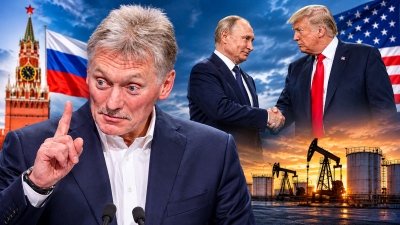
There are moments when two seemingly unrelated statements reveal more than an entire diplomatic analysis. This appears to be happening in the case of the latest positions expressed by Kremlin spokesman Dmitry Peskov. On the one hand, the Kremlin signals that Russia is not going to link the advancement of its strategic goals to political developments in Washington. On the other, it confirms that cooperation between Russia and the United States in the energy sector continues, with agreements for the distribution of Russian diesel fuel on international markets remaining active, shaping US-Russia energy relations.
"Russia is a sovereign state"
Answering questions from journalists, Dmitry Peskov made it clear that the advancement of Russian interests around the Ukrainian issue is not going to depend on the internal political situation in the United States. "Our interests will be secured in any case. Russia is an absolutely sovereign state," he stated characteristically. The position came during a period when much of the international discussion focuses on the role American political developments could play in the future course of the war in Ukraine. The Kremlin's answer was clear: Moscow does not wish to appear as an actor waiting for decisions from Washington to determine its own strategy. It is a geopolitical subject, not a geopolitical object, reinforcing Russian geopolitical strategy.
The agreements on Russian diesel
At the same time, the same official confirmed that agreements reached between Presidents Vladimir Putin and Donald Trump for the disposition of Russian diesel fuel on the international market continue to be implemented. According to Peskov, exports continue normally and the entirety of the quantities will find buyers. The Kremlin avoided providing further details, maintaining that these are purely commercial agreements whose individual elements are not made public. However, confirmation of the continuation of deliveries demonstrates that, despite geopolitical confrontations, the "energy communication channels" between Moscow and Washington remain open, driving global oil markets.
Energy as a field of understanding
This specific approach is not new. As early as March, Dmitry Peskov had argued that cooperation between Russia and the United States in energy markets can function as a stabilizing factor for the global economic system. The logic behind this stance is relatively simple: despite geopolitical conflicts, the planet's two largest nuclear powers continue to play a significant role in shaping international energy balances. Consequently, maintaining certain channels of cooperation is considered by many sides necessary to avoid extreme market fluctuations, impacting global market stability.
The "return to normalcy"
A similar message had been conveyed by Deputy Foreign Minister of Russia Sergey Ryabkov, who had spoken of a gradual "return to normalcy" in contacts between Moscow and Washington. The phrase went almost unnoticed at the time. However, it acquires different weight today, as it appears to connect with a series of contacts and understandings continuing behind the scenes despite the tension characterizing relations between the two countries on other fronts, guiding diplomatic communication channels.
A relationship more complex than it appears
The public image of relations between Russia and the United States is usually presented through the prism of sanctions, geopolitical conflicts, and the Ukrainian war. Dmitry Peskov's statements, however, reveal a more complex reality. Moscow wants to show that it does not depend on Washington's decisions. And indeed, since Vladimir Putin's arrival on the Russian political scene, Russia has followed a long path of restoring and strengthening its sovereignty. At the same time, it recognizes the value of cooperation where shared economic interests exist and appears willing to examine any initiative that can serve its broader national interests.
Thus, behind the tough rhetoric regarding the Ukrainian conflict and Great Power power competition on a planetary level, a less visible but extant mechanism of understanding continues to function. Perhaps this is the most interesting element of the case. In an era where public rhetoric is dominated by confrontation, some of the most important communication channels continue to remain active. Not out of goodwill, nor out of mutual trust, but because geopolitical reality dictates that even the strongest adversaries must maintain open lines of contact when energy, strategic stability, and international security are at stake, transforming international security dialogue.
www.bankingnews.gr

Readers’ Comments