

Wall Street Journal: The White House is unsure of next steps, heavy strike on Iran or withdrawal - Mohsen Rezaei (Iran National Security): The Iranian nation inflicted a major strategic and political defeat on Trump
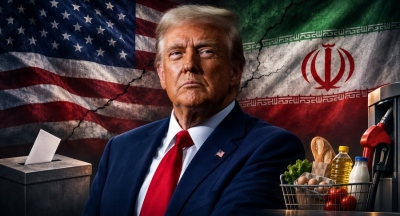
Hours after the humiliating defeat of Republicans in the midterm elections resulting from the failure of the US military to impose its will on Iran, and driven by the pro-Israel lobby, US President Donald Trump stated that he plans to strike Iran very hard and that the war against this country is worth it. While Trump himself admitted that Republicans lost the elections because of the war in Iran and rising fuel prices, he nevertheless wants to continue the war. However, in an article, the Wall Street Journal reports that the White House is unable to decide on its stance regarding Iran following the electoral defeat of the Republicans. Meanwhile, the Iranian side warns Trump not to dare, stating he will be humiliated again, and notes that Iran is ready to face a nuclear strike from the Americans, but the day after, the entire Middle East will disappear. The war cries are once again very loud in the Persian Gulf, shaping US-Iran military tensions.
Trump: I am considering a terrifying strike on Iran very seriously – The war will end when I decide
"If we have to do something big, we will do it. There are many people who want to hit Iran hard. All I can tell you with certainty is that Iran will never acquire nuclear weapons," emphasized the US President after the elections and the defeat of the Republicans, which he attributed to Iran. When asked if he is considering firing the Secretary of War, he replied: "No, I think he is doing a very good job." I think it is largely true that the war with Iran was the cause of the electoral defeat. The war caused a short-term increase in natural gas prices. I knew the war would affect election results. The war was worth it. You have no other choice. I know how Vice President Vance feels about this. The war with Iran ends whenever I want, impacting Donald Trump foreign policy.
Wall Street Journal: The White House is unsure of next steps, heavy strike on Iran or withdrawal
The White House is unable to decide on its stance regarding Iran following the electoral defeat of the Republicans, reports the Wall Street Journal, citing sources. According to the report, some administration officials are pushing US President Trump to launch new attacks against Iran in order to achieve peace before his term ends in two years. "Others believe Trump should accept losses and curtail the military operation," reports the Wall Street Journal. Senate Democratic Leader Chuck Schumer promised to end the conflict with Iran after Democratic election victories in both chambers. He said some Republicans also share this commitment. The majority in Congress will allow Democrats to block Trump's legislative agenda, investigate his administration, and curb government spending. Control of the Senate will also give them the power to block the appointment of presidential nominees to public office. The White House chief himself stated his readiness to accept the results of the midterm elections and cooperate with Democrats. Trump attributed the defeat of the Republicans to rising natural gas prices due to the conflict with Iran, defining US congressional shift.
Mohsen Rezaei (Iran National Security): The Iranian nation inflicted a major strategic and political defeat on Trump
Major General Mohsen Rezaei, Secretary of the Supreme National Security Council, commenting on the results of the midterm elections for the US Congress—which resulted in a humiliating defeat for Trump and his party officials—stated: "The great nation of Iran inflicted a major strategic defeat on Trump on the battlefield and in the Strait of Hormuz, as well as a heavy political defeat in Washington." "American citizens and the US government ultimately ended up bearing the unbearable and heavy cost of Trump's warmongering policy." "Anyone who clashes with the Islamic Republic of Iran will pay a heavy price on the battlefield down to their everyday life," reflecting Iranian security assessment.
Joe Kent (Former US Counterterrorism): The American people "emphatically" rejected the illegal US-Israel war in Iran
Joe Kent, a former top US counterterrorism official, says the results of the 2026 midterm elections showed that the American people "emphatically" reject the illegal US-Israel war in Iran. "A referendum was held on the war in Iran. The American people categorically rejected it, and the election results confirmed what we have been warning about for months." Joe Kent, who resigned in March 2026 from his position as director of the National Counterterrorism Center (NCC) due to the war against Iran, stated that Trump had better end the war "now" and refrain from any renewed aggression against Iran. "President Trump must understand that he still has the choice to make corrections on the Iran issue. End the war now. Withdraw and dedicate the rest of his term to improving the lives of the American people." "Trump still has the power to do the right thing. He can still prevent the catastrophe of a chaotic escalation. He must focus on caring for his fellow American citizens if he has any hope of saving his legacy," he said. "End the war. Put the American people first," shaping anti-war political debate.
IRGC: 2 tankers and a tugboat in flames in Hormuz - Two LUCAS drones "captured"
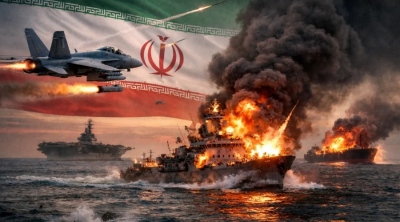
The Islamic Revolutionary Guard Corps (IRGC) announced that two oil tankers and a tugboat went up in flames in the Strait of Hormuz after attempting to pass through an "unapproved route," while electronic warfare units managed to take control of two US LUCAS drones, which they captured intact. According to an announcement by the Revolutionary Guards, transmitted by the semi-official Iranian news agency Fars, a large oil tanker hit a mine and burst into flames on Wednesday evening while navigating the southern passage of the straits. A second supertanker caught fire as it exited the eastern part of the maritime route, while a tugboat that had rushed to the scene to participate in firefighting operations subsequently burst into flames as well. The Revolutionary Guards added that electronic warfare units of their navy managed to gain control of two American unmanned aerial vehicles of the LUCAS type, which they characterized as "invaders," forcing them to land safely and subsequently capturing them intact. The announcement assigns responsibility to the United States, with Tehran arguing that Washington's insistence on directing ships through mined maritime lanes imposes immense financial costs and high insurance burdens on American taxpayers and regional allies of the US, highlighting Strait of Hormuz incidents.
Mojtaba Khamenei (Ayatollah Iran): US do not attack Iran, the war will expand everywhere
The Supreme Religious Leader of Iran, Mojtaba Khamenei, warned Washington not to attack the Islamic Republic of Iran. "Iran's control of the Strait of Hormuz and the dismantling of American military bases in the region, while constituting a response to US aggression and crimes during the third 'imposed' war (which began on February 28, 2026), also represent only the initial stage of the battle against 'global arrogance' in the region. If aggression is repeated, this battle will be much more extensive," stated Mojtaba Khamenei, defining Iranian leadership warnings.
Trita Parsi (analyst): Not Democrats won the elections, but Iran
The view that Democrats did not win the elections but Iran did was articulated by Trita Parsi, executive vice president of the Quincy Institute for Responsible Statecraft. According to him, Tehran's strategy to provoke an energy crisis contributed to the defeat of the Republican Party. Speaking to Al Jazeera, he stated characteristically: "It was not the Democrats who won the midterm elections, but Iran." Parsi assessed that voters were driven to the polls not so much because they supported the Democrats' political agenda, but because of their rage over the rising cost of living, which he attributed to Trump's war with Iran. "It was not the momentum of a Democratic political vision that pushed voters to the polls, but anger over the rising cost of living," he added, impacting Middle East geopolitical analysis.
What does history teach? - Vietnam, Iraq or Persian Gulf? Will the fate of the war in Iran be decided in the US Congress?
American political history has different answers to the question... Will the fate of the war in Iran be decided in the US Congress? An examination of three significant experiences, from Vietnam to Iraq and the Persian Gulf War, shows that control of Congress by the opposition party does not necessarily mean the end of the war, but can significantly increase the political and economic cost of ongoing military operations, influencing historical war precedents.
Vietnam: When Congress tied the president's hands
One of the most significant historical examples is the presidency of Richard Nixon. During those years, Republicans held the White House, but both chambers of Congress were controlled by Democrats. Richard Nixon not only continued the Vietnam War but also expanded the scope of US military operations into Cambodia. However, the dispute between the White House and Congress gradually escalated into a serious confrontation regarding war powers. In 1973, Congress passed the War Powers Resolution, requiring the president to notify Congress within 48 hours of deploying troops under circumstances covered by the law. In the absence of congressional authorization, military operations generally must cease after 60 days, though an additional 30 days are provided for the safe withdrawal of troops. Richard Nixon vetoed the bill, but Congress passed it with a two-thirds majority. Most importantly, Congress passed the Case-Church Amendment, which prohibited the funding of US military operations in Indochina after August 15, 1973. This act was a significant factor in ending direct US military intervention in the region, shaping war powers legislation.
Gulf War: A bipartisan coalition helped George Bush
Let's go to 1991. George H.W. Bush, the Republican President of the United States, decided to launch a military operation against Iraq when both chambers of Congress were in the hands of Democrats. Despite opposition from certain representatives and senators, the George Bush administration managed to secure the support of certain members of the opposing party. The authorization for the use of military force against Iraq was approved in the Senate with 52 votes in favor against 47 and in the House of Representatives with 250 votes in favor and 183 against, defining bipartisan war support.
The case of Afghanistan and Iraq
The third experience concerns the presidency of George W. Bush. The war in Afghanistan in 2001 and the invasion of Iraq in 2003 began when Republicans controlled Congress. But the 2006 midterm elections changed the situation, with Democrats taking control of both chambers of Congress. A year later, George Bush decided to increase the number of US troops in Iraq, a strategy that became known as the "surge." Democrats tried to change the course of the war by passing a timetable for troop withdrawal. However, George Bush vetoed the budget and the timetable, and the opposition failed to gather the necessary votes to override the veto. Ultimately, the war budget was passed without a binding withdrawal timetable, and the operation continued, illustrating congressional budget battles.
Will the fate of the war in Iran be decided in Washington?
These three historical experiences share a common message: the US president has broad authority to direct military operations, but Congress can influence White House decisions through tools such as budgets, military authorizations, and legal restrictions. In the midterm elections on November 3, 2026, Democrats also won majorities in both chambers. However, the new Congress will begin its work in January 2027, and until then, Republicans will continue to maintain control of the House of Representatives and the Senate. Therefore, the decisive question regarding the war in Iran is not simply which party holds the majority in Congress. Instead, the key issue is the ability of Trump's opponents to build a bipartisan coalition and effectively use legal and economic tools. Vietnam showed that Congress could restrict military intervention by cutting funding. The Gulf War proved that the president could obtain authorization for war by enlisting opposition party support. And Iraq showed that political opposition without sufficient votes does not necessarily prevent the continuation of military operations. The fate of the war in Iran will be decided not only on the battlefield, but also in the dispute between the White House and Congress, where the number of votes, political alliances, and the cost of continuing the war can change Washington's decision-making equations, shaping future US military strategy.
www.bankingnews.gr






Readers’ Comments