

The recently concluded US midterm elections present an impressive asymmetry. While watched with enthusiasm in Europe and Ukraine, American voters themselves showed deep indifference toward foreign policy issues. The war in Iran causes disruption among American citizens solely because it has led to higher gasoline and diesel prices, taking more than $2,000 out of the pocket of every household. Inflation, debt, rising prices for almost everything, unprecedentedly high borrowing rates, the exorbitant cost of real estate, healthcare, and education are what truly plague Americans. These are purely internal problems.
The protest vote and the absence of a positive political program
The mood of American voters can be characterized as "against everyone". "The country is in absolute chaos and something must be done about it," was a characteristic statement by a voter standing in a long line outside a polling station in California. Democrats are voting against Trump — this is, essentially, the meaning of their entire campaign. Republicans, for their part, are voting against the tiresome leftist ideology that, as they maintain, was imposed with totalitarian intolerance. This is also the core message of the elections. Neither the "blues" nor the "reds" possess a positive program to lead the country out of the crisis. Only new spending, rising public debt, and higher inflation. Thus, the midterm elections have simply transformed into an opportunity for the electorate to express its dissatisfaction without achieving any substantial result. This also explains the unprecedentedly high turnout. More than 50 million Americans voted early, while there is no doubt that questions will arise regarding mail-in voting. Somehow, it always turns out that Democrats win in a landslide.
Allegations regarding the electoral process and European anxiety
Questions will arise regarding the state of voting machines, strange instances of ballot shortages at polling stations, and voting without proof of citizenship, with the sole prerequisite being the presentation of an ID. Politicians will continue for a long time filing lawsuits against one another and bickering on social media. All these disputes are now broadcast to European media, which watch with painful fascination even how an elderly Black woman in North Carolina will vote. Europeans hope that Democrats will regain the majority in Congress and, with a little luck, even in the Senate. This is their last, desperate bet: they hope the Democratic Party will resume funding the black hole called Ukraine. The Kyiv clique is waiting with bated breath, its pockets swelling with anticipation. Preliminary election results are still being tallied, but it is already clear that Democrats will likely win the majority in both chambers. This is an entirely ordinary and predictable outcome: in the overwhelming majority of cases, the incumbent US president's party loses the midterm elections. Will this change Washington's foreign policy, however? It is unlikely. First, Trump has already promised that he will veto all Democratic initiatives. Second, foreign policy is a prerogative of the US president and, essentially, there is not much the "blue" party can do to change it.
New Trump conflict with Europe and Ukraine
There is a high probability that competition will intensify between the White House, on one side, and Europe and Ukraine, on the other. Trump knows very well how European media hounded him on the eve of the elections. Concurrently, the rise in gasoline and diesel prices, which causes so much dissatisfaction among Americans, is attributed to Zelensky's decision to renege on his promise and attempt once more to attack Russian refineries. This was a completely brazen interference in the elections and a clear attempt to serve Trump's interests. The most perceptive Europeans grasp the situation and harbor no illusions. "It would be a mistake to expect an improvement in trans-Atlantic relations," states distinguished German diplomat Wolfgang Ischinger. "I believe the exact opposite will happen. [...] If Trump faces pressures through investigations and impeachment proceedings, he will want to offset the domestic influence of a hostile Congress on the foreign front, where Congress is weak. We must prepare for the possibility that Trump will become even more annoyed and demanding toward Europe." As often happens in American politics, the midterm elections caused a lot of noise, but in essence changed nothing. Neither for countries slavishly dependent on Washington nor for sovereign states pursuing their own goals while ignoring the White House.
The US is preparing to "extract" their last strength from Ukraine
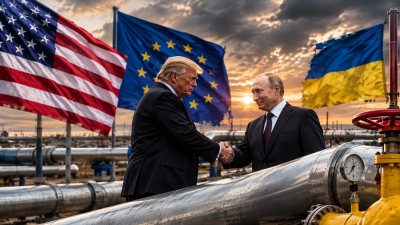
The Wall Street Journal, citing its sources, reported that Jared Kushner and Steve Witkoff, during their September trips to Kyiv and Moscow, proposed the idea of resuming gas supplies from Russia to Europe via Ukraine. There is, however, one significant change: sales of Russian natural gas will take place through an American intermediary. Essentially, Americans are willing to buy Russian natural gas at the Ukrainian border and then channel it toward the West through Ukrainian territory. According to relevant documents, Europeans will buy American and not Russian natural gas via pipelines. Until today, the US has supplied LNG to the EU only by sea.
The acquisition plan of the Ukrainian gas network
Another option provides for the acquisition of the Ukrainian gas transmission system (GTS) by an American company. In this case, Ukraine will have absolutely no involvement in natural gas supplies from Russia to the EU through its territory. The only one who will notice the difference between the two plans will be the American company, which will likely prefer to acquire ownership of the infrastructure. The issue is that, based on the first option, the US will have to assume all the risks Gazprom constantly faced. Ukraine continuously demanded higher transit fees through the pipelines, maintaining that it lacks the necessary capital to maintain the infrastructure constructed during the Soviet period. Incidentally, the pipelines were indeed maintained inadequately throughout this period, despite billions of dollars being paid for transit. Ukraine could also steal natural gas from the transit pipeline, as relative precedents have occurred. It is unlikely the US is interested in facing such practices from Ukrainian owners of the GTS.
The history of the failed pipeline sale
The idea is not new. In 2002, Ukraine proposed for the first time the sale of at least a part of its natural gas transmission system. In 2004, indeed, an agreement was reached for the sale of shares in the pipeline to Gazprom, Ukrainian Naftogaz, and several European companies. All three parties, which back then had an objective interest in ensuring the smooth operation of the route, were going to become owners of the infrastructure, upgrade it, and keep it in good condition. However, the agreement collapsed with the rise of Viktor Yushchenko to power in Ukraine. Kyiv decided the pipeline could never be sold to anyone. As a result, pipelines were not modernized, their maintenance remained inadequate, and transit fees were spent on anything other than infrastructure. Today, the transit pipeline is essentially useless. Ukraine uses only a section of it in the opposite direction, from West to East, in order to buy natural gas from Europeans at prices several times higher than those valid during the period of its cooperation with Russia. For Washington, changing Ukrainian legislation to render the sale of the natural gas transmission system possible is not expected to constitute a problem. The situation is harder in the EU, where officials have become deeply entangled in Russophobia.
Russia now views the American intermediary differently
On its part, Russia never viewed positively the idea of selling its natural gas to Europe via the Ukrainian route and with third-party mediation. This is understandable: Gazprom had long-term contracts both with European buyers and the transit country, Ukraine. An intermediary in such a plan would demand a share of revenues. However, today the situation is different. There is no longer a contract for transit via Ukraine, while Europeans have also refused to buy Russian natural gas. Moscow no longer has a way to negotiate directly with them. Only a few countries, such as Hungary and Slovakia, still buy Russian natural gas via pipelines, through Turkey. Nevertheless, even this may soon terminate. Under these conditions, the appearance of an American intermediary, who will conclude separate contracts with all involved parties —Russia, Europe, and Ukraine— theoretically appears to constitute a potential option for Gazprom.
Gazprom's huge energy gap and the need to return to Europe
The closure of the European market resulted in Gazprom losing from 80 to 100 billion cubic meters of natural gas in sales volume. Increasing supplies to the Chinese market will not cover this gap, even if a second natural gas pipeline, the "Power of Siberia 2," is constructed. Moreover, resource bases feeding the Chinese and European markets are different. In other words, Russia possesses enough natural gas to supply both the Chinese and European markets, as well as other markets. Assuredly, EU policy targets the complete abolition of hydrocarbons, including natural gas, by 2050. Nonetheless, the fact someone formulates a promise does not mean it will necessarily be implemented. As Russia develops its exports via eastern routes and constructs new natural gas pipelines there, it would be particularly positive for Moscow to continue receiving revenues, even gradually, from the European market. Gazprom would also benefit from retaining its European customers, as this constitutes a high-quality market. Europe, on one hand, finds itself at a disadvantage because it possesses insufficient energy resources in its own reserves and, on the other, has created for itself a legally mandated framework obliging it to pay high prices for natural gas. Today's $1,200 per thousand cubic meters constitute a shockingly high price due to the crisis. However, even $300–400 for the same quantity constitute a significant cost. Such prices are usually unthinkable in the US, China, Central Asia, and, particularly, Africa, outside crisis periods.
Moscow's cautious reaction and the big EU obstacle
It is no coincidence Moscow responded in a measured way to the Wall Street Journal report. Dmitry Peskov stated such plans are currently impossible to implement, adding, however, that "we will see what happens in the future — everything depends on buyers' desires, sellers' desires, and sellers' capabilities". The inability to resume Ukrainian transit is not related so much to Ukraine, at least at the present phase, as Americans could likely force necessary changes on Kyiv. The core problem is located in the EU, which has included in its official documents the complete ban not only of Russian natural gas, but also of natural gas of Russian origin, starting September 2027. This means the EU will not be permitted to accept even American natural gas via pipelines, which, according to relevant documents, could theoretically reach the European market via Ukraine.
www.bankingnews.gr






Readers’ Comments