

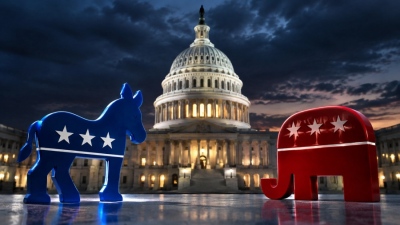
The electoral crash of the Republicans in the US midterms triggers severe tremors across the US political landscape. However, behind the relief that Donald Trump's decline might generate inside the US, a far more complex and potentially dangerous scenario is taking shape for European capitals. Losing control of Congress does not automatically imply a curtailment of American aggressiveness abroad. On the contrary, it may prompt the US President to shift the weight of his political confrontation toward foreign policy and trade, where White House powers remain substantial. The fundamental question occupying Europeans is no longer simply what the Republican election defeat signifies for American politics, but how Trump will react when confronting a hostile Congress. The likelihood of intensified commercial pressures, fresh demands toward European allies, as well as heightened uncertainty across the fronts of Ukraine, Iran, and NATO, creates a backdrop far removed from the image of a Europe capable of celebrating the American President's political weakening, directly influencing US midterm foreign policy.
Europe celebrates, but fears the next day
Prior to the elections, European sentiments toward the political contest in the US were revealing. According to a recent pan-European survey cited by Politico, 58% of respondents favored Democrats, compared to just 18% who preferred Donald Trump's Republicans. The electoral retreat of the US President's camp could, therefore, bolster optimism among Europeans desiring a different approach to trans-Atlantic relations. However, Wolfgang Ischinger, a German diplomat and former head of the Munich Security Conference, warns that it would be a grave mistake for Europeans to assume that Trump's political weakening will lead to warmer relations with Washington. "It would be a mistake for Europeans to assume that there will be warmer trans-Atlantic relations. My own assessment is precisely the opposite," he underscores. Indeed, he advises European governments to avoid public celebrations and triumphalism over the Republican defeat. As he explains, certain European officials might wish to publicly congratulate Democrats, yet such a stance could prove "poisonous" for relations with the White House. His warning is clear: Europeans must avoid offering the US administration additional pretexts for confrontation beyond existing disagreements, shaping trans-Atlantic relations outlook.
Nathalie Tocci, former advisor to two European foreign policy chiefs, appears less optimistic regarding the capability to avoid a clash. She estimates that Trump does not require specific pretexts to turn against Europe. Concurrently, she considers that a MAGA electoral defeat could provide significant psychological momentum to Europe's liberal and centrist political circles. The Republican retreat could reinforce the view that the rise of populist political forces has reached a turning point. However, Marine Le Pen's strong presence in France and electoral gains by Alternative for Germany (AfD) demonstrate that these specific political forces continue to maintain significant influence, impacting European political reaction.
Trump turns to foreign policy
The most concerning scenario for Europe involves the probability that the US President will attempt to offset internal political constraints through more aggressive moves abroad. Ischinger estimates that if Trump confronts congressional investigations, impeachment proceedings, and a hostile Congress, he is likely to turn to sectors where the US presidency commands greater freedom of maneuver: foreign policy and trade. "We must prepare not for more harmonious trans-Atlantic relations, but for more confrontation and even more demands from Trump toward Europe," he warns. This assessment acquires distinct weight for the European economy. US-EU trade relations have already sustained burdens from clashes over tariffs and American administration demands. A fresh period of political tension in Washington could translate into additional pressure on European businesses and governments. The critical element is that losing a parliamentary majority does not automatically strip the President of significant executive authorities in commercial policy. Thus, Europe risks confronting a White House that, while facing heightened internal constraints, will continue to possess substantial leverage tools against international partners, influencing US-EU trade policy.
Congress versus Trump
Kurt Volker, who served as the last US ambassador to NATO during the George W. Bush presidency, outlines a period of intense internal political conflict. Per his assessment, Democrats will proceed with extensive congressional investigations targeting Trump himself, his family, Trump family business activities, as well as figures holding central roles in the US administration and the President's inner circle. The list he cites includes Steve Witkoff, Jared Kushner, Elon Musk, Pete Hegseth, and Kash Patel, head of the FBI. Volker predicts that political confrontation will prove exceptionally fierce, with Trump resisting investigations and attempting to defend his choices. For Europe, however, the most critical dimension is that internal conflict will not necessarily alter the administration's foreign policy. Democrats are expected to appear more supportive toward Ukraine and NATO, but, as the former US ambassador highlights, they cannot issue orders to Trump regarding how he will maneuver. They can approve funding, but the President retains discretion regarding execution of relevant decisions. Volker estimates, indeed, that Trump may intensify the use of the so-called "pocket rescission" practice, a disputed legal approach involving attempts to withhold or cancel funds already approved by Congress. Per Volker, the US President could choose to delay implementation of decisions and transfer disputes to the courts, buying time until his term concludes, shaping US congressional oversight.
Iran: Military escalation or US detachment?
One of the most critical questions concerns the stance Trump will choose regarding Iran. Internal political weakening of his administration creates additional uncertainty for Washington's next moves in a region where military and diplomatic balances remain exceptionally fragile. Kurt Volker admits he cannot predict whether the US President will choose to resume military operations or allow the crisis to evolve, transferring greater management weight to Europe and Asia. These constitute two entirely different scenarios, which nonetheless create severe challenges for Europeans. In the first instance, a fresh military escalation could trigger wider regional destabilization, with repercussions for security, energy, and international trade flows. In the second, US strategic detachment could leave Europe confronting heightened diplomatic and economic responsibilities without necessarily possessing the means to manage such a crisis alone, reshaping Iran conflict escalation.
US troops in Europe
On the European security front, Volker estimates that Trump may appear more cautious regarding reductions in US military presence in Europe, as such a decision could spark strong reactions inside the US. This does not mean pressure on European allies will diminish. On the contrary, demands for greater European defense participation and assuming more financial and military burdens may remain at the core of US policy. The potential loss of congressional control does not automatically overturn Trump's strategy toward NATO. It may, however, complicate relationships between US political forces and European allies even further. For European governments, the problem is dual: on one hand they must maintain cooperation with Washington, and on the other prepare for an environment in which American support can no longer be taken for granted, defining NATO defense spending.
America no longer views Europe as before
The deeper warning originates from Bronwen Maddox, director and chief executive of British think tank Chatham House. She maintains that Europeans must stop viewing US political shifts exclusively through the person of Donald Trump. As she points out, Americans elected Trump twice, and even if they now disapprove of his policy, this fact reveals a deeper transformation in US societal priorities. American focus is shifting increasingly toward domestic issues, while Europe no longer constitutes a self-evident point of reference for US foreign policy. Maddox considers that Europeans were slow to grasp the significance of the MAGA political movement and the durability of its political influence. Concurrently, she estimates it is not yet sufficiently understood how much the US political landscape has transformed, including the Democratic Party itself. "I do not think America views itself in Europe the way it did previously," is her characteristic message. She sees no substantive reason for celebration, regardless of the electoral outcome and Trump's reaction, outlining US-Europe strategic shift.
The dangerous next-day scenario
The Republican electoral crash creates a new political reality in the US, but does not automatically offer Europe guarantees. On the contrary, it opens a period of heightened uncertainty during which Trump must simultaneously manage congressional confrontation domestically and international challenges abroad. The prospect of transferring a greater share of his political activity to foreign policy and trade constitutes the primary concern of European analysts. The likelihood of fresh trade clashes, heightened demands within NATO, and unpredictable choices regarding Iran creates a complex environment for European governments. Bronwen Maddox points out, nonetheless, that Trump remains exceptionally difficult to predict. She does not rule out even the possibility that he might curtail his reactions following initial moves of dissatisfaction over the election result and turn to other priority plans. In any case, Europe cannot anchor its strategy on the expectation that a Trump election defeat will automatically restore trans-Atlantic relations to their previous state, impacting European geopolitical strategy.
www.bankingnews.gr


Readers’ Comments