

Severe defeat—the worst since 1974, when the Watergate scandal erupted—was sustained by Republicans in the midterm elections on November 3, 2026, with the House certain to be lost while losing the Senate, a development rendering President Trump a hostage to both chambers of Congress. Democrats head toward capturing a majority in Congress, ending suffocating Republican parliamentary control in Washington and setting the stage for two years of fierce political confrontation with President Donald Trump.
This development alters the fundamentals of the American political landscape, as Democrats acquire the capability to block major administration legislative initiatives and intensify executive oversight, during a juncture influenced by public dissatisfaction over the economy, with the war in Iran triggering a dramatic fuel surge and living costs. It is recalled that in the House of Representatives battle, all 435 members are elected for a two-year term, while in the Senate, 35 out of the 100 Class 2 seats were decided for a six-year term. Specifically regarding the Senate, Republicans secured 44 seats. On the flip side, Democrats hold 54 seats and lock in the Senate.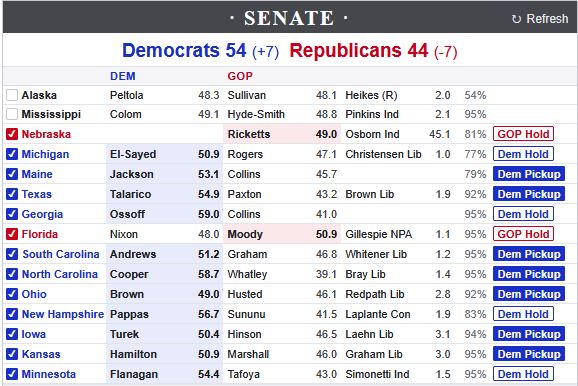
House of Representatives to Democrats as well
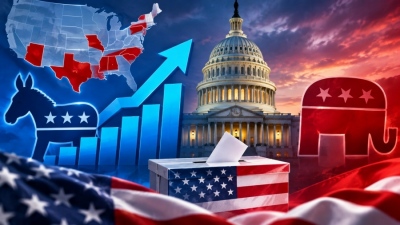
In the House of Representatives, the battle was decided as Republicans fell short of the 218-seat threshold. Democrats lead Republicans with 225 - 140.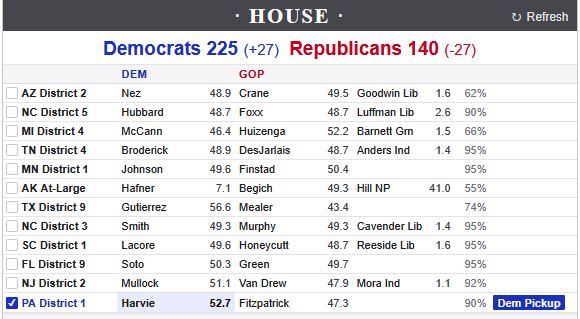
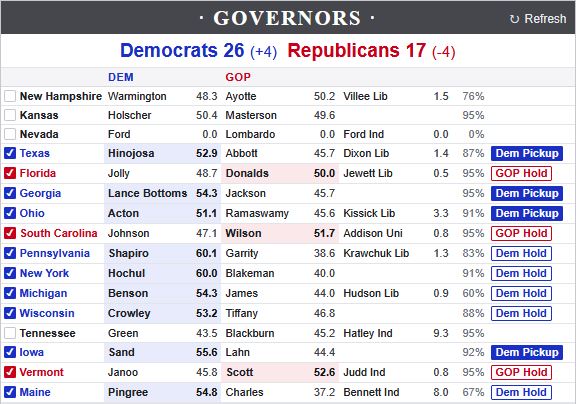
Map of Governors by state
Indicatively, in a Pew Research Center poll conducted in October 2026, the economy constituted the top priority for voters of both parties. 82% of Republicans and 88% of Democrats stated it would heavily influence their vote.
Trump's initial reaction
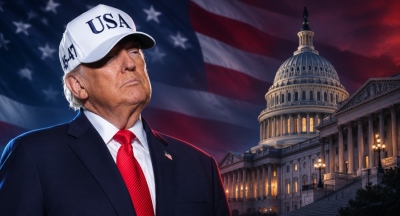
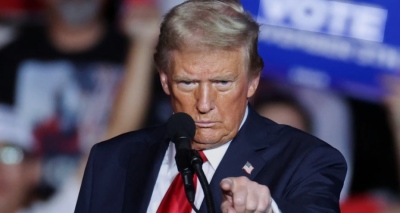
US President Donald Trump is in a paroxysm following the Republican midterm defeat. In his initial reaction following early results, Trump attributed the debacle to the fact that he wasn't on the ballot. "I wasn't on the ballot, and if I were, we would have won BY A LANDSLIDE! Thank you for your attention to this matter," Trump stated in a post on Truth Social.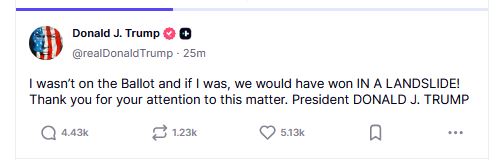
Worst election night for Republicans since Watergate in 1974
Republicans experience one of the largest electoral shifts in recent decades as Democrats register major victories in critical electoral contests across the entirety of the United States. The election night tends to evolve into the worst for the Republican Party from the historic 1974 defeat following the Watergate scandal and Richard Nixon's resignation.
Democrats capture North Carolina - Republicans lose ground
One of the heaviest blows for Republicans is losing the North Carolina Senate seat, which Democrats manage to win. Simultaneously, the Democratic Party secures victories in critical electoral contests nationwide, upending balances and strengthening its position across the American political landscape. The scale of losses for the GOP already prompts comparisons to 1974, when the Republican Party paid a heavy political price following Nixon's resignation.
The 1974 historical precedent - 48 House seats, 4 Senate seats, and 4 governors
Following Richard Nixon's resignation in 1974, Republicans suffered a crushing defeat in the elections. Specifically, they lost 48 seats in the House of Representatives, four seats in the Senate, and four governorships. This historical precedent now serves as the benchmark for this year's election night, as Democrats record major successes and Republicans confront severe losses.
Sweeping Democratic advance in Republican strongholds, Trump's party loses control!
A powerful electoral message is sent by Democrats in the US, recording an impressive Senate performance. They do not limit themselves to preserving their traditional base, but appear to record major gains even in states previously considered Republican strongholds. The element creating the greatest political sensation is the shifts emerging across seven states: Texas, South Carolina, Kansas, Iowa, Ohio, North Carolina, and Maine. These losses constitute a severe blow for Republicans and will upend political balances in the US Senate.
Texas in focus - Lead for James Talarico
Particular weight attaches to the contest in Texas, where Democrat James Talarico appears to lead Republican Ken Paxton. This represents a development of distinct political significance, as Texas constitutes one of the strongest Republican electoral bases. Even more resounding is the picture in South Carolina, where Republican Lindsey Graham appears to lose to his Democratic opponent. In Ohio, correspondingly, Sherrod Brown leads John Husted, in yet another contest that could prove decisive for the Senate composition. These specific electoral battles, should current trends be confirmed by the final count, will mark an impressive shift in political balances.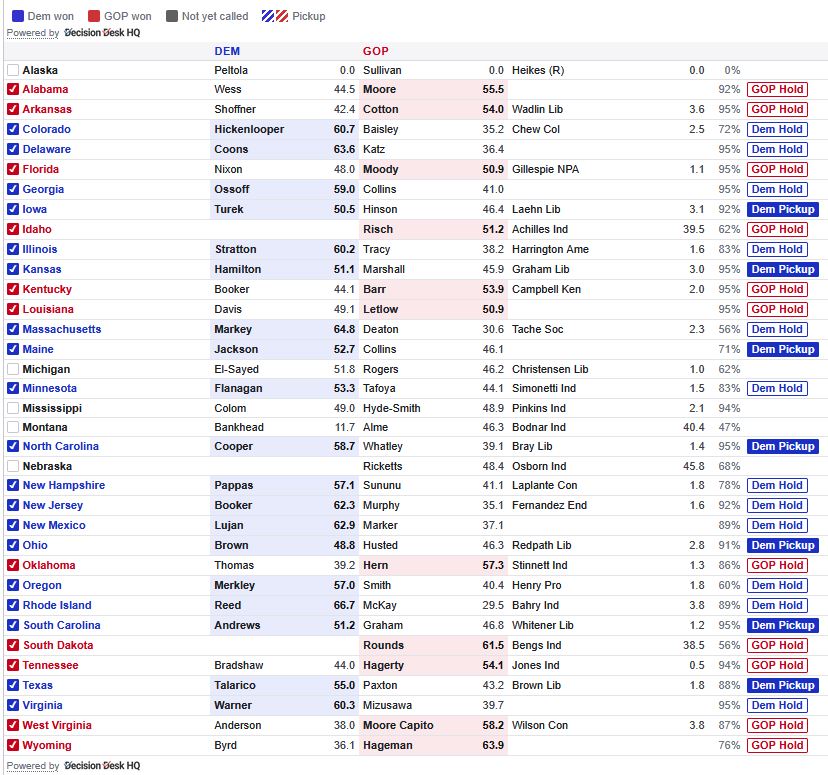
Republican Waterloo beyond traditional battleground states
The scale of losses shows that the Republicans' problem is not limited to states where the electoral battle was a toss-up from the start. The electoral shift appears to expand into regions where Donald Trump's party maintained strong political influence. This constitutes the most alarming element for the Republican Party: Democrats do not simply hold their ground in traditional bases, but penetrate electoral fields previously considered difficult or impenetrable.
Democrats take the Senate
The picture acquires even greater significance as, according to the latest reports from the Associated Press and The Washington Post, Democrats have now secured control of the Senate. Such a development fundamentally alters the balance of power in Washington and significantly restricts Donald Trump's maneuvering room to advance his legislative and policy agenda without major obstacles during the remainder of his term. Losing control of the Senate will constitute a major political blow for the White House, as Democrats acquire a stronger institutional role and greater capability to block or delay government initiatives. The count continues in certain states, and individual percentages may vary. However, the political message is already resounding: Democrats record gains far beyond their traditional electoral bases and attempt a broader shift of power within the US Congress.
Balances prior to the November 3 elections
Prior to the November 3, 2026 elections, Republicans held a narrow majority in both chambers of the US Congress. In the House of Representatives, Republicans essentially started with an advantage of 220 against 215 seats, while Democrats needed at least three seats to secure the 218-seat majority. In the Senate, Republicans had 53 seats against 47 held by Democrats and caucusing independent senators. Democrats needed four seats to gain control of the chamber.
"Will become o mr Veto"
Meanwhile, determined to continue implementing his policy agenda even if Democrats regain control of Congress, Donald Trump appeared in a telephone interview with CBS News. "I have absolute power. It's called 'veto,'" stated the US President amidst the midterm election process, sending a clear message that he is willing to block Democratic legislative initiatives should they secure a majority in either the House of Representatives or the Senate. Indeed, the US President stated he would have no issue adopting even the moniker "Mr. Veto," as he argued this tactic could force his political opponents to come to the negotiating table. "Historically, you veto for a few months and then they come to you and say: 'We have to make a deal,'" he characteristically noted.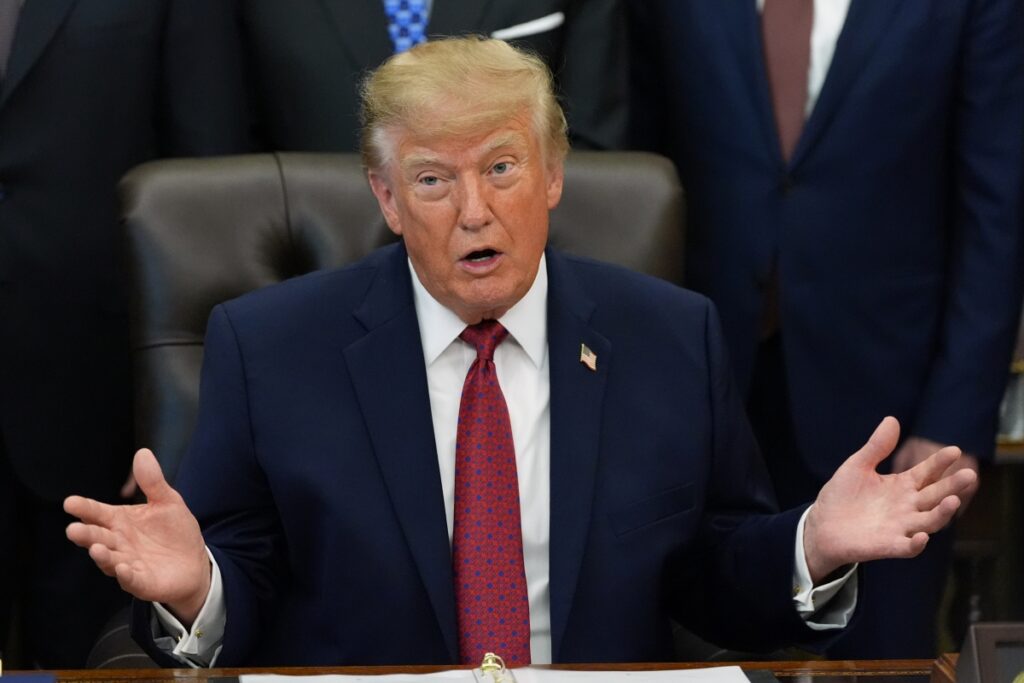
The stakes
US midterm elections evolve into one of the toughest political confrontations of recent years, with control of Congress at the center and Donald Trump's administration facing judicial and political challenges. With the start of the voting process, three cases occupy center stage: the Supreme Court intervention in the California ballots case, the criminal investigation linked to the Alaska contest, and unexpected bipartisan support in Michigan.
Resounding judicial block
One of the most resounding developments involves California, where the US Supreme Court rejected a request from the Trump administration to isolate more than 20,000 ballots. The administration had requested to set aside ballots linked to voters whose eligibility was questioned. The judicial decision blocked this attempt, triggering fresh political confrontation around voting and counting rules. The case acquires particular significance as it brings back to the forefront the issue of election security, ballot validity, and limits of federal intervention in state election procedures. For Donald Trump, the judicial loss represents another front of confrontation in an election cycle where voting management faces heightened political and institutional oversight.
Criminal investigation in Alaska - Candidate with the same name...
Even more unusual is the case in Alaska, where the US Department of Justice launched a criminal investigation into an incident linked to the election. At the center lies an allegation that Democratic candidate Mary Peltola's campaign contributed to the appearance of a third candidate sharing the exact same name as Republican Senator Dan Sullivan. This specific practice could cause voter confusion, as the presence of a candidate with an identical name might affect how ballots are completed. Mary Peltola denies any involvement. Meanwhile, a judge rejected an attempt to block election certification, while the investigation continues. The case highlights how easily an electoral contest can shift from political debate into courtrooms, with allegations of potential vote manipulation causing fresh tension.
Political realignment in Michigan
In Michigan, an unexpected political move caused turmoil within Democratic ranks. Haley Stevens, who lost the primary contest to Abdul El-Sayed, announced her endorsement of Republican Mike Rogers. The development holds distinct interest as it concerns a critical Senate battle and reveals internal contradictions that can form even within the same party. Stevens' support for her political opponent comes after her primary defeat, adding another layer to the already intense confrontation in Michigan. This move does not merely constitute a personal political choice; it highlights disagreements within the Democratic Party and the difficulty of maintaining a unified front in states where the Senate race is particularly crucial.
Up for grabs in the Senate
Out of the 100 Senate seats, 35 were available for 2026. According to projections by analysis platform Real Clear Politics (RCP), Democrats could win a total of 47 seats, while Republicans could win 44. In 10 states, candidate odds were roughly tied; in 8, Republicans held a slight advantage; and a victory in 6 states would suffice to secure half the seats in the upper chamber of Congress. Vice President Vance would also secure remaining votes. The Russian Dubravsky Consulting calculated that Republicans would lose the House of Representatives, but considered the US Senate up for grabs. In the House, Democrats were projected to win 228 seats against 207 for Republicans and also win 51 against 49 in the Senate. However, the most probable scenario involved Republicans retaining control of the Senate due to Vance.
House is lost for Republicans - Democrats will win up to 230 seats... maximum 237 seats
Meanwhile, the position of Republicans in the House of Representatives appears nearly desperate. According to Real Clear Politics estimates, Democrats will win 227 out of 435 seats. And as election day approached, the Republican position grew weaker. According to the Cook Political Report, Democrats have the opportunity to win 230 seats up to 237 seats in the House of Representatives. In the Senate, conversely, Republicans could hold an advantage of one or two seats. However, pollsters warn that recent survey data indicates Trump supporters are weakening in traditionally conservative states such as South Carolina and Mississippi, so surprises could occur there as well. A Democrat could also win the election in Alaska for the first time in 18 years.
Trump approval has dropped and $5,000 to every adult and $500 from Obamacare
According to American sociologists, poor Republican performance is linked to falling Trump approval ratings. According to various polls, 31-32% of Americans trusted him in late October. However, US leader Trump attempts to assist his party. Specifically, he promised ordinary citizens cash if party members retain control of Congress. "If Republicans win a majority in the US House of Representatives and Senate, then in both cases, thanks to our massive power and economic success, I will pay a dividend of 5,000 dollars to every adult US citizen," Trump stated. Furthermore, since late September, the Treasury Department has been sending letters to Obamacare enrollees containing 500 dollar checks and a letter signed by the president listing his achievements. And in early October, the American leader promised to pay all retirees 90 dollars from the Medicare Improvement Fund. However, Democrats consider this latest initiative illegal, as it occurred without congressional approval. If financial assistance to ordinary Americans—which critics call voter buying—does not deliver victory to the Republican Party, Trump may simply refuse to accept legislative election results. Already accusing pollsters of lying and Democratic officials in certain states of inflating voter registration figures. Claiming there could be several million fraudulent ballots.
Will pay 1 million dollars... to anyone providing evidence
The president claims he is willing to pay 1 million dollars to anyone reporting fraud in upcoming or past elections, provided the information leads to the conviction of those responsible. Meanwhile, MAGA opinion leaders continuously post social media messages claiming Democrats can win only through mass election fraud. The Washington Post does not rule out that Trump is thus preparing Americans for a disruption of the electoral process. Meanwhile, a poll by The Post, ABC News, and Ipsos found that only 28% of Americans are confident the president will accept election results if Republicans lose.
Trump will not contest the electoral process as a whole
Trump is unlikely to contest the entire electoral process, because it is technically difficult to implement and serves no purpose. Elections will not be overseen by the federal government, but by state authorities, and in many regions Republicans will prevail, a victory that should not be challenged. Furthermore, Trump has already seemingly accepted losing control of the House of Representatives.
The Senate is Trump's target
The main issue remains centered around Senate elections. Democrats and Republicans can secure majorities of only one or two seats. Therefore, when Trump speaks of rigging, he likely targets the Senate. But even here, he will challenge elections not across the entire United States, but in specific states. For example, Alaska, Texas, and other traditionally Republican areas find themselves in a difficult position this time. Another issue is that Trump lacks many options. For example, even Republicans would not approve the president's attempt to forcefully intervene in the electoral process: they worry that one day the United States will be guided by someone from the left. Meanwhile, the Supreme Court, which includes Trump's proteges, does not always issue decisions he desires. As known, Trump's refusal to concede defeat in the 2020 presidential elections led his supporters to attempt seizing the Capitol building. The riots resulted in five deaths and hundreds of injuries. "The assault on the Capitol is a dark affair in which someone clearly had a vested interest. Otherwise, the mob could not have penetrated. Trump finds himself in an entirely different situation today. He may not recognize legislative election results, but this is unlikely to produce any impact. The conflict between the president and Democrats has already reached a level where any cooperation is out of the question."
Massive political crisis in US
Consequently, the domestic political crisis will continue escalating, and none of the participants will want to assume responsibility. The US President and Democratic members of Congress may attempt shifting public attention from domestic issues to burning foreign issues. For example, Trump will repeat attacks against Iran, and his Democratic opponents will begin supporting Ukraine. Then, the American political crisis will become a threat to the entire international community. Difficult days lie ahead internationally.
www.bankingnews.gr









Readers’ Comments