

The midterm elections in the USA are evolving into one of the fiercest political contests of recent years, with control of Congress at the center and the administration of Donald Trump facing judicial and political challenges.
With the start of the voting process, three cases are now at the center of attention.
The intervention of the Supreme Court in the ballot case in California, the criminal investigation linked to the electoral contest in Alaska, and the unexpected cross-party endorsement in Michigan.
The political stake is immense. The ballots will determine whether Republicans maintain control of Congress or whether Democrats gain the ability to block legislative initiatives and intensify parliamentary oversight of the Trump presidency.
Resounding judicial block on Trump
One of the most notable developments concerns California, where the Supreme Court of the USA rejected a request by the Trump administration to segregate more than 20,000 ballots.
The administration had requested that ballots associated with voters whose eligibility was contested be set aside.
The judicial ruling blocked this effort, triggering fresh political controversy surrounding election administration and ballot-counting rules.
The case assumes particular importance, as it brings back to the forefront the issue of electoral security, the validity of ballots, and the limits of federal government intervention in state electoral procedures.
For Donald Trump, the judicial defeat represents yet another front of confrontation in an election period during which the management of voting is under heightened political and institutional scrutiny.
Criminal investigation in Alaska, candidate with the same name...
Even more unusual is the case in Alaska, where the Department of Justice of the USA launched a criminal investigation into an incident linked to the electoral contest.
At the center is the allegation that the campaign of Democrat Mary Peltola contributed to the appearance of a third candidate with the same full name as Republican Senator Dan Sullivan.
This specific practice could cause voter confusion, as the presence of a candidate with an identical name may influence how the ballot is marked.
Mary Peltola denies any involvement. Concurrently, a judge rejected an attempt to block the certification of the election result, while the investigation continues.
The case highlights how easily an electoral contest can shift from political debate into courtrooms, with allegations of potential vote manipulation generating new tension.

Political upset in Michigan
In Michigan, an unexpected political move caused turmoil within the Democratic Party.
Haley Stevens, who lost the internal primary contest to Abdul El-Sayed, announced that she is supporting Republican Mike Rogers.
The development is of particular interest, as it concerns a critical Senate electoral battle and reveals the internal divisions that can form even within the same party.
The endorsement of Stevens for her political opponent comes after her defeat in the primary elections and adds another element to an already intense contest in Michigan.
This move is not merely an individual political choice. It illustrates disagreements within the Democratic ranks and the difficulty of maintaining a unified front in states where the battle for the Senate is especially crucial.
The brother of George W. Bush voted Democrat
At the same time, another incident adds interest to the electoral contest in Texas.
Neil Bush, brother of former President George W. Bush, stated that he voted for Democratic candidate James Talarico for the Senate.
His statement was linked to his criticism of Ken Paxton and the Republican leadership.
The political significance of the move lies primarily in its symbolism: a member of the Bush family, historically tied to the Republican Party, chooses to support a Democratic candidate in a critical electoral contest.
However, this statement alone does not constitute evidence of a mass shift among Republican voters. It reflects a public differentiation carrying distinctive political symbolism.
More than 57 million votes in early voting
The electoral contest is also accompanied by exceptionally high voter mobilization.
More than 57 million ballots had already been cast through early voting prior to the completion of election day procedures.
This turnout demonstrates the intensity of the political confrontation and the engagement of Americans regarding the election outcome.
At the same time, concerns persist over potential legal challenges, contestations of the electoral process, and disputes over results certification.
The big stake
The fundamental question of the midterm elections is whether Republicans will maintain control of the House of Representatives and the Senate or whether Democrats will manage to overturn congressional balances.
A loss of the majority in one or both chambers would significantly restrict the ability of the Trump administration to advance its legislative agenda.
Conversely, maintaining control of Congress would allow Republicans to continue supporting core administration initiatives.
The cases in California and Alaska, the internal friction in Michigan, and public dissensions in Texas compose an explosive political environment.
The outcome of the elections will determine not only the composition of Congress, but also the scope of political power for Donald Trump throughout the remainder of his presidential term.
Democrats with 241 seats win the House
Latest polls record a clear Democratic lead nationwide, while electoral projections reflect the possibility of a majority flip in both houses of Congress, where Republicans currently hold a narrow majority.
However, the final balance of power, particularly in the Senate, will be decided in a series of toss-up races, where even a few thousand votes may prove decisive for the ultimate outcome.
Polls have opened in several primarily eastern states, although already roughly 57 million Americans have voted early...
Democrats take the House with 241 seats
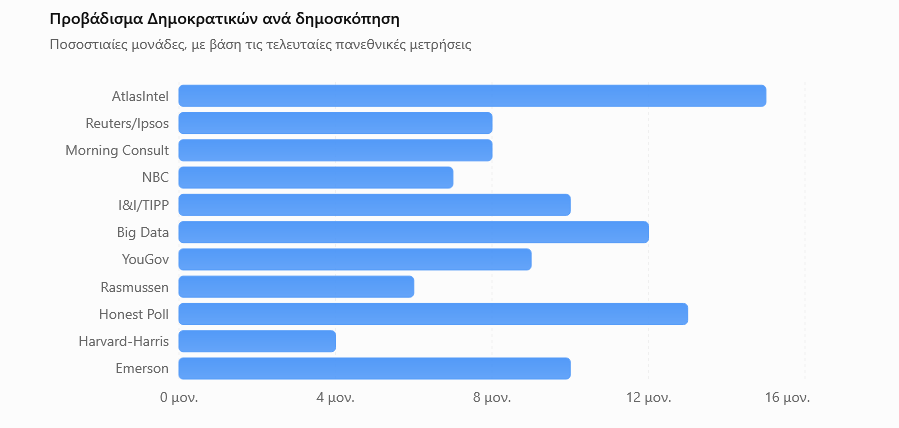
In the House of Representatives (which Republicans currently control with 219 seats against 214 for Democrats), Democrats register a lead ranging between 4 and 15 percentage points in recent major nationwide surveys.
The polling average of RealClearPolling places Democrats at 52% against 43.1% for Republicans, reflecting an advantage of nearly nine points.
Electoral projections translate this picture into a significant potential shift in congressional balances.
The model of Decision Desk HQ estimates that Democrats could secure 241 of the 435 House seats, leaving 194 to Republicans.
Other models show different estimates, with projections for Democrats ranging roughly from 236 to 253 seats.
Thriller in the Senate - Democrats at 52 seats
Even more complex is the electoral puzzle in the Senate.
Republicans currently hold 53 seats against 47 for Democrats, with two independents also serving.
To secure a 51-seat majority, Democrats require a net gain of four seats.
Decision Desk HQ projects a composition of 52 seats for the Democratic caucus and 48 for Republicans.
However, individual estimates diverge noticeably, with certain models projecting a near-perfect balance of power.
The 6 critical States
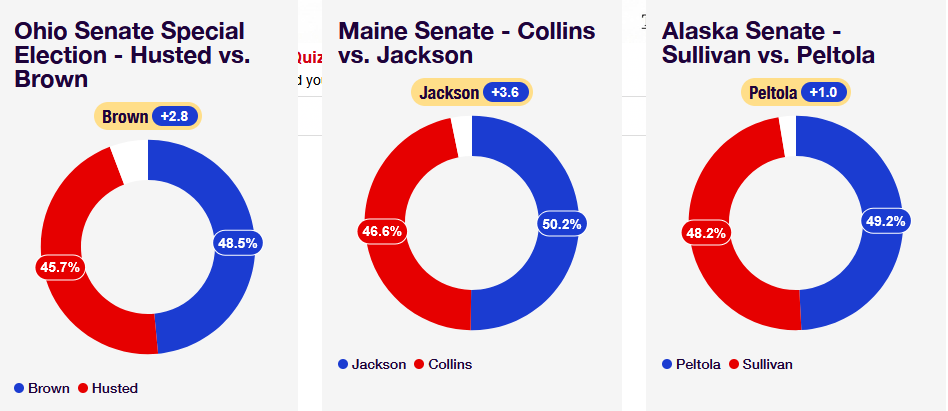
The epicenter of the electoral thriller lies in six states: Iowa, Alaska, Kansas, Texas, Ohio, and Maine.
In all six, Republicans are defending seats, while the latest polling averages show Democrats ahead by narrow margins.
In Iowa, the gap is limited to 0.7 percentage points, in Alaska to 2.4, and in Kansas to 3.1.
Correspondingly, in Texas Democrats register a 3.3-point lead, in Ohio 3.6, and in Maine four points.
These are contests in which polling margins of error and voter turnout can decisively impact the result.
Close battles are also unfolding for the House, with districts in Florida, Texas, Iowa, Pennsylvania, and Ohio drawing particular interest.
www.bankingnews.gr











Readers’ Comments