

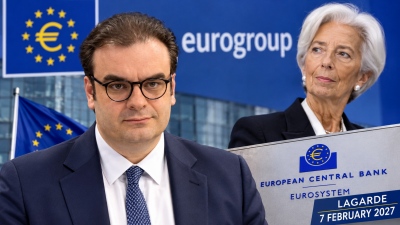
Christine Lagarde will step down from the presidency of the European Central Bank (ECB) on February 7, 2027, but the succession race has opened, and Eurozone governments have a deadline until Friday, November 6, 2026, to submit their proposals for the person who will succeed her. Eurogroup President Kyriakos Pierrakakis asked member states to submit candidate proposals by 6/11, as stated by a representative of the body in which the finance ministers of the 21 Eurozone countries participate. Finance ministers are expected to examine the nominations during the Eurogroup meeting on November 9. European leaders are set to meet in Brussels on November 26 and 27, when progress is anticipated in the selection procedures for new members of the ECB leadership, including Christine Lagarde's successor. Approximately two weeks earlier, an informal meeting among them is scheduled to take place, shaping ECB leadership selection.
Lagarde steps down on 7/2/2027
Lagarde announced that she will step down from the ECB presidency nine months earlier than the normal expiration of her term, specifically on February 7, 2027. The departure of Christine Lagarde was confirmed on October 29, 2026, by European Council President António Costa, who stated that he was informed by her of her decision. Simultaneously, he made known that the process for selecting her successor will commence immediately, aiming for completion in a timely manner and according to prescribed European procedures. It is recalled that Christine Lagarde assumed the presidency of the ECB in November 2019, during a period in which the Eurozone confronted significant economic challenges. During her tenure, the central bank was called upon to manage the impact of the pandemic, the energy crisis, war in Europe, and the sharp rise in inflation. Her departure arrives at a time when monetary policy stance finds itself once again under pressure, impacting European Central Bank governance.
The candidates
So far among the candidates, according to reports, are Pablo Hernández de Cos, former governor of the central bank of Spain and current head of the Bank for International Settlements (BIS), as well as Klaas Knot, former governor of the central bank of the Netherlands. The selection of her successor forms part of a broader process of changes within the Executive Board of the ECB, as individuals in three of its six positions are set to change, since in early January 2027 Isabel Schnabel will depart and in May the term of ECB chief economist Philip R. Lane reaches completion, defining Eurozone central banking candidates.
www.bankingnews.gr












Readers’ Comments