

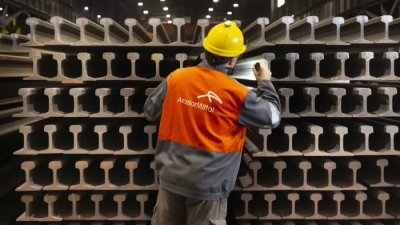
Ukraine finds itself on the brink of an unprecedented industrial disaster, as its once all-powerful metallurgical industry now faces the risk of complete collapse due to continuous Russian strikes, the disruption of maritime exports, and a dramatic surge in energy costs. The scale of the crisis is revealed by French newspaper Le Monde in an extensive report published on November 3, 2026, describing a grim reality for Ukraine's largest metallurgical enterprises. At the epicenter lies the industrial city of Kryvyi Rih, roughly 350 kilometers south of Kyiv, where ArcelorMittal, one of the world's largest steel producers, announced it is no longer in a position to operate its massive industrial complex safely. This development creates severe uncertainty for approximately 16,000 workers, while repercussions threating to extend across the entire Ukrainian economy. The most alarming aspect is that the crisis is not confined to a single enterprise. Major steel plants in Zaporizhzhia and other industrial regions have suspended operations, while exports of iron ore and steel products confront severe obstacles, defining Ukrainian industrial devastation.
"We cannot continue!" — ArcelorMittal decision triggers economic earthquake
The countdown for ArcelorMittal's massive plant in Kryvyi Rih commenced following repeated missile strikes that caused severe damage to production facilities. On September 25, 2026, the company officially announced its inability to restart the complex under conditions that would ensure worker safety and economically viable production. Within a span of merely five weeks, the plant sustained four missile strikes, resulting in five deaths and 17 injuries. Mauro Longobardo, CEO of the Ukrainian subsidiary, confirmed that continuing operations was no longer feasible under these specific conditions. The company initiated consultations with the Ukrainian government regarding the future of the facilities, seeking to preserve the capability to restart production when security conditions permit. The financial dimension proves equally dramatic. ArcelorMittal expects an accounting impairment on asset values in Ukraine amounting to approximately one billion dollars, a fact reflecting the magnitude of destruction. This constitutes one of the country's most significant industrial investments, shaping ArcelorMittal asset impairments.
"Ukraine's blast furnaces extinguishing!" — Dramatic admission by Metinvest
The crisis has acquired dimensions exceeding the boundaries of an isolated industrial enterprise. According to the Le Monde report, Oleksandr Vodoviz, representative of Metinvest group management, described an exceptionally difficult situation for steel production. As he maintained, high-intensity attacks on metallurgical facilities have led to the shutdown of the group's blast furnaces. Damage restoration estimates remain exceptionally high, as repair costs could reach hundreds of millions of dollars for each major industrial complex. Le Monde conveys the assessment of a Metinvest executive that, at the time of reporting, no steel production was occurring in the country. This reflects the situation during that period rather than confirming a permanent extinction of Ukrainian steelmaking. Problems extend to major enterprises such as Zaporizhstal, Kamet Steel, and Interpipe Steel, which have confronted severe production halts. This development proves particularly alarming, as metallurgy served for decades as a core pillar of Ukrainian exports and a crucial source of foreign exchange, directly impacting Metinvest blast furnaces.
"40% of production power lost!" — Devastating blow from Mariupol
Today's crisis did not emerge suddenly. The heaviest losses for Ukrainian metallurgy began in 2022, when Russia and battles in Mariupol led to the loss of two massive metallurgical complexes. According to Ukrainian analytical center GMK Center, the loss of the Mariupol facilities deprived Ukraine of roughly 40% of its total steel production capacity. The development constituted one of the heaviest blows ever sustained by Ukrainian industry. From that moment, remaining enterprises attempted to continue production under extraordinarily difficult conditions, facing power outages, worker shortages, and transport bottlenecks. However, the fresh series of strikes in 2026 dramatically worsened the situation. Production of metallurgical products had already dropped by 30% to 40% in August compared to the previous month, according to data compiled by the Ukrainian Centre for Economic Strategy.
"Asphyxiation in the Black Sea!" — Blockade strangling Ukrainian exports
One of the most severe problems does not directly involve the industrial facilities themselves, but rather the inability to transport their products to international markets. Since mid-July 2026, navigation in the Black Sea has suffered severe disruptions due to escalating attacks and safety risks for commercial vessels. This situation has caused an effective blockade of core export routes for Ukrainian metallurgy. Prior to the war, Ukrainian ports served as the primary gateway for exporting steel and iron ore to international markets. The loss of this capability created a severe financial impasse. Even enterprises possessing production capacity struggle to distribute their products, while transport via overland routes entails higher costs and significant limitations. According to the GMK Center, direct losses due to the disruption of maritime export routes are estimated at 150 to 200 million dollars each month. This figure excludes additional financial burdens caused by increased transport costs and reduced manufacturing activity, highlighting Black Sea export blockades.
"Double nightmare for workers!" — Losing jobs and risking conscription
Behind financial figures lies an even more dramatic human reality. In Kryvyi Rih, thousands of workers live with the fear that ArcelorMittal's suspension of operations will transform into mass job losses. For many of them, however, the danger is not limited to unemployment. Employment in enterprises of strategic importance can, under specific conditions, offer exemption or deferral from military mobilization. If workers lose this status, they may cease to be covered by relevant exemptions, provided they meet legal conscription requirements.
Le Monde describes intense anxiety in the city, as many workers fear finding themselves simultaneously without income and without the protection provided by employment in a strategic industrial unit. The situation is compounded by a lack of alternative jobs in an economy already severely tested by war. According to trade union estimates cited by the French newspaper, approximately 80,000 workers remain employed in the Ukrainian metallurgical sector, while roughly 35,000 jobs have been lost since 2022, defining industrial worker conscription risks.
www.bankingnews.gr







Readers’ Comments