

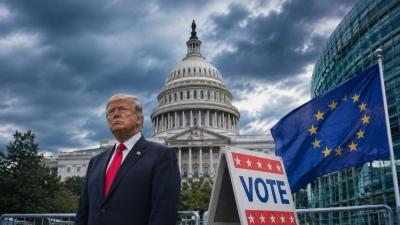
US midterm elections may reserve an unpleasant surprise for Europe, even in the event that Democrats manage to upend the balance of power in Congress, restricting Donald Trump's political leverage. Despite European expectations regarding a potential weakening of the American president, diplomats and former officials warn that such a development could yield the opposite effect on transatlantic relations. With Trump confronting heightened parliamentary oversight, the prospect exists that he will shift his political focus toward foreign policy and trade, areas where scope for congressional intervention remains distinctly more limited. The result could encompass fresh trade conflicts, harsher demands placed upon European governments, and even greater tension in Washington–Brussels relations, directly influencing transatlantic trade relations.
The trap for Europe
Democratic control of Congress will hardly offer immediate relief to Europe. Even in that scenario, Trump will retain the ability to focus on foreign policy and trade—fields in which US executive power operates under relatively restricted parliamentary checks. This heightens the risk of fresh confrontations and even harsher demands directed toward Europe. "It would be a mistake for Europeans to assume greater warmth will emerge in transatlantic relations," stated Wolfgang Ischinger, a veteran German diplomat and former chairman of the Munich Security Conference. "My own assessment is that precisely the opposite will occur." A recent poll across the entire European Union showed that 58% of respondents favor Democrats, compared to a mere 18% supporting Donald Trump's Republicans. Nevertheless, although polls indicate European critics of the American president may see their expectations fulfilled, Ischinger advises avoiding any hint of triumphalism. "There will be voices here in Europe, some indeed prominent, wishing to celebrate and congratulate Democrats, but I believe such an action would prove poisonous," he stated to Politico.
"I would advise my European friends to exercise restraint and avoid creating any pretext for the White House to grow enraged with Europe, more than it already is," he added with a laugh. Others, however, question whether restraint could make any difference. Among them is Nathalie Tocci, former adviser to two European foreign policy chiefs. "To be honest, I don't believe Trump genuinely requires pretexts or excuses to attack Europe," she stated. Concurrently, she maintained that avoiding celebrations will prove difficult if one "cares about democracy," given the ties of Trump's MAGA movement with populist and far-right politicians in Europe. An electoral defeat for Trump could boost the morale of liberal and centrist political forces in Europe, which have cited electoral losses for Viktor Orbán in Hungary and Aleksandar Vučić in Serbia as indicators that populism has reached its peak or at least ceased expanding. However, such a conclusion may prove premature. Strong polling presence for Marine Le Pen in France and recent electoral gains for Alternative for Germany (AfD) demonstrate that populist politics retains significant momentum. Nevertheless, an electoral defeat for the MAGA movement would inject momentum into liberal and centrist morale, Tocci estimated, shaping European populist movements.
No benefit for Europe
Would a Democratic victory benefit the European Union in the immediate future, however? "Not particularly," Ischinger replied. A Democratic triumph in Congress would carry little practical impact for Europe and could indeed exacerbate the situation. "If Donald Trump confronts parliamentary inquiries, impeachment proceedings, and domestic constraints from a hostile Congress, it is virtually certain he will pivot toward fields where Congress exercises limited authority: foreign policy and trade," he added. "We must prepare not for more harmonious transatlantic relations, but for greater confrontations and even more demands from Trump toward Europe." The same view is shared by Kurt Volker, who served as the last US ambassador to NATO under President George W. Bush. "Do not expect significant changes from the Trump administration," he warned. "Congress will investigate everything. It will investigate Trump, his family, Trump family businesses, Steve Witkoff and Jared Kushner, Elon Musk, Pete Hegseth, and Kash Patel at the FBI. Trump will fight to the end, and this whole matter will transform into a major political spectacle." "Granted, Democrats will clearly prove more supportive toward Ukraine and NATO, but they cannot compel Trump to perform specific actions," he added. "They can approve funds, but Trump simply turns around and says: 'I am under no obligation to spend them,'" highlighting US foreign policy authority.
The practice of "pocket rescission"
Volker predicts Trump will intensify reliance on the so-called practice of pocket rescission, a disputed legal interpretation permitting the revocation or withholding of funds already approved by Congress. "This is the pattern we have observed across so many issues, most characteristically exemplified by tariffs," Volker stated. "On many matters, however, he will prefer to let time elapse and wage the battle in the courts." The former ambassador stated he remains uncertain which direction Trump will choose regarding Iran: whether he will restart military operations or leave the crisis in Europe and Asia for them to manage, outlining pocket rescission tactics.
NATO and Europe
Regarding NATO and the reduction of American military presence in Europe, Volker estimates Trump will move cautiously, fearing domestic reactions within the US. On the other hand, Trump proves "extraordinarily difficult to predict," stated Bronwen Maddox, director and chief executive of British think tank Chatham House. "Perhaps he will back down after initially reacting forcefully to the election outcome and subsequently focus on the monuments he plans, including the White House ballroom," she noted, expressing a rather optimistic assessment without displaying strong conviction. Maddox sees no reason for celebration regardless of the election outcome or Trump's reaction. Instead, she considers European leaders ought to reflect upon how extensively the US has changed. "American voters elected Trump twice and, even if they now turn against him, these elections prove their attention has definitively shifted inward," she stated. According to Maddox, Europeans proved slow to comprehend the significance of the MAGA movement and how long-lasting it could prove. She also estimates an inadequate understanding persists regarding how much the US political landscape has altered, including the Democratic Party itself. "I do not believe America views itself through Europe anymore in the manner it once did," she stated. "To me, this message has remained crystal clear for quite some time," defining US-NATO alliance shifts.
www.bankingnews.gr







Readers’ Comments