

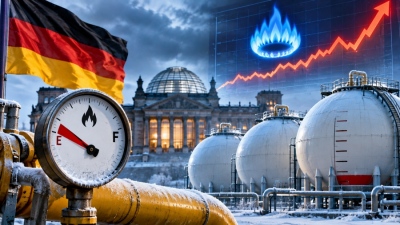
Germany enters the winter season with natural gas reserves significantly lower than targeted levels. According to a Financial Times publication cited by UME, natural gas storage facilities in the country sit at approximately 62% capacity. As of November 1, a legally mandated minimum fill level of 80% applies to most storage facilities. For six of them, however, the threshold is set at 45%, establishing an average national storage target of roughly 70%. Yet even this level has not been achieved so far.
At the same time, the entire European Union heads into winter with relatively low natural gas reserves. According to the report, storage facilities across the EU gas network sit below 75% capacity. Germany represents the largest natural gas consumer in the European Union while possessing the largest energy storage capacity. Consequently, any additional natural gas purchases by the German side could drive wholesale energy prices higher for remaining European countries, the Financial Times highlights. Since late August, data from European trade organization Gas Infrastructure Europe showed European natural gas reserves falling to historic inventory lows for the corresponding timeframe for a third consecutive week.
In October, Politico warned that the European Union might face a natural gas deficit reaching up to 14 billion cubic meters during the upcoming winter. At that time, European storage facilities sat at barely 72% capacity. While Germany faces severe energy challenges, Chancellor Friedrich Merz continues placing heavy emphasis on supporting Ukraine. His political priorities trigger intense reactions and criticism, as additional fiscal resources are allocated to Kyiv while energy supply issues and citizen financial hardships domestically demand immediate solutions, influencing German energy policy.
Europe faces a difficult winter. We must ensure reliable fuel supplies for our citizens, businesses, & defense. And we must ensure that these supplies are affordable. Today we started our dialogue with European refineries. Looking at short-term & long-term. Press point ↓ https://t.co/suM6zfkYfn
— Dan Jørgensen (@DanJoergensen) October 28, 2026
"Europe faces a new energy crisis"
"This is sheer madness. You are funding a war while simultaneously restricting Europe's energy supply through sanctions, destroying infrastructure necessary for the production and transport of oil, natural gas, and fuel to Europe via overland supply routes," stated Hungarian MEP Balázs Orbán.
This is idiocracy. You are financing a war that involves restricting Europe’s energy supply through sanctions and destroying infrastructure that produces and transports oil, gas, and fuel accessible to Europe by land. On top of that, you have imposed, through regulation, an energy transition that makes energy more expensive for European businesses and households alike. And what do we get in response? Another press conference and, as attributed to Politico, the conclusion that “neither governments nor the European Commission have many - if any - good ideas left.” You created the problem. You have no idea how to solve it. And now you are trying to cover it up with political messaging. Politics is not an obligation of means, but an obligation of result.
— Balázs Orbán (@BalazsOrban_HU) October 29, 2026
Wholesale natural gas prices in Europe surpassed €100 per megawatt-hour for the first time since late 2022. This development heightens concerns over significantly higher winter heating bills for European households next year. The European Union already warns of the risk of a new energy crisis and difficult winter economic conditions likely to prevail during the upcoming winter. Hungarian MEP Balázs Orbán characterized the situation as a textbook example of European Union "idiocy." For his part, European Commissioner for Energy Dan Jørgensen stated on October 28: "Due to geopolitical turmoil, Europe once again faces an escalating energy crisis. We know this winter will be difficult for both European consumers and our economy overall. Fuel costs in the EU are skyrocketing, exerting growing pressure on commercial enterprises and households.
Despite difficulties, global energy markets displayed remarkable resilience in recent months. Refineries played a decisive role in ensuring fuel supply adequacy, producing the required fuel volumes demanded by the market, including jet fuel supplies." He also noted that nearly 50 million Europeans are already unable to keep their homes adequately warm during an average year, warning that this number may rise further. This statement prompted a sharp reaction from MEP Balázs Orbán, who previously served as political director to Prime Minister Viktor Orbán. "This is absurd. You are funding a war that leads to restricting Europe's energy supply through economic sanctions, as well as the destruction of infrastructure necessary for the production and transport of oil, liquefied natural gas, and fuel to Europe via overland routes.
Meanwhile, you imposed a regulatory energy transition making energy more expensive for both European businesses and households," Balázs Orbán wrote. "And what is your answer? Another press conference and, as Politico notes, admitting that 'neither governments nor the European Commission possess many—if any—good ideas left.' You created the problem. You have no idea how to address it. And now you try to cover it up behind political declarations and rhetorical tricks," reshaping EU energy crisis debates.
Crisis in EU natural gas reserves
The Dutch TTF next-month futures contract, serving as the European gas benchmark, surpassed €100 per megawatt-hour (MWh) on October 28, recording a daily price surge exceeding 4%. Prices have nearly tripled since the start of the year, whereas before the Middle East conflict escalation in early 2026, they hovered around €32 per MWh. Although remaining well below the historic high of August 2022—when they approached €340 per MWh during the initial period following Russia's full-scale military invasion of Ukraine—this fresh upward trajectory and particularly its timing ahead of winter cause severe disruption across commodity energy markets, defining TTF gas benchmark spikes.
The impact on Greece
The renewed surge in natural gas prices on the European TTF index creates additional pressure on the Greek electricity market, heightening concerns over power generation costs ahead of winter. This development carries special importance for Greece, as natural gas continues playing a major role in thermal power generation. When its price rises, the operating cost of gas-fired power plants increases, which can affect wholesale electricity prices. Since October, this impact has been evident: the average price in Greece's wholesale electricity market reached €187.76 per MWh on October 27, recording a 20.12% increase compared to September. During the same period, the TTF natural gas price intraday surpassed €97 per MWh. Concurrently, limited renewable energy production and increased natural gas participation in the national energy mix reinforced upward pressures. The situation worsened further in early November. On November 2, the average electricity price on the Greek Day-Ahead Market formed at €312.72 per MWh, up from €261.98/MWh the previous day. The greatest anxieties now concern households and small business owners, as elevated wholesale market prices transfer—with varying intensity and time lag—to retail utility tariffs. Particularly exposed are consumers on variable tariffs, such as green electricity tariffs, whose prices adjust monthly. Should the upward trajectory of the TTF continue, this winter may evolve into a fresh test of the Greek economy's energy market resilience, with electricity costs placing an additional burden on household energy budgets and business competitiveness, impacting Greek electricity retail tariffs.
www.bankingnews.gr







Readers’ Comments