

Direct and exceptionally serious allegations of German interference in the internal affairs of Warsaw are causing an uproar in Poland, launched by the MEP of the conservative Law and Justice (PiS) party, Dominik Tarczyński, lending a new, European dimension to the dramatic confrontation unfolding around the country's Constitutional Tribunal.
The Polish MEP argues that the government of Donald Tusk does not act exclusively guided by its domestic political pursuits, but is under the influence of Germany, which, according to him, seeks to impose strategic shifts in the economic and migration orientation of Poland.
In his public statements, Tarczyński links the attempt to change the leadership of the Constitutional Tribunal to three main goals: the abandonment of the Polish zloty, the adoption of the euro, and the relaxation of restrictions on migration policy.
According to him, the German side wishes to transfer part of the pressure it faces regarding migration to Poland, while the current government is attempting to neutralize institutional obstacles that could prevent such changes.
The weightiest accusation made by Tarczyński is that the clash over the Constitutional Tribunal does not merely concern the operation of justice, but forms part of a broader effort for political control over Poland, with German influence and a European dimension.
The MEP goes even further, linking the potential adoption of the euro with the management of Polish gold reserves and the role of the European Central Bank, which is based in Frankfurt.
The intervention of Tarczyński is politically significant, as it transfers the conflict from the domestic sphere of Poland to the level of the country's relations with Berlin and Brussels.
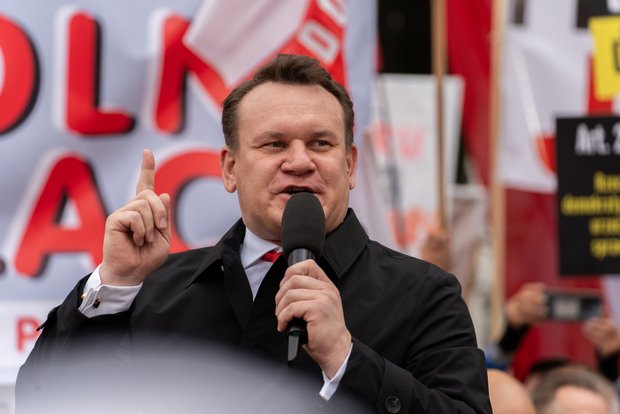
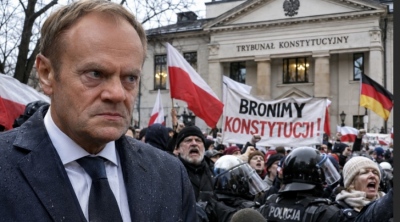
Dominik Tarczyński
The night of October 30: Police at the Constitutional Tribunal and coup allegations
The crisis peaked on October 30, 2026, when Judge Anna Korwin-Piotrowska announced the suspension of duties, for one month, of the President of the Constitutional Tribunal Bogdan Święczkowski and Vice President Bartłomiej Sochański.
She assumed management of the institution, arguing that the leadership until then had obstructed its functioning and the assumption of duties by judges who had been elected by parliament.
The decision was immediately rejected by the previous leadership, which questioned its legality and accused those involved of an attempted unlawful seizure of the Tribunal.
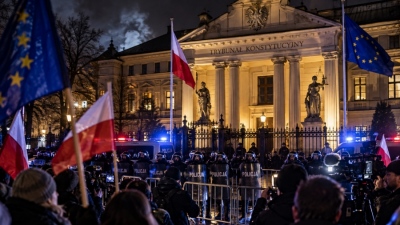
The presence of police forces around the building, gatherings of opposition supporters, and mutual contestation of judicial authority created a picture of an unprecedented institutional clash.
The President of the country, Karol Nawrocki, who was en route to Senegal for an official visit, cut short his journey and returned urgently to Warsaw.
His move demonstrated the gravity with which the presidency views developments.
Nawrocki described the actions against the previous leadership of the Tribunal as a forced takeover of the institution and demanded the restoration of constitutional order.
On the other side, Donald Tusk maintained that his government is seeking the restoration of the rule of law and the eradication of interference that, according to its assessment, took place under the governments of PiS.
The essence of the crisis is that two rival political and institutional camps are simultaneously claiming legitimacy for their decisions, without a mutually accepted mechanism to resolve the dispute.
Why the Constitutional Tribunal constitutes the real stake
The Polish Constitutional Tribunal holds the competence to review the compatibility of laws with the Constitution.
Its rulings can determine the fate of critical governmental reforms.
Precisely for this reason, control over its composition and administration has become a central battleground.
The current government holds a parliamentary majority, but President Karol Nawrocki, politically affiliated with PiS, can exercise a veto or refer legislation for constitutional review.
The confrontation has a long history.
It began in 2015, when appointments of judges by successive parliamentary majorities created disputes over the lawful composition of the Tribunal.
The governments of PiS were accused by European institutions of undermining the independence of the judiciary.
After assuming power in 2023, Tusk pledged to overturn the controversial reforms.
However, his own attempt to restore legality has led to new clashes regarding the limits of executive power.
In 2026, parliament elected new constitutional judges, but Nawrocki refused to accept the swearing-in of several of them.
Conflicting legal interpretations, interventions by European bodies, and ultimately the open conflict of October ensued.
The outcome is a Constitutional Tribunal whose legitimacy, leadership, and ability to issue mutually recognized rulings are contested.
And this creates an exceptionally serious problem: when the very institutions tasked with resolving constitutional disputes become the subject of the dispute, political conflict risks degenerating into generalized institutional paralysis.
The zloty, the euro, and the clash over economic sovereignty
The accusation by Dominik Tarczyński carries particular weight because it touches upon one of the most sensitive issues in Polish politics: the preservation of the national currency.
Poland, although a member of the European Union, continues to use the zloty.
This choice allows the country to maintain its own monetary policy, with its central bank determining interest rates and managing monetary stability.
Accession to the Eurozone would entail the transfer of significant monetary competences to the European Central Bank.
For supporters of the euro, such a transition could enhance economic integration and reduce transaction costs.
For its critics, however, it would limit national capacity to handle economic crises.
Tarczyński frames this debate within a broader scenario of German influence, arguing that control of the Constitutional Tribunal could facilitate the promotion of changes that currently face institutional barriers.
There is, nevertheless, a fundamental distinction: accession of Poland to the Eurozone cannot simply arise from changing the leadership of a court.
It requires legal adjustments, compliance with specific economic criteria, and participation in European procedures.
The European Central Bank itself, in its convergence report of June 2026, pointed out that the legislation of Poland had not yet been fully harmonized with the requirements for adopting the euro.
The central political question, therefore, is not only whether Poland will eventually join the Eurozone, but who will decide, with what democratic legitimacy, and with what guarantees for the national economy.
Migration and allegations of pressure from Berlin
The second major issue highlighted by the Polish MEP concerns migration.
Tarczyński accuses Germany of desiring to share the burden of managing migration flows and of viewing Poland as a potential recipient of more migrants.
The issue is particularly sensitive for Polish society, as the country is situated on the eastern border of the European Union, confronts migration pressures on the border with Belarus, and has hosted a large number of refugees from Ukraine.
Concurrently, migration policy represents a perennial field of friction between national governments and European institutions.
Brussels: The stance of the Commission and the reactions of European Conservatives
The crisis in Poland has already moved to European institutions, where reactions reflect deep political disagreements over the rule of law.
The European Commission argued that the election of new judges constitutes a constitutional competence of the Polish parliament and pointed to relevant rulings of the European Court of Human Rights.
The European Court had requested in May 2026 that the assumption of duties by the judges elected in March not be impeded.
Correspondingly, the Venice Commission had questioned the ability of the president to indefinitely block the assumption of duties by lawfully elected judges.
On the other side, the European Conservatives and Reformists (ECR) group condemned the governmental actions, arguing that they undermine judicial independence and constitutional safeguards.
The co-chairman of the group, Nicola Procaccini, called on European bodies not to overlook developments due to political alliances.
Here a critical question arises regarding the credibility of European institutions.
The European Union has repeatedly intervened in disputes with member states regarding the independence of the judiciary, the protection of the Constitution, and the separation of powers.
For its intervention to be convincing, however, it needs to rely on uniform rules, regardless of the political identity of any given government.
The opposition in Poland denounces that Brussels treats Donald Tusk more favorably due to his pro-European orientation.
The return of Nawrocki and the fracture in the governing camp
The developments of October 31 brought new political momentum to the crisis.
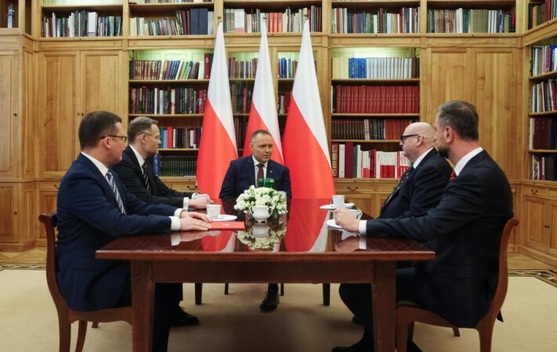
President Karol Nawrocki convened emergency consultations with representatives of parliamentary forces, seeking a way out of the institutional deadlock.
The refusal of Donald Tusk to participate in the discussions, combined with the presence of representatives from other coalition parties, highlighted the difficulties of achieving a unified political line.
The ruling coalition consists of political forces with differing ideological starting points.
A prolonged constitutional crisis could test its cohesion, particularly when the debate shifts from reforms to the legality of governmental actions themselves.
Within the opposition, former Prime Minister Mateusz Morawiecki is promoting the idea of a parliamentary initiative against the government and a transitional cabinet that could guide the country toward the elections of 2027.
At the same time, allegations were publicized regarding a police directive ordering heightened operational readiness for early November.
Lawmakers Sławomir Mentzen and Przemysław Wipler linked the document politically to the crisis at the Constitutional Tribunal.
Police leadership, however, denied this connection, asserting that the measures related to broader sabotage and security risks.
The existence of operational readiness, on its own, does not prove a coup plan.
The fact, however, that even security measures acquire conflicting political interpretations illustrates how deeply trust between government, presidency, and opposition has fractured.
The elections of 2027 and the battle for the future distribution of power
Beyond immediate developments, the confrontation acquires particular significance ahead of the parliamentary elections of 2027.
Control over judicial review can affect the ability of any government to implement its program.
For PiS, the stake concerns preserving institutional checks against the Tusk government.
For the governing coalition, it concerns restoring functionality to a Tribunal whose independence has been contested for more than a decade.
This explains why the conflict has taken on the characteristics of a struggle for state power itself.
The historical experience of Poland makes such confrontations even more emotionally charged.
The country has experienced foreign interventions, loss of independence, Nazi occupation, and decades of communist rule under Soviet influence.
The historical memory of the Solidarity movement, Lech Wałęsa, and the confrontation with the regime of Wojciech Jaruzelski continues to carry special weight in public life.
This is why referencing foreign influence does not serve merely as a foreign policy argument.
It touches a deeper debate regarding national independence and the historical identity of the country.
Connecting the current government with regimes of the past remains, however, a political analogy and does not constitute proof that conditions are institutionally or historically equivalent.
Poland as a test for the future of European sovereignty
The dispute in Poland fits into a broader European debate over where the competences of national governments end and those of supranational bodies begin.
In Hungary, Romania, Slovakia, and other countries, political and institutional clashes of varying character have occurred, often accompanied by confrontations with Brussels.
These cases do not prove the existence of a unified destabilization plan.
They highlight, however, the tension between differing conceptions of national sovereignty, European integration, and democratic accountability.
The discussion has also been influenced by the interventions of American officials.
The Vice President of the USA, JD Vance, has publicly criticized European practices that, in his view, restrict democratic expression and overlook voter concerns.
However, assessing Polish events requires examining specific constitutional acts, rather than automatically integrating them into an overarching geopolitical clash.
Poland is one of the most important nations on the eastern flank of the European Union and NATO.
The size of its economy, its geographical position, and its role in European security lend broader interest to its internal developments.
Its relationship with Germany also carries distinctive economic and historical weight.
Therefore, an allegation attributing to Berlin an effort to influence Polish constitutional developments cannot be regarded as insignificant.
www.bankingnews.gr






Readers’ Comments