

Mohammad Bagher Ghalibaf, speaker of the Iranian Parliament, demonstrated that the American economy faces a geopolitical trap
On September 16, 2026, the day the Federal Reserve raised interest rates, an Iranian politician posted a mathematical equation on social media. That politician is Mohammad Bagher Ghalibaf, speaker of the Iranian Parliament. Millions of people saw the post, but most did not understand what they were looking at. The equation was a copy of the mathematical formula used by American central bankers to decide whether to raise or lower interest rates. Ghalibaf had slightly modified the formula, adding two new variables, each bearing the name of a maritime chokepoint controlled by Iran and its allies. Although the post was obviously an ironic jab at the US administration, it was not necessarily a joke. It was a message about who determines the cost of money in America, namely the cost of your mortgage, your car loan, and the diesel fuel consumed by trucks supplying grocery stores. One week after Ghalibaf's post, the price of diesel reached $6.53 per gallon, the highest price ever recorded in the United States. To understand his message, we must first understand the formula he used as a propaganda weapon, highlighting geopolitical interest rates.
The mathematical formula
In 1993, Stanford economist John Taylor formulated a rule for central banks. It became known as the Taylor Rule and has since been used by central bankers and Wall Street. The rule asks two questions. First, are prices rising faster than the central bank desires? Second, is the economy moving at a pace faster than normal? If the answer to either question is yes, the rule suggests raising interest rates. If no, it suggests lowering them. For instance, the formula is as follows: i = r* + π + 0.5(π − π*) + 0.5(y − y*). In plain English: Interest Rate = Neutral Rate + Inflation + ½ × (Inflation - Target) + ½ × (Economic Activity Gap). Interest rate: the rate the central bank should set. Neutral rate: the intermediate interest rate level that neither accelerates nor slows down the economy. Inflation: the rate at which prices are currently rising. Target: the price growth rate sought by the central bank, usually 2% annually. Economic activity gap: indicates whether the country is producing and selling more than its economy can smoothly support or less. In the first case, businesses struggle to meet demand. In the second, they scale back activity and workers lose jobs. If all this sounds complicated, do not worry. The logic is simple: when prices rise too fast, the Federal Reserve raises interest rates, making borrowing more expensive. When borrowing costs more, households and businesses borrow less and cut spending, leading to the cooling of price growth. Ghalibaf kept all this in his equation, but added two more terms. He named the first "SOH," standing for the Strait of Hormuz, and the second "BEM," for Bab el-Mandeb, the narrow passage at the southern tip of the Red Sea. Ironically, he named the modified equation the Straits Taylor Rule. Beneath the formula, he wrote: "You cannot cut by 25 basis points a strategically important maritime point," defining Taylor Rule mechanics.

What does it all mean?
Part of today's high oil price stems from fear arising from mounting risk, known as the risk premium. Buyers pay extra for every barrel because they do not know whether the Strait of Hormuz will remain open the next day. Iran controls this fear and consequently influences the additional cost it generates. This is the Hormuz risk premium Ghalibaf refers to. As he states: "We determine it." What, then, is the connection between the Hormuz risk premium and Ghalibaf's claim that Iran can now influence the direction of US interest rates? The answer is simple: higher oil prices mean higher prices for almost all goods. The Federal Reserve raises interest rates to curb inflation, assuming price rises stem from excessive liquidity and cheap borrowing channeled into the economy. However, when inflation is driven by high energy prices due to oil supply restrictions, raising interest rates does not address the root cause. If the Fed raises rates every time oil prices spike to fight inflation, as the Taylor Rule dictates, whoever controls oil prices gains leverage over the Fed. And the cheapest way for Iran to influence oil prices is by making transport difficult. This is what Ghalibaf meant when he wrote: "You cannot cut by 25 basis points... a strategic maritime point." Essentially, he argued that because Iran influences the price of oil, it also influences inflation, thereby stripping power away from the Federal Reserve. The Fed uses a tool designed to tackle excessive borrowing to combat a problem caused by insufficient oil supply, shaping oil price leverage.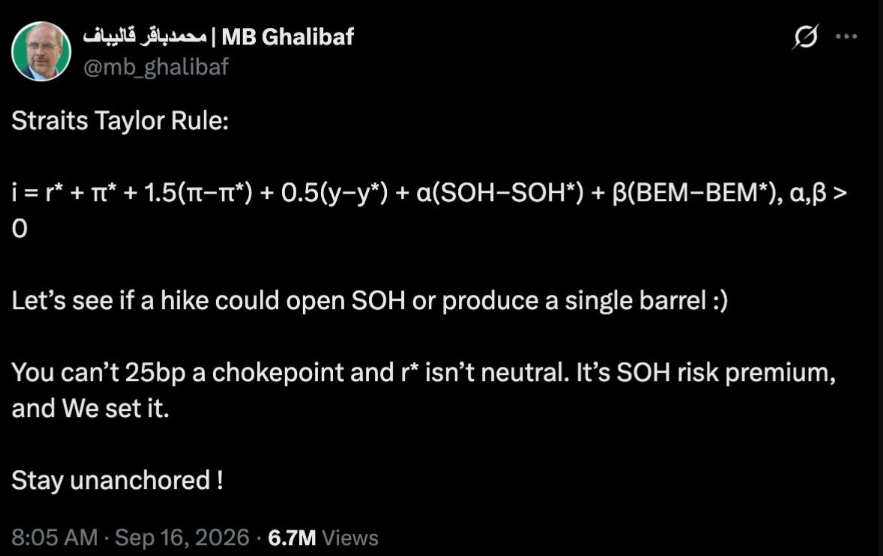

Let us examine what has happened up to today. Before the Fed's rate decision on September 16, tankers were attacked in and around the Strait of Hormuz, while a Saudi Arabian refinery in Jizan was also hit. The pro-Iranian Houthi militia seized the coastline along Bab el-Mandeb, making that passage closed as well. These are the two maritime routes Ghalibaf added to his equation. Together they control both the main exit from the Gulf and the primary alternative route. Hormuz is the only maritime outlet from the Persian Gulf. The most important alternative is a Saudi oil pipeline transporting oil across the desert to the Red Sea. Tankers subsequently carrying this oil toward Asia must pass through Bab el-Mandeb. Whoever controls both straits can block the main and alternative exits simultaneously. Here lies the critical point. Oil is refined and converted into diesel, which powers a large part of the American economy. Diesel-powered trucks transport roughly 73% of all freight in the United States. Before the war, diesel cost about $3.76 per gallon. The week of September 21, it reached $6.53, an increase of about 74%. Farmers are among the first to feel the impact. Tractors and combine harvesters run on diesel, while autumn, the current season, is the most demanding harvest period. The Persian Gulf also produces a large share of the world's fertilizers. Nearly a quarter of global urea production, the most common nitrogen fertilizer, moves through the Middle East. From February to April, urea prices surged by 80%. Aircraft use aviation fuel sourced from the same raw material. Jet fuel prices nearly doubled after the war began. By August, airline tickets were 23% more expensive compared to a year earlier. Why do all these matter? Factoring in the impact brings us to August inflation figures. Economy-wide prices were up 3.4% from a year earlier. Energy prices had surged by 16%, impacting maritime choke points.


At this point, the Taylor Rule does exactly what it was designed to do. Prices are rising faster than the Fed desires, so the rule signals a rate hike. On September 16, 2026, the Fed did just that, raising rates for the first time since 2023. This is the trap Ghalibaf referred to. Raising interest rates works by restricting borrowing and spending. Yet Americans are not paying more for diesel because credit markets offer excessively cheap money. They are paying more because oil cannot exit the Persian Gulf. In other words, the Fed is once again using a tool designed to fight excessive borrowing to combat a problem caused by insufficient oil supply, driving inflationary monetary traps.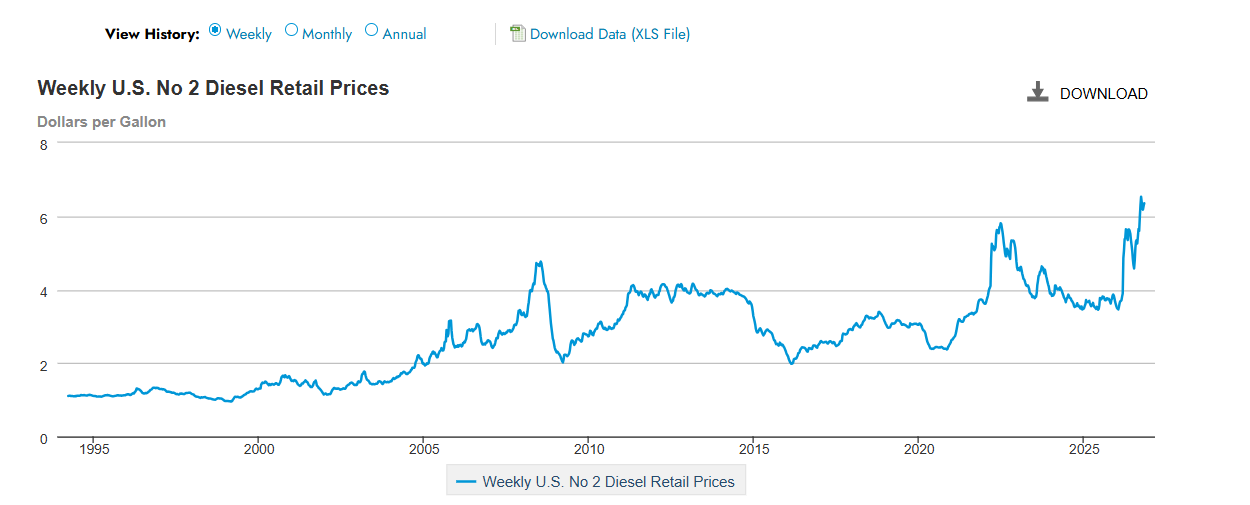
Stage two: High prices lead to rate hikes
Rate hikes do not resolve the oil shortage, but they affect every borrower in the country. On February 26, 2026, two days before the war began, the average interest rate on a 30-year fixed mortgage in the US was 5.98%. It was the first time in three and a half years it had dropped below 6%. By September 24, it reached 7.03%. Let us see what this means for a real family. For a $400,000 mortgage, the monthly payment at a 5.98% rate is about $2,393. At a 7.03% rate, it reaches about $2,669. The difference is $276 a month, or over $3,300 a year, for the exact same home. The same applies to car loans, business loans, and credit cards. Thus, a family already paying more for diesel, food, and airfare is now called upon to pay more for borrowing as well, shaping mortgage payment spikes.
Stage three: Rate hikes hit citizens' wallets
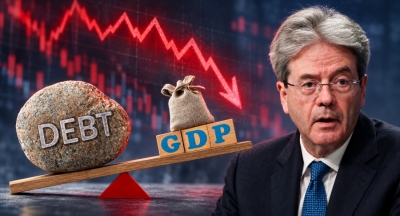
The largest borrower in America is the US government itself. When the government spends more than it collects through taxes, it borrows the difference, doing so by issuing debt securities called US Treasury bonds. A bond is a promise: you lend money to the government today, and it commits to returning it later while paying interest. On September 21, 2026, US public debt stood at roughly $40.1 trillion. Every rate hike makes borrowing more expensive. The cost is already immense. During the first eleven months of fiscal year 2026, the United States spent about $1.05 trillion on debt interest payments. For defense spending during the same period, it allocated just $833 billion. America now spends more servicing its debt than on its defense, highlighting national debt interest costs.
Stage four: Rate hikes damage public finances
Historian Niall Ferguson has given this phenomenon a name: Ferguson's Law. According to him, when a state spends more servicing debt than on defense, it signals the decline of its imperial power. Spain crossed this threshold in the 16th century, France in the 1780s right before the revolution, the Ottoman Empire in the 1870s, and Britain between the two world wars. All were great powers, and all soon lost their power after beginning to spend more on debt service than on defense. Under Ferguson's calculation, the United States crossed that same threshold in 2024. Where this sequence leads: let us trace the steps cyclically. Iran makes oil transport difficult. Expensive oil turns into expensive diesel. Expensive diesel fuels inflation. Inflation pushes the Fed to raise interest rates. Higher rates make public debt more expensive, forcing the government to borrow even more just to pay its interest. At some point, the Fed must choose how this cycle ends. It can keep raising rates until something breaks—the housing market, the stock market, or even the bond market. Or it can stop hiking while prices are still climbing and print money to fund its needs when other countries stop buying its bonds. The second option protects the bond market but reduces the value of the dollar and accelerates price growth even further. This is Iran's bet, and it is a serious one, redefining imperial power decline.
Return to the equation
Let us return to Ghalibaf's equation. His two additions, SOH and BEM, only matter as long as global oil is forced to transit through those two straits. The entire American plan aims to render these energy passages insignificant, and it remains doubtful whether it will succeed. The Fed will make its next decision on December 8-9, 2026. Watch the Persian Gulf and the Red Sea in the weeks leading up to it. If a tanker is hit or a pipeline disrupted and oil prices spike right as the Fed meets to vote, you will know Ghalibaf's equation is still operating, cementing geopolitical energy risks.
www.bankingnews.gr



Readers’ Comments