

Shoving at the entrance of the Constitutional Court, allegations of a «coup», and a police alert. Karol Nawrocki cut short his flight to Senegal and returned to Warsaw. Donald Tusk backs the change in judicial leadership, while an order placing submachine-gun units on alert ignites fresh political conflict. What is confirmed and how authorities respond.
The morning of October 31, 2026 finds Poland at the center of an unprecedented institutional and political crisis, following an eventful night at the Constitutional Court of the country.
Shortly before 5:00 in the morning, departing from the Court building, President Karol Nawrocki (via the head of his office, Paweł Szefernaker) issued an official statement condemning a «violent seizure of a constitutional body», calling urgent consultations for today, October 31, with representatives of all parliamentary forces aimed at restoring constitutional order.
The President demanded the immediate withdrawal of police forces from the building and stated that he permitted Bartłomiej Sochański (deputy to the ousted Bogdan Święczkowski) to enter the premises.
Prime Minister Donald Tusk again defended the actions, stressing that restoring the rule of law after the years of PiS governance is a «difficult and painful process» requiring determination.
The government side (through judge Maciej Berek) released video footage of the nighttime entrance of Karol Nawrocki, accusing him of shoving judges.
From the side of the presidency, it is maintained that the President was unlawfully obstructed from entering the building.
Jakub Kumoch tendered his resignation in the morning from the position of Ambassador of Poland to China.
As former president Andrzej Duda revealed, Jakub Kumoch refused to transmit the diplomatic note of the government to foreign authorities regarding the events at the Court, deeming it inaccurate.
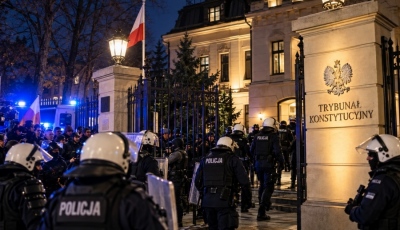
Protesters and officials from the opposition (PiS) remain gathered outside the building, while police maintain strong forces.
The three arrests during the night and reports of standby orders for police reserves keep the political thermometer at boiling point.
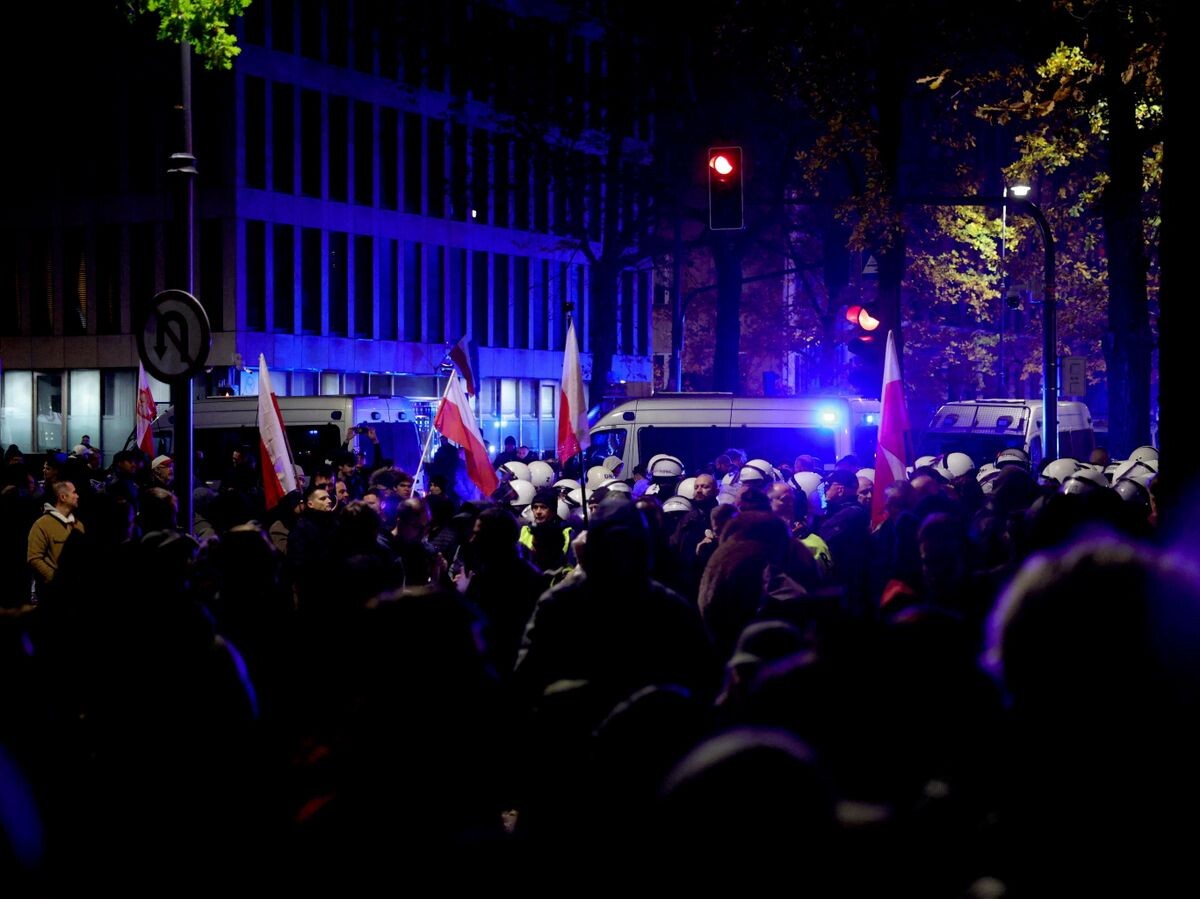
The Polish crisis transitioned from courtroom chambers to the entrance of the Constitutional Court.
The disputed suspension of duties of its leadership, the deployment of police forces, and the nighttime intervention of President Karol Nawrocki brought two camps into conflict, both invoking the same principle: defending the Constitution.
At the same time, videos from the entrance of the building capture shoving matches between the president and judges, with both sides trading accusations over the incident.
The political stake is larger than who will occupy the office of the Court president.
It is the clash between the government of Donald Tusk and the presidency over the control and legitimacy of an institution situated for years at the epicenter of the rule-of-law dispute.
The decision that lit the fire
The escalation began on Friday, October 30.
Anna Korwin-Piotrowska announced the suspension of duties of President Bogdan Święczkowski and Vice President Bartłomiej Sochański and her assumption of the administration of the institution.
The relevant order stipulates a one-month suspension of duties. Consequently, this does not constitute an undisputed, permanent dismissal and replacement of the leadership.
The very capacity to issue such an order lies at the core of the conflict.
The Bogdan Święczkowski camp rejects its legality, while judges supporting it invoke the necessity of restoring Court operations.
The confrontation also concerns who is entitled to exercise judicial duties.
Judges elected by the parliamentary majority were not accepted by the incumbent leadership, centered also on the dispute surrounding their swearing-in before the president.
Karol Nawrocki turned the plane around and headed to the Court
The Polish presidency confirmed that Karol Nawrocki cut short his flight to Senegal due to the developments.
He returned to Warsaw and, during the night, proceeded to the Constitutional Court.
His entry was accompanied by physical confrontation.
Judge Maciej Berek accused the president of assaulting judges.
The presidential side, conversely, maintained that an unlawful attempt was made to block his entry and that his personal inviolability was breached.
These conflicting allegations must not be confused with judicially established liability.
In his official statement, dated October 31, Karol Nawrocki denounced a violent seizure of a constitutional body, demanded the departure of coercive forces from the premises, and announced urgent consultations with representatives of parliamentary forces to stabilize the situation.
Police cordons, protesters, and arrests
Protesters and opposition politicians gathered outside the Court.
According to the Associated Press, certain demonstrators breached the perimeter fence and threw objects at police officers, resulting in three arrests.
Police maintained that they deployed in the surrounding courtyard without entering the building.
According to their official version, this followed a request by Anna Korwin-Piotrowska, who warned of potential risks to the life and health of judges and employees, as well as disturbances to public order.
What is happening with the submachine-gun order
Within this climate, a document dated October 29, signed by Deputy Police Chief Tomasz Michułka, was publicized.
It provides for full combat readiness for specific units of the central police reserve from November 2 to November 8.
The prescribed equipment includes submachine guns, bulletproof vests, helmets, and riot-control gear.
This does not, therefore, represent a substantiated order for the immediate arming of all patrols with «machine guns», as certain translations might imply.
Police leadership acknowledged the document, but dismissed any connection to the Constitutional Court.
According to their explanation, the readiness pertains to threats of sabotage and subversion.
Donald Tusk defends the intervention, opposition decries deviation
Prime Minister Donald Tusk defended the government effort as a restoration of the rule of law following the governance of the Law and Justice party (PiS), arguing that decisive measures are required.
The leadership of PiS, conversely, views the developments as an assault on constitutional order.
Sławomir Mentzen called for convening the National Security Council and consultations among political party leaders, arguing that the country stands on the threshold of a coup.
The clash that did not end in 2015
Today's explosion originates in the dispute over the composition of the Constitutional Court in 2015.
The government of Donald Tusk, taking office in 2023, promised reforms to restore judicial independence.
The presidency and the opposition dispute critical choices in this process, generating a protracted institutional deadlock.
The next test is whether urgent consultations will lead to de-escalation and an acceptable dispute resolution process.
Until then, the central question remains open: who can restore the functioning of the Constitutional Court when rival sides do not recognize the legitimacy of one another?
Why is this happening in Poland? The core of the conflict: Dual power and constitutional paralysis
The problem in Poland is not merely a political dispute, but a state of «dual legitimacy».
During its eight-year rule (2015–2023), the PiS party installed its own judges in the Constitutional Court, establishing a stronghold of power.
The pro-European government of Donald Tusk considers these appointments unlawful and seeks to nullify them, while the Presidency (Karol Nawrocki) utilizes presidential powers to block government initiatives.
The result is an absolute institutional deadlock, where neither side recognizes the rulings of the other, reaching all the way to the doors of the Court with police present.
How East and West view events in Poland: Three different perspectives...
1st. In Brussels and Western capitals, the attempt by the government of Donald Tusk to purge judges appointed during the tenure of the right-wing conservative Law and Justice party (PiS) is theoretically viewed as an essential step toward restoring democratic legitimacy and unlocking European funds.
However, European think tanks warn that employing controversial or extreme administrative measures (such as suspension of duties backed by police presence) threatens to slide into a «reverse revanchist coup», undermining the very confidence in institutions that the government pledges to reform.
2nd. Russian state media and analysts (such as RIA Novosti and TASS) present the events in Warsaw as clear proof of the «hypocrisy of the Western model» and the «collapse of Western democratic standards».
Moscow projects imagery of police cordons and scuffles at the Constitutional Court to argue that Poland (one of the most hardline allies in NATO) finds itself in a state of domestic political chaos.
In parallel, Russian circles (such as Kirill Dmitriev) point out that internal strife in Warsaw exposes a weak and divided leadership attempting to mask domestic deadlocks with aggressive anti-Russian rhetoric.
3rd. Chinese and Asian analysts view the Polish crisis as a symptom of deep structural polarization plaguing Western democracies, exposing institutional instability on the eastern flank of NATO.
Poland, as the central pillar of the eastern defensive posture of the West, appears institutionally paralyzed: the President of the Republic and the Prime Minister are locked in open «warfare», obstructing decision-making at an exceptionally critical juncture for the war in Ukraine.
www.bankingnews.gr








Readers’ Comments