

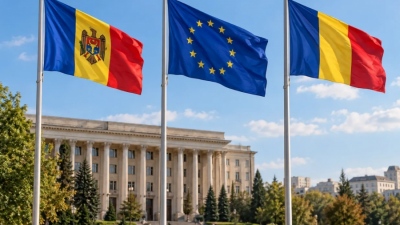
A striking geopolitical scenario re-emerges, with Moldova examining the possibility of unification with Romania as an alternative route to the European Union. Romanian Prime Minister Luca Niculescu leaves the possibility open, while President Maia Sandu has already stated she would vote in favor of unifying the two countries
The discussion regarding the future of Moldova acquires new momentum as the prospect of a historic union with Romania returns to the European spotlight. According to a report in The Economist, a potential "Plan B" could gain greater significance if the process of Moldova's independent accession to the European Union encounters delays or confronts severe obstacles. The scenario involves the unification of Moldova with Romania, which has been a European Union member state since 2007. However, it does not constitute an officially agreed plan between the two governments, directly impacting Eastern European geopolitics.
Paving the way for historic unification? Luca Niculescu's statement
On October 27, 2026, Prime Minister of Romania Luca Niculescu, speaking to TVR Moldova, clarified that prospective unification depends on the will of citizens in both countries. He emphasized that Bucharest's current priority centers on reinforcing ties with Chișinău and deepening Moldova's alignment with the European Union. The statement was not accompanied by a specific timeline or unification procedure; nevertheless, it maintained an open political dialogue regarding a potential historic transformation, reshaping Romanian Moldovan relations.
Maia Sandu throws her weight behind unification
The issue had acquired substantial weight as early as January 2026, when Moldovan President Maia Sandu declared that she would vote in favor of unification with Romania if a referendum were conducted. Her statement sparked widespread discussions concerning the future of Moldovan statehood and the nation's relations with Russia. Nonetheless, Maia Sandu acknowledged that a societal majority supporting unification does not exist today, pointing out that independent accession to the European Union remains the most realistic goal, influencing European integration paths.
Geopolitical earthquake on Europe's eastern border?
A potential unification of Romania and Moldova would generate major political, legal, and geopolitical questions. Romania is a member of both the European Union and NATO, whereas Moldova maintains a constitutionally enshrined status of neutrality. Concurrently, the unresolved issue of Transnistria and the presence of Russian military forces in the region introduce an additional layer of complexity. Unification would not automatically equate to a simple administrative procedure for joining the European Union, as it would demand intricate constitutional, political, and international settlements, affecting NATO regional stability.
The grand dilemma: Independent Moldova or unification with Romania?
"Plan B" poses a fundamental question regarding the country's destiny: will Moldova continue to pursue European integration as an independent sovereign nation, or could it eventually choose unification with Romania? For the time being, official policy across both governments remains focused on strengthening bilateral cooperation and supporting Moldova's European trajectory. Yet the prospect of unification remains an active component of public discourse, highlighting how closely Moldova's future connects to broader balance of power dynamics across Eastern Europe, defining European border revisions.
www.bankingnews.gr




Readers’ Comments