

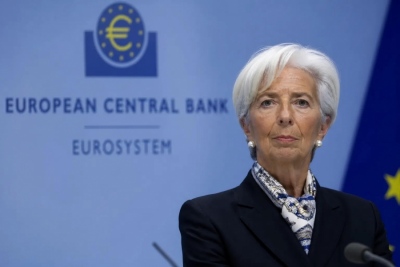
An alarm signal for the future of the European economy was sounded during her swan song as European central banker by Christine Lagarde...
As she pointed out, the simultaneous pressure from runaway energy prices and persistent inflation forms a dangerous cocktail, threatening the well-being of millions of citizens.
This dual threat establishes a new reality of increased uncertainty and challenges for the entire European Union.
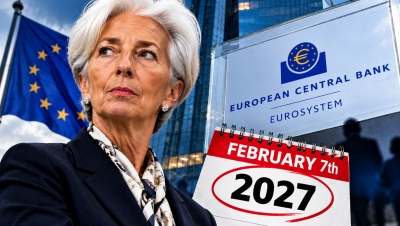
It should be noted that Lagarde will step down from the presidency of the European Central Bank (ECB) on February 7, 2027, approximately nine months before the completion of her eight-year term, as the Central Bank announced on Thursday, October 29.
Her early departure paves the way for the launch of a particularly significant succession process, with European governments called upon to select the next leader of one of Europe's most powerful institutions, during a period of economic stagnation and intense international uncertainty.
The decision on her successor will be made by the 21 countries that have adopted the euro.
The announcement came just hours before the decision of the ECB to keep the deposit facility rate unchanged at 2.5%.
At the same time, turmoil in the French bond market is weighing on borrowing costs across the entire Eurozone.
I have just informed my colleagues that I will step down as @ECB President on 7 February 2027. It has been a source of great pride to serve this institution. I thank all of those who have supported me on this journey over the past seven years. https://t.co/eSLLTaDAej
— Christine Lagarde (@Lagarde) October 29, 2026
Lagarde wore two bandages on her face in her video message, which, as she stated, was due to «minor surgery earlier in the week».
She added: «Follow doctor instructions and check your skin regularly».
What Lagarde stated
According to Lagarde, the Governing Council of the European Central Bank (ECB) decided to keep the three key interest rates unchanged, as the fresh rise in energy prices intensifies risks to inflation and dampens the economic outlook.
Although the effects of the energy shock have not yet fully materialized, underlying inflation remains broadly stable so far and wages have not shown substantial reactions. However, the intensity and duration of the energy crisis could lead to further price increases and weaker economic growth. At the same time, financing conditions have tightened since the previous meeting of the ECB, a development expected to exert additional pressure on economic activity and inflation. The primary priority of the central bank remains stabilizing inflation at 2% over the medium term.
The ECB considers itself in a position to handle increased uncertainty by maintaining a flexible stance and evaluating incoming data on a meeting-by-meeting basis. Interest rate decisions will continue to depend on the inflation outlook and accompanying risks, taking into account the latest economic and financial data, the trajectory of underlying inflation, and the strength of monetary policy transmission. The central bank is not pre-committing to a specific rate path.
Economic activity
Available data indicate that the economy of the Eurozone continued to expand in the third quarter of the year. The services sector rebounded following the slowdown recorded at the onset of the conflict in the Middle East, while manufacturing, digital services, and exports are being boosted by business investments linked to artificial intelligence. Public spending on infrastructure and defense has also contributed positively to economic activity and is expected to continue supporting growth in the near term. However, fresh increases in energy prices have dampened consumer confidence, while higher financing costs create additional headwinds for the economy.
The unemployment rate remained at 6.4% in August. At the same time, growth in both employment and the labor force remains subdued, although productivity shows gradual improvement.
Over the medium term, the recovery of confidence and real incomes is expected to support domestic demand. This development will depend, among other factors, on the gradual de-escalation of energy prices and the preservation of a resilient labor market. Concurrently, investments related to artificial intelligence, as well as public spending on infrastructure and defense, are projected to continue sustaining economic activity. Export growth is also expected to accelerate thanks to strengthening foreign demand.
The ECB emphasizes that enhancing potential growth requires structural reforms and sound public finances, with fiscal sustainability serving as a cornerstone for broader economic stability. Support measures adopted in response to the energy shock should be temporary, targeted, and tailored to the needs of the economy. In parallel, simplifying and harmonizing regulations across the single market of the European Union, accelerating the green transition, and completing the savings and investments union are considered indispensable prerequisites for a more dynamic and resilient European economy. As negotiations on the legal framework for the digital euro enter their final stretch, the ECB reiterates the necessity of reaching an agreement on the single currency package as swiftly as possible.
Inflation
Inflation in the Eurozone rose to 3.8% in September, up from 3.2% in August, primarily driven by the sharp surge in energy prices. Energy inflation reached 18.9%, compared to 14.3% the previous month, while diesel and gasoline prices hit new highs, partly reflecting increased refining margins. Inflation excluding energy rose to 2.3%, from 2.1% in August. Food inflation also moved upward to 1.3% from 1.1%, while services inflation increased to 3.2% from 3%. Conversely, goods inflation eased to 1.1%, compared to 1.2% in the previous month.
Measures of underlying inflation remained broadly stable, though data from the early stages of the pricing chain point to building upward pressures. Wage pressures remain moderate: compensation per employee grew by 3.3% in the second quarter, compared to 3.6% in the first quarter. In parallel, productivity gains helped contain unit labor cost growth.
The wage tracker of the ECB indicates that negotiated wage growth will hover between 2.5% and 2.8% over the remaining months of 2026, with an average growth rate of 2.6% projected for the first three quarters of 2027. Short-term inflation expectations have picked up, yet most measures of longer-term expectations continue to stand around 2%, a factor supporting its stabilization near the target of the ECB over the medium term.
Energy prices have already exceeded the levels projected in the staff macroeconomic projections of the ECB in September. This development is expected to further stoke inflation in the near term and keep it significantly above target over coming quarters. At a later stage, the moderation of energy inflation, combined with the impact of higher interest rates, is expected to bring inflation back to target.
Risk assessment
Risks to economic growth prospects remain tilted to the downside, primarily due to the conflict in the Middle East and recent developments in the war of Russia against Ukraine, which the ECB describes as unjustified. A prolonged disruption to energy supplies could lead to even higher energy prices for a longer period than anticipated, squeezing real incomes, consumption, and investment.
Furthermore, a deterioration in sentiment across international financial markets or amplified spillover effects in global bond markets could further tighten financing conditions and suppress demand. Fiscal uncertainty may also raise funding costs and undermine confidence, negatively impacting consumption and investment. Concurrently, a renewed escalation of trade tensions among major economies could disrupt supply chains, restrict exports, and dampen economic activity.
On the other hand, growth could turn out stronger than anticipated if the economy and energy markets adjust more rapidly to disruptions caused by ongoing conflicts, or if conflicts are resolved on a sustainable basis. Additional impetus could stem from the adoption of new technologies by firms across the Eurozone, public investments in infrastructure and defense, and reforms that bolster productivity and foster deeper integration of the single market of the EU.
For inflation, risks are conversely tilted to the upside. The conflict in the Middle East and recent developments in the war of Russia against Ukraine could intensify the energy shock, while its pass-through to other prices and wages could prove stronger than initially estimated. In particular, natural gas prices could climb further in the event of new supply disruptions or if an unusually cold winter coincides with low storage levels.
The longer elevated energy prices persist, the greater the likelihood that they will pass through into headline inflation via indirect and second-round effects. Renewed trade tensions could also spur greater fragmentation of global supply chains, restrict access to critical raw materials, and exacerbate capacity constraints in the Eurozone. Furthermore, extreme weather events, potentially compounded by strengthening El Niño conditions and wider climate and nature crises, could drive food prices higher than expected.
Conversely, inflation could evolve lower if geopolitical conflicts are resolved sustainably or if indirect and second-round effects from rising energy prices prove milder than forecast. In addition, heightened financial market volatility and greater investor risk aversion, coupled with higher long-term interest rates, could curb demand and, by extension, inflationary pressures.
Financial and monetary conditions
Financial conditions in the Eurozone have tightened since the previous meeting of the ECB. Interest rates have broadly moved higher, while equity prices have declined.
Market-based corporate borrowing costs climbed to 4.1% in August, from 4% in July, while bank lending rates to non-financial corporations held steady at 3.8%. Meanwhile, the annual growth rate of bank loans to firms slowed to 4.2% in August and September, from 4.4% in July. In contrast, corporate bond issuance accelerated, with the annual growth rate reaching 4.2% in September, compared to 3.8% in August and 3.5% in July.
Credit standards for business loans tightened in the third quarter, according to the latest Bank Lending Survey of the ECB. Banks attributed this development to concerns regarding economic risks faced by their clients. Despite higher financing needs to fund inventories and working capital, demand for corporate loans declined, largely driven by higher borrowing costs.
A similar burden is observed in the housing credit market. Mortgage interest rates rose to 3.6% in August, from 3.5% in July, while the annual growth rate of housing loans eased to 3% in September. Mortgage lending standards remained unchanged during the third quarter, but demand dropped noticeably as a result of higher interest rates.
Why she is stepping down
Lagarde stated that she is stepping down convinced that she accomplished her mission successfully and that she leaves the European Central Bank prepared to face future challenges.
The now former president of the ECB explained that she decided to depart prior to the conclusion of her term in order to gain greater freedom of expression and engage with issues beyond monetary policy.
As she reportedly indicated, she cannot remain neutral regarding developments unfolding in France and across the rest of the world.
The same sources added that Lagarde believes she can make a meaningful contribution in her capacity as a Frenchwoman, a European, and a citizen of the world.
Although the ECB provided no official explanation for the decision of Lagarde, scenarios regarding her early exit had been circulating for several months.
As Euronews reported in February, initial reports indicated that Lagarde was weighing an early departure so that French President Emmanuel Macron and German Chancellor Friedrich Merz would have the opportunity to designate her successor before the French presidential elections of April 2027.
Macron is barred from seeking a third presidential term, while the far-right Rassemblement National party records strong performances in opinion polls. The potential emergence of a Eurosceptic government in France could complicate the selection process for the next head of the ECB.
The departure of Lagarde in February 2027 therefore affords European leaders sufficient room to agree on her successor well before French voters head to the polls.
A similar move was made in February by the governor of the Bank of France, François Villeroy de Galhau, who announced he would step down early, reportedly spurred by comparable motives.
Lagarde, however, kept her own plans shielded from the public eye for several months.
That same month, she stated that the presidency of the World Economic Forum, the organization hosting the annual Davos summit, represented one of the potential options for her future. In July, in an interview with Euronews, she clarified that she was not a candidate for any post, seeking to put an end to speculation regarding potential participation in French elections.
The leading candidates for the succession
At the center of discussions regarding the succession of Lagarde stand two figures at present.
Pablo Hernández de Cos, former governor of the Bank of Spain and head of the Basel-based Bank for International Settlements since 2025, was officially nominated by Madrid in July. This marks the first time that Spain has fielded a candidacy for the presidency of the ECB.
In early October, Hernández de Cos also secured the backing of Spanish opposition leader Alberto Núñez Feijóo, whose party leads in most polls ahead of snap elections scheduled for next month.
His principal rival is considered to be Klaas Knot, who helmed the Dutch central bank from 2011 to 2025. Knot, formerly branded an inflation hawk, is now regarded as a consensus builder. Lagarde herself has praised his capacity to foster cooperation, calling it rare and exceptionally necessary.
Among the names also circulating is the president of the Bundesbank, Joachim Nagel, although Germany has never held the presidency of the ECB to date.
However, the choice of the new president represents just one of the major changes anticipated at the helm of the central bank. Isabel Schnabel, member of the Executive Board of the ECB responsible for market operations, is scheduled to depart on January 3, 2027, to take up a post at the International Monetary Fund. Concurrently, the mandate of the chief economist of the ECB, Philip Lane, concludes on May 31, 2027.
These developments mean that half of the six members of the Executive Board, which is responsible for the daily operations of the ECB, will be replaced within a timeframe of just five months. Consequently, the three posts are expected to become the focus of broader negotiations among European capitals.
The deadline for Eurozone governments to submit nominations for the position of Schnabel was set to expire on Wednesday, but was extended to November 27. Although the Eurogroup issued no official announcement, a spokesperson confirmed the extension to media outlets.
France, Germany, and Italy have long maintained representation on the Executive Board, while Spain aims to regain a presence after losing its seat when the vice-presidency of the ECB passed this year to Croatian Boris Vujčić, who succeeded Luis de Guindos.
Germany is expected to seek retention of the portfolio overseeing market operations. Correspondingly, France is anticipated to seek the chief economist role rather than attempting to secure the presidency for a third time. As Carsten Brzeski, global head of macro at Dutch lender ING, noted to Euronews in February, France understands European balances well and is likely to avoid trying to install a third French president at the ECB.
Traditionally, each country holds only one seat on the Executive Board. This implies that if Klaas Knot secures the presidency of the ECB, his compatriot Frank Elderson may also have to depart from the Board.
www.bankingnews.gr








Readers’ Comments