

Grave suspicions over illegal funding aimed at influencing the electoral outcome
The case of potential foreign interference in the recent parliamentary elections is assuming serious proportions in Israel, as Central Elections Committee Chairman Noam Sohlberg requested internal security agency Shin Bet chief David Zini to investigate information regarding potential illegal funding aimed at influencing the electoral process. According to reports in Israeli media outlets, the countries under scrutiny regarding relevant suspicions are Qatar and Turkey. The allegations concern the potential channeling of significant sums of money from foreign actors to boost Arab voter turnout through illicit practices. However, to date, no official findings have been presented proving the involvement of Qatar or any other foreign state. Noam Sohlberg's order itself concerns investigating suspicions rather than confirming that electoral outcome tampering occurred.
The order to Shin Bet and the one-week deadline
Noam Sohlberg asked David Zini to deploy Shin Bet's authority to identify evidence that will confirm or refute information regarding foreign funding. In his letter, the Elections Committee chairman referred to grave suspicions of undue influence on the election via financing from foreign actors allegedly operating contrary to Israel's interests. Concurrently, he requested to be informed of any findings within one week, citing strict statutory deadlines provided for submitting election petitions. The case acquires particular gravity, as it concerns safeguarding the integrity of the voting process and the possibility that external factors attempted to alter the parliamentary political balance.
Qatar at the center of suspicions
Qatar sits at the center of reports linking the affair with possible funding to boost voter turnout in Israel's Arab sector. According to relevant reports, investigators are examining whether large sums of money were channeled to enhance Arab voter participation in the October 27, 2026 elections. Within the same context, Qatar's former prime minister reportedly publicly praised the performance of Arab political slates in the Israeli elections, placing particular emphasis on Ahmad Tibi. The post, according to the report, was subsequently deleted. Furthermore, a day prior to the election, Ahmad Tibi traveled to Qatar, officially to grant an interview to news network Al Jazeera. These incidents are cited in the public discussion surrounding the case without constituting in themselves proof of illegal funding or electoral process intervention.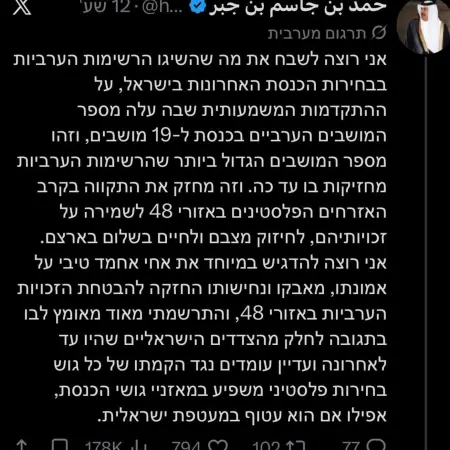
The rise of the Arab vote and the political contest
Suspicions of potential external interference emerge during a period of intense political realignments in Israel. Based on vote-count projections published during the tallying process, the Arab political parties Joint List and Ra'am were expected to capture a combined total of 19 seats in the 120-member Knesset. This development bolsters the role of Arab parties in negotiations over forming a government, as neither of the two main political blocs appeared to secure an outright parliamentary majority. The result has sparked intense political clash. Likud, the party of Benjamin Netanyahu, has raised allegations of electoral irregularities and requested an investigation by competent authorities. Conversely, political opponents of Netanyahu warn that allegations must not be used to challenge the legitimacy of Arab citizens' participation in parliamentary election processes.
Investigations into potential vote buying
Parallel to the broader probe into potential foreign financing, Israeli authorities are examining a separate case involving suspicions of attempted vote buying. According to reports, three individuals were arrested in southern Israel under suspicion of offering money to voters to support the Ra'am party, led by Mansour Abbas. Searches of their residences reportedly uncovered cash, ballots, and other items being examined as potential evidence in the case. The charges have not been proven in court, while those involved deny the infractions attributed to them. Their defense counsel offered alternative explanations for the funds, including covering travel expenses and charitable donations. Ra'am accused authorities of politically targeting its supporters. Simultaneously, according to relevant reports, investigations to date have not substantiated the broader scenario of organized voter fraud alleged by Likud, impacting electoral integrity probes.
Clarification of the case critical
The investigation ordered by Noam Sohlberg is expected to serve as a major test for Israeli authorities as they are called upon to determine whether real evidence exists linking foreign actors to illegal financing or attempts to influence the election. The distinction between political allegations and evidentiary material is critical, as it has not been proven that Qatar funded illegal actions or that the election result was altered. Attention now turns to the findings to be presented by Shin Bet, as these could influence both the public debate over election security and the already complex Israeli political landscape.
The official results
Israel's Central Elections Committee (CEC) announced on Wednesday afternoon that, with 89.8% of ballots counted, the coalition under Prime Minister Benjamin Netanyahu is expected to secure 53 seats in the 120-member Knesset, while the coalition led by Yashar party chief Gadi Eisenkot is projected to hold 48 seats. Both factions remain significantly short of the 61-seat threshold required to secure a parliamentary majority. At the same time, the two Arab parties are projected to secure a historic combined total of 19 seats, potentially acquiring a kingmaker role in post-election developments. This development follows record turnout among Arab voters in Tuesday's election, who turned out en masse hoping to remove Netanyahu and his far-right allies from power. The previous record for Arab party representation was 15 seats, marking a milestone in knesset representation dynamics.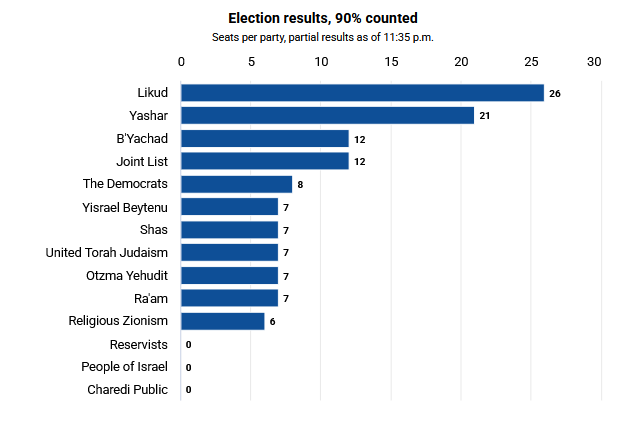
Exit polls missed the mark
The picture taking shape by Wednesday evening differed noticeably from projections presented by most opinion polls during the weeks and months preceding the election. Almost all showed Eisenkot's coalition leading Netanyahu's, albeit with varying margins. However, even those surveys did not record a clear prospect for either faction to assemble a governing coalition. This trajectory also represented a reversal of the picture painted by major television network exit polls on Tuesday evening, immediately after polls closed at 22:00. Initial estimates gave Eisenkot's coalition a two-to-three-seat lead over Netanyahu's. Yet, as vote counting continued through the night and into Wednesday afternoon, it became evident that exit polls had missed their forecasts, with both Netanyahu's party and broader political coalition moving ahead of Eisenkot's corresponding forces. In its latest tally, the Central Elections Committee announced that 89.8% of all votes had been counted, representing results from nearly all standard polling stations. Although results were not yet final, dramatic reversals in the final knesset seat distribution were not anticipated.
Final results on November 4
The Central Elections Committee stated that counting remaining ballots from regular polling stations required additional verification checks, explaining the expected delay. Furthermore, the Committee clarified that approximately 430,000 to 480,000 votes cast via the "double envelope" system remained to be counted. Their tally began in the early hours of Thursday, October 30, and is expected to conclude by Thursday evening. With each Knesset seat estimated to correspond to roughly 40,000 votes, these ballots could influence the final political alignment. Results of this count were expected to be incorporated into the total tally over the coming two days. Final, official election results are scheduled for announcement on November 4.
www.bankingnews.gr












Readers’ Comments