

The countdown to a new, uncontrollable conflagration in the Middle East may prove far more perilous than markets anticipate.
If the US and Israel launch a new large-scale attack against Iran, Tehran has every reason to warn that its response will not be confined to isolated military strikes.
The stakes will not merely encompass military bases and nuclear installations. At the epicenter of a regional escalation scenario could lie ports, airports, energy facilities, electricity and water supply grids, telecommunications, and commercial infrastructure sustaining the economy of the entire Persian Gulf.
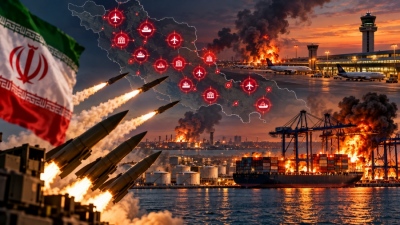
The map depicting ports, airports, major urban centers, and commercial hubs across countries in the region highlights the extent of economic and logistical interdependence throughout the Middle East.
It does not constitute, however, a confirmed target list of Iran, nor does it demonstrate that any specific facility has been selected for attack.
The message is clear: in an all-out war, the conflict could easily transcend the borders of Iranian territory and transform into an energy, transport, and supply crisis bearing global repercussions.
20 ports on the map: What is their significance?
The tally of port entries across the specific sections of the graphic reaches 20 listings across six nations.
These are ports tied to commerce, maritime shipping, and, in certain instances, the region's energy exports.
Included on the list are ports in Israel, Saudi Arabia, Bahrain, Kuwait, Qatar, and the United Arab Emirates.
In Israel, the ports of Haifa, Ashdod, Ashkelon, and Eilat serve distinct roles in maritime trade and within the energy and supply chain.
In Saudi Arabia, the ports of Jeddah, King Abdullah, King Fahd, and Dammam are connected to commercial activity and freight transit.
In the Persian Gulf, the ports of Qatar, Kuwait, Bahrain, and the UAE hold exceptional importance for cargo transit, supplying markets, and linking the region to international transport networks.
The count refers to entries depicted on the map rather than 20 confirmed targets. Furthermore, the presence of an installation on such a map does not automatically imply that it has been selected by Iranian military leadership.

15 airports and the threat to transportation
The graphic also includes 15 airport entries, which serve as critical hubs for passenger and cargo transit, business operations, and the functioning of regional aviation networks.
In the event of an all-out conflict, repercussions would not be limited to facilities potentially sustaining direct strikes.
Even without physical destruction, the threat of missile barrages, airspace restrictions, and flight suspensions could trigger cascading upheavals.
Airlines would be forced to reroute schedules, freight shipments would face delays, and enterprises would encounter soaring insurance and transit expenses.
Airports, therefore, are vital not only as physical installations, but also as links in an international network vulnerable to disruption by a security crisis.
The energy shock: Oil, LNG, and refineries
The greatest economic hazard concerns energy.
The Persian Gulf region concentrates critical production, processing, and export infrastructure for oil and natural gas, while Qatar and other energy hubs play a pivotal role in the global LNG market.
In the event of escalation, markets would react not only to actual physical damage, but also to the probability of disruptions to production or exports.
A threat against energy infrastructure could drive up crude oil and natural gas prices, intensify volatility, and transmit fresh inflationary pressures into economies dependent on imported energy.
Of paramount importance is the Strait of Hormuz, one of the most vital chokepoints for global oil trade.
A protracted disruption to maritime navigation could burden transport, elevate vessel insurance premiums, and precipitate delays in cargo delivery.
The true economic weapon would not necessarily be the physical destruction of an installation, but the generation of pervasive uncertainty over whether oil and LNG will continue reaching international markets.
The vulnerable economic heart of the UAE
The United Arab Emirates constitutes a major commercial, financial, and logistics hub.
The operation of ports, airports, corporate headquarters, and multinational corporations is inextricably linked to the image of stability projected by the nation.
Under an all-out conflict scenario, threats against transport and infrastructure could disrupt commercial flows, impact tourist arrivals, and escalate corporate operating costs.
Dubai and Abu Dhabi are not merely urban centers.
They represent components of a broader economic architecture reliant upon the unhindered movement of people, capital, energy, and commodities.
A severe security crisis could shatter investor and corporate confidence even in the absence of widespread physical destruction.
Saudi Arabia, Kuwait, Bahrain, and Qatar at the center
Saudi Arabia possesses extensive energy and commercial infrastructure, while its geographic location renders it a decisive factor for regional stability.
Kuwait and Bahrain are likewise situated in an environment where military installations, maritime shipping, and energy operations are intimately intertwined with regional balances.
Qatar, for its part, holds exceptional weight in the global natural gas market.
Any severe disruption to LNG exports could impact off-takers across different continents, intensify competition for spot cargoes, and exacerbate upward pricing pressures.
Oman and Jordan are also incorporated into the broader regional instability scenario detailed in the material.
The extent of potential ramifications would depend on the form of the conflict, its geographic spread, and whether commercial and energy corridors were compromised.
Bridges, railways, electricity, and desalination
The threat facing the region does not concern ports and airports alone.
The inventory of infrastructure described in the publication also encompasses bridges, railway networks, subsea cables, power generation stations, and water desalination plants.
This infrastructure underpins the daily operation of modern economies.
Subsea cables support international communications and data interconnectivity, while desalination plants carry vital importance for nations with scarce natural freshwater resources.
A major disruption could impact electricity supply, potable water distribution, transit networks, and access to essential services.
The result would be a crisis extending far beyond the realm of military operations into the daily lives of citizens and the core functionality of the economy.
Tech firms, hotels, and shopping malls
In the broader scenario outlined, technology and artificial intelligence firms, hotels, and commercial shopping centers are also referenced.
This reference reflects the sheer breadth of economic activities that could be caught up in a regional crisis.
However, a clear distinction is required: referencing these categories in media reports or on a graphic does not constitute proof that specific businesses, hotels, or shopping malls have been selected as targets. Without independent corroboration, such an inference would be arbitrary.
What can safely be affirmed is that the spillover of conflict into commercial and digital infrastructure could cause severe disruptions to services, business enterprise, and global supply chains.
US bases and the hazard of a multi-front war
American military installations across the broader region form part of the baseline scenario for prospective Iranian retaliation.
Concurrently, assessments attributed to American intelligence agencies warn that a renewed strike against Iran could trigger responses targeting US personnel and facilities.
The Houthis of Yemen are also cited as a factor that could broaden the conflict front. Were additional actors to become embroiled, risks to maritime shipping, regional transit, and military installations would escalate.
The prospect of simultaneous crises across disparate theaters would complicate air defense, infrastructure protection, and keeping commercial shipping lanes open.
This does not mean, however, that such a development is unavoidable.
Hormuz remains the market's overarching fear
The Strait of Hormuz constitutes the critical focal point of the crisis. Threats to the safe passage of commercial vessels can roil markets even without a total cessation of navigation.
Surging insurance premiums, transit delays, route diversions, and fear of renewed attacks can inflate freight costs and burden energy prices.
In the event of a protracted crisis, consequences could bleed into industrial production, freight transport, manufacturing, and the overall cost of living.
For international markets, therefore, the pivotal question is not merely how many facilities could be hit, but whether the networks ferrying energy and goods from the Middle East to the rest of the world will remain operational.
How many targets will be hit? The big question remains unanswered
The figures shown on the map, 20 port entries and 15 airports, alongside dozens of other listings of urban, commercial, and financial nodes, demonstrate the high density of critical infrastructure in the region.
They do not disclose, however, how many of these could realistically serve as targets in the event of Iranian retaliation.
Based on the available data from the graphic, no verified roster of installations selected for attack exists.
Any representation of the 20 ports or 15 airports as definite targets would be misleading.
The fundamental takeaway is different: an all-out confrontation between the US, Israel, and Iran could turn the critical infrastructure of the Middle East into a vector of colossal economic uncertainty, impacting energy, maritime navigation, aviation, telecommunications, and international trade.
The worst-case scenario is not merely a sequence of kinetic military strikes.
It is a protracted crisis during which the mere threat hanging over ports, airports, and energy grids suffices to paralyze markets, ratchet up transportation costs, and transmit the shock across the global economy.
And in a region upon which vital energy and commercial flows depend, even uncertainty can carry an exorbitant price tag.
www.bankingnews.gr






Readers’ Comments