

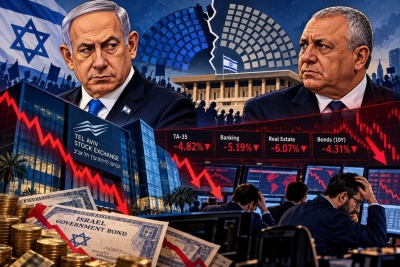
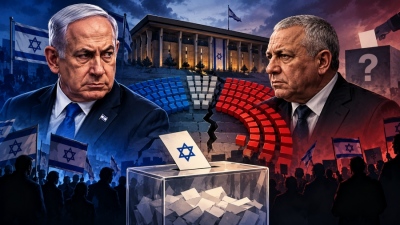
Israeli financial assets traded lower on Wednesday, October 28, 2026, as the country's parliamentary elections failed to yield a clear victor, leaving open the prospect of prolonged negotiations to form a governing coalition. Partial results showed that the party of Prime Minister Benjamin Netanyahu gathered 20.8% of the counted votes, while the party of his rival, Gadi Eisenkot, secured 16.4%. However, data from Israel's Central Elections Committee does not yet clarify how many seats each party will hold in the Knesset, Israel's 120-seat parliament. Polls indicated that Arab parties, which do not align with either of the two main political blocs, secured approximately 18 seats in total—a development that could play a decisive role in post-election coalition negotiations, shaping Israeli political stability.
Markets price in political uncertainty
The uncertainty surrounding the aftermath of the Israeli political landscape was immediately reflected across foreign exchange and bond markets. The Israeli shekel fell by 2% against the US dollar, while the benchmark Tel Aviv 35 stock index recorded a 2.3% drop. At the same time, Israeli government bonds faced selling pressure, with yields moving higher across the entire curve. Specifically, the yield on the 2-year government bond rose by 6 basis points, while the yield on the benchmark 10-year note increased by 8 basis points. The 30-year bond yield climbed 6 basis points. As bond prices move inversely to their yields, the rise in yields reflects falling prices and heightened pressure on sovereign debt markets.
Eisenkot declared victory, but the power struggle continues
Gadi Eisenkot, former chief of general staff of the Israel Defense Forces, had declared victory earlier in the day, maintaining that preliminary results gave a slight lead to his political block. As he stated, the outcome should grant him the first opportunity to attempt forming a government. "Initial exit poll results show a total lack of trust in Netanyahu and his October 7 government," he stated in a post on platform X. Exit polls, however, do not constitute official election results, with the formal announcement expected on November 4. According to the Central Elections Committee, voter turnout reached 77.7% of registered voters—the highest level in 27 years for Knesset elections. The contest is considered particularly critical as it represents the first national election in Israel since the Hamas attack on October 7, 2023, and the subsequent wars in Gaza, Lebanon, and Iran. Furthermore, the vote was viewed as a referendum on the political dominance of Benjamin Netanyahu, who has stood at the center of Israeli politics since 2009, influencing Middle East geopolitics.
The Arab element and complex coalition dynamics
A decisive factor for the formation of the next government is expected to be the performance of Arab parties, which appear to record a historic result. The head of the Ra'am party, Mansour Abbas, declared that "our vote will change the government." For his part, the leader of the Joint List parliamentary group, Ahmad Tibi, had previously presented a plan aimed at preventing Netanyahu from remaining in power after the elections, according to the Jerusalem Post. The pro-Palestinian stance of Arab parties brings them politically closer to Eisenkot than to Netanyahu, according to Amin Saikal, senior associate fellow at the S. Rajaratnam School of International Studies in Singapore. However, neither leader has expressed a willingness to partner with these parties. Even if Eisenkot's bloc secures more seats, forming a majority coalition without Arab and left-wing parties will prove challenging. "Even if Eisenkot's alliance wins more seats, it is less likely to assemble a governing majority without including Arab and left-wing parties," noted Michael Feller, head of strategy at Geopolitical Strategy. He added that otherwise, the next administration's policy on Iran, Palestine, and security may remain largely unchanged. An obstacle in negotiations, however, remains the stance of Avigdor Liberman, head of Yisrael Beytenu—projected to win 7 to 9 seats and currently part of Eisenkot's opposition block—who ruled out relying on Arab parties during the campaign, impacting potential parliamentary coalition building.
Netanyahu's warnings over Arab voter turnout
Earlier on Tuesday, Benjamin Netanyahu and his far-right coalition partners had warned of increased Arab voter turnout, drawing accusations of racism from political opponents. "If we do not wake up now, we will find ourselves with a government of Mansour Abbas and Ahmad Tibi," Netanyahu stated following a series of posts highlighting long queues at polling stations in Arab communities. This rhetoric underscores the weight attached by Netanyahu's camp to the electoral influence of Arab parties, as seat distribution could prove decisive in securing a parliamentary majority and defining the future electoral outcome.
Why Netanyahu remains a formidable force
Benjamin Netanyahu remains the longest-serving prime minister in Israel's history, having survived repeated political stalemates in the past. On several occasions, the inability of rival parties to agree on a governing coalition before legal deadlines allowed him to remain in power. Indicatively, Israel held five elections between 2019 and 2022 due to prolonged political instability. Supporters credit Netanyahu with managing the war effort and standing firm against international pressure. Critics, on the other hand, point to his ongoing corruption trial, controversial judicial reform efforts, and handling of the war in Gaza, arguing he is unfit for office. Furthermore, Netanyahu faces an arrest warrant from the International Criminal Court over the Gaza campaign, which he has rejected, creating ongoing debates over leadership and governance.
Political deadlock could be prolonged
Even if Eisenkot ends up with more seats in the Knesset, Netanyahu may leverage the coming weeks or months to delay the process of forming a new government, according to Amin Saikal of Singapore's S. Rajaratnam School of International Studies. "He will fight for his political survival," Saikal noted regarding Netanyahu. Meanwhile, P.R. Kumaraswamy, emeritus professor of Middle Eastern Studies at Jawaharlal Nehru University specializing in Israeli politics, estimates that the announcement of final results will be followed by a prolonged negotiation period. As he observed, it remains premature to assume that Netanyahu has permanently lost his political power. "It is too early to write him off," he remarked. The final results and the ability to assemble a viable parliamentary majority will determine not only the next prime minister, but also the trajectory of Israeli security policy, foreign relations, and economic stability.
www.bankingnews.gr







Readers’ Comments