

Alarm bells are ringing at the US Pentagon over the threat of Iranian Shahed drones, which are emerging as one of the biggest headaches for the American military apparatus at a time when scenarios of a new military showdown with Iran are multiplying. The US military is mobilizing even its powerful Apache attack helicopters, training their crews in Germany to intercept cheap, mass-produced unmanned aerial vehicles that threaten to disrupt balances on the modern battlefield. The "Skyfall 2" exercise reveals a critical operational challenge for Washington: how to tackle swarms of Iranian drones without depleting multi-million weapon systems and munitions. Against the backdrop of reports detailing a collision between an Apache and a Shahed in the Strait of Hormuz, the US is seeking new air defense methods as the prospect of a reignited war with Iran brings the vulnerability of American bases to mass drone attacks back into sharp focus.
Training the Apaches
The US military is intensifying training for Apache attack helicopter crews to counter unmanned aerial vehicles similar to Iranian Shaheds, at a time when reports indicate that potential scenarios for resuming war with Iran are under evaluation. Iranian media contend that the "Skyfall 2" military exercise conducted in Germany aimed to assess the helicopters' capability to detect, track, and shoot down small drones. The exercise highlights the necessity for American armed forces to adapt to the ever-increasing deployment of Iranian drones across conflict theaters.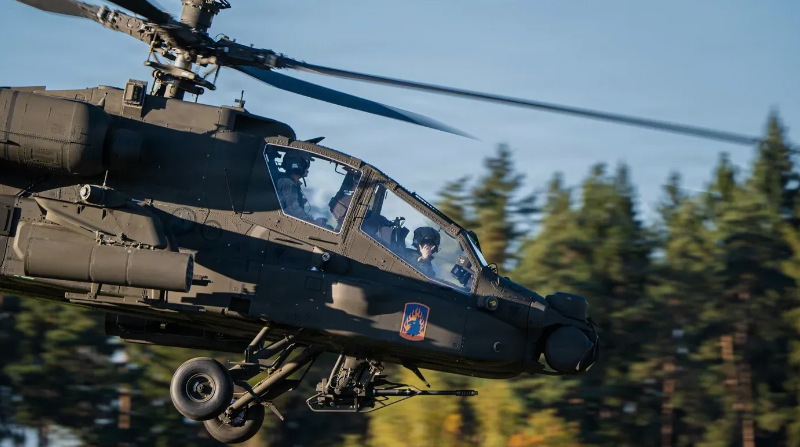
Why they are being deployed
Apache helicopters, which were primarily designed to destroy ground targets such as main battle tanks and armored vehicles, are now called upon to face threats of much smaller physical dimensions and significantly lower manufacturing costs. Within the framework of the "Skyfall 2" exercise, Apache helicopter crews from the US Army's 2nd Battalion, 159th Aviation Regiment carried out surveillance and interception missions against Outlaw-type unmanned aircraft. These specific training drones, featuring a wingspan of approximately 3.3 meters, were selected due to their physical dimensions, which closely approximate those of Iranian long-range drones such as the Shahed.
Searching for low-cost interception solutions
According to a report by the New York Times, 30mm target practice munitions were utilized during the exercise, carrying a lower cost compared to certain advanced interceptor missiles. The financial dimension of countering drones acquires particular significance, as defending against mass unmanned aerial vehicle attacks does not depend exclusively on the ability to detect and destroy targets. The cost per interception can evolve into a decisive factor in a prolonged conflict.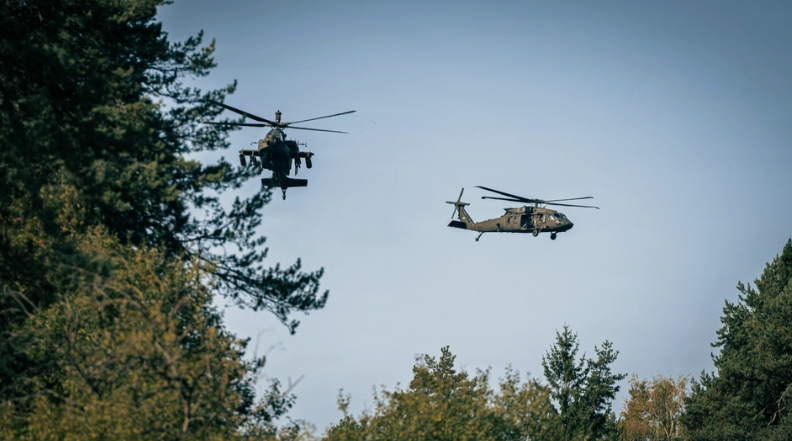
The Shahed challenge for the US military
Iranian Shahed drones, despite their relatively simple design and lower speed compared to many military aircraft, constitute a significant challenge for American air defense systems. Their low production cost and capacity for mass deployment enable the execution of saturation attacks using large numbers of unmanned aerial vehicles. In such attacks, even a limited number of drones that manage to penetrate defensive perimeters can inflict severe damage on military facilities and personnel. For this reason, American commanders are evaluating combinations of different defensive assets.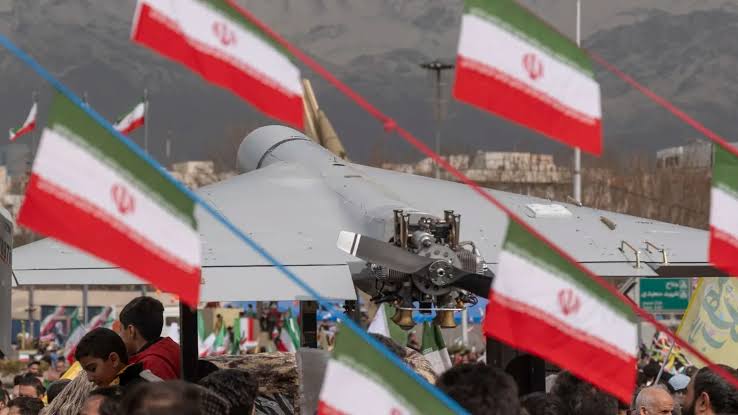
Complementary weapons
Apaches are not intended to handle all unmanned aerial vehicles single-handedly. Instead, they can operate complementarily alongside ground-based radars and other interception systems, enhancing the protection of troops and military installations. In the new exercises of the US military, particular emphasis is also placed on leveraging data from radar networks so that helicopter crews can be directed toward aerial targets with greater precision and operational effectiveness.
What happened in Hormuz
Information regarding an incident that reportedly occurred in June is generating extraordinary interest, when an Apache helicopter crashed over the Strait of Hormuz following a collision with an Iranian Shahed drone. According to the report, the two helicopter pilots survived and were rescued with the assistance of an unmanned US Navy vessel. However, it remains unknown whether the drone deliberately targeted the helicopter or if the collision was accidental. The incident, as reported by Iranian media, demonstrates that countering drones is not exclusively a matter of firepower. Timely threat identification, situational awareness, and coordination among different military units represent equally critical parameters.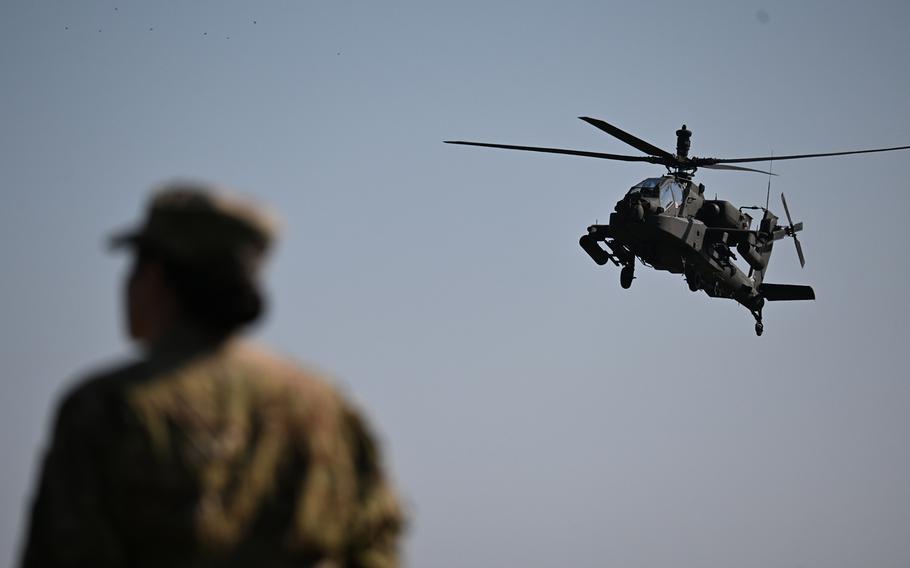
Limits of the Apache against next-generation drones
Despite the tests conducted in Germany, questions persist regarding the capability of Apaches to effectively counter all types of unmanned aerial vehicles. Certain newer drones feature jet engines and achieve significantly higher speeds, a factor that could complicate their interception by relatively heavy attack helicopters. Overall, the American exercise in Germany can be viewed as part of Washington's effort to adapt to the shifts of modern warfare. In this new operational environment, cheap drones deployed en masse can exert substantial pressure on advanced and exceptionally costly defense systems. In the event of resumed military clashes with Iran, the ability to counter drone attacks could prove to be a pivotal factor in protecting US bases and other military targets in the region. However, conducting this specific exercise does not in itself prove that Washington has taken a definitive decision for a new military attack against Iran.
www.bankingnews.gr













Readers’ Comments