

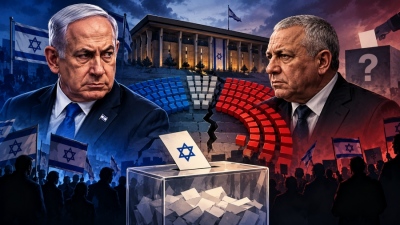
The elections in Israel produced no clear winner on Tuesday night, according to exit polls, as neither Prime Minister Benjamin Netanyahu nor his main political rival, Gadi Eisenkot, appears capable of securing the 61 seats required to form a governing majority in Israel's parliament, the Knesset, which counts 120 seats.
All scenarios remain open in Israel.
Official results
According to official figures with 57.3% of the vote counted, the Likud party leads with 27 seats, followed by the Yashar party with 21. In third place with 12 seats stands the Joint List, followed by B’ Yachad with 11 seats. These results show that the Netanyahu bloc leads with 55 seats compared to 49 for the opposition political camp. The remaining 16 seats are occupied collectively by the two predominantly Arab political formations, Joint List and Ra’am. Falling below the 3.25% electoral threshold required for entry into the Knesset so far are the Reservists (2.7%), People of Israel (1.7%), and Charedi Public (0.2%) parties. These results remain provisional and are expected to shift as counting progresses. Ballots submitted in double envelopes, including those of soldiers, will be counted at a later stage.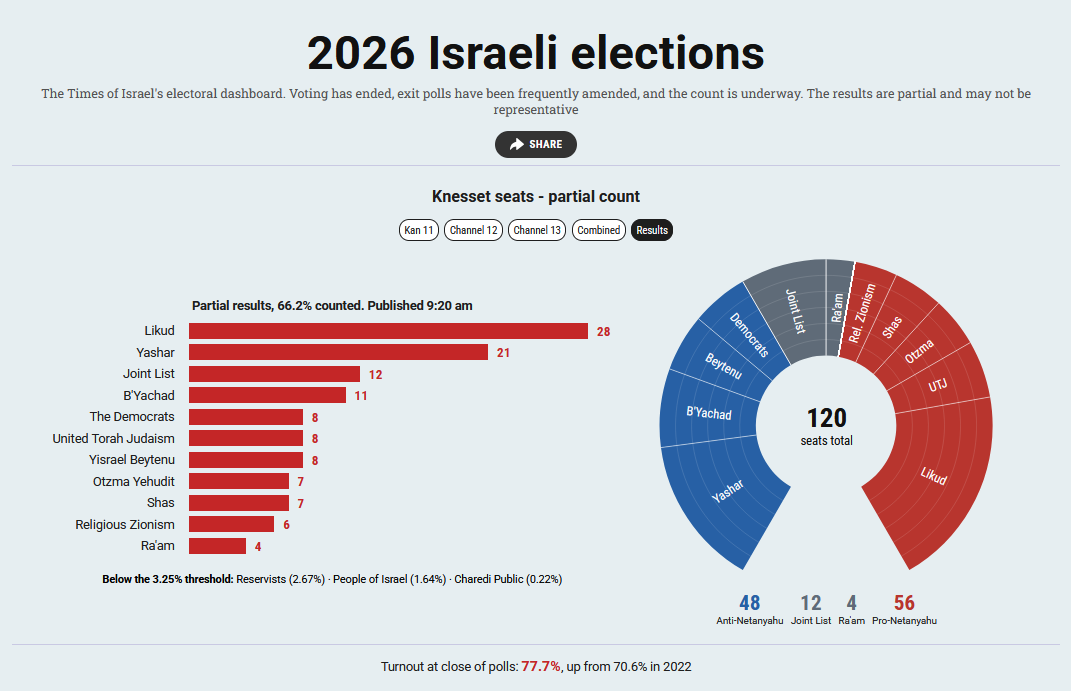
Likud first, decline for Netanyahu
The three main Israeli television channels—11, 12, and 13—projected that the Netanyahu bloc will secure 51–52 seats, marking a significant decline compared to the 68 seats his governing coalition held in the outgoing Knesset. His party, Likud, is nevertheless projected to remain the largest party, with 25–27 seats. However, Israeli politics revolves around the formation of governing coalitions rather than simply emerging as the largest party. Consequently, Netanyahu's path to remaining in power is now uncertain.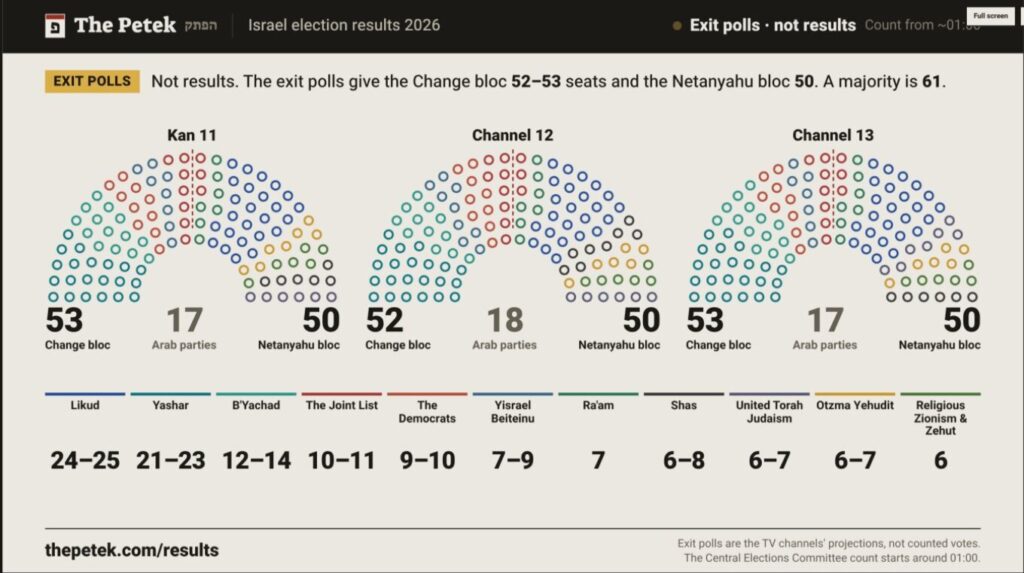
Majority of seats for the opposition, but…
The opposition also faces a complex process to form a government. Parties opposing Netanyahu secured a clear majority of seats, gathering a total of 68–70 seats according to exit polls. However, they are fragmented and divided among the Right, Left, and Center, as well as between Jewish and Arab parties. Eisenkot's Yashar party emerges as the largest force in the opposition, with projections granting it 21–23 seats. However, its path to power presupposes cooperation with Arab parties, a prospect not all opposition party leaders are willing to accept.
The exception
One poll differentiated itself significantly from the rest, presenting favorable results for Netanyahu and his political bloc. According to the exit poll by the pro-government Channel 14, the Netanyahu bloc secures a total of 60 seats, while Likud alone takes 30. However, as exit polls are merely estimates, the picture may change as actual votes are counted overnight. Completing the vote count is expected to take several days.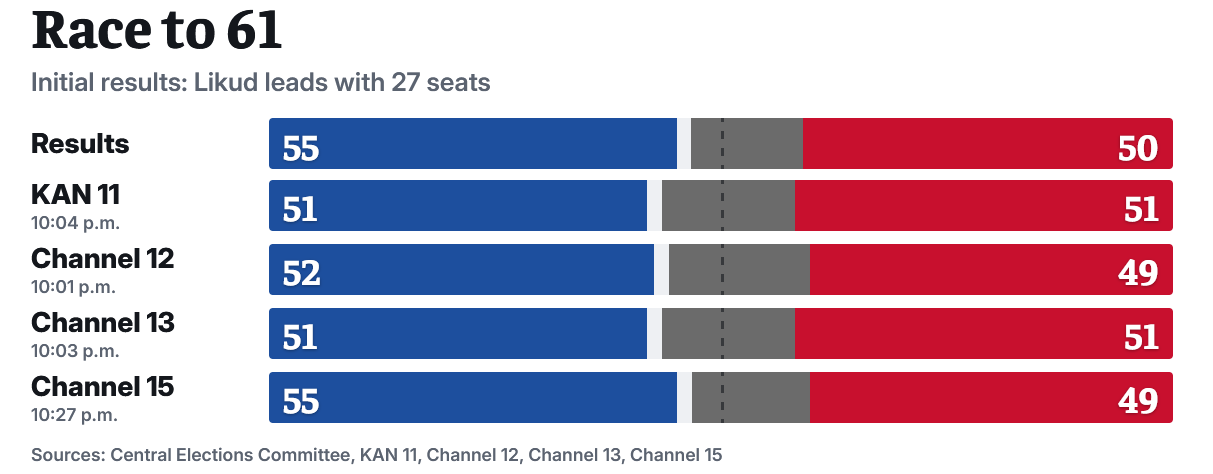
No immediate declaration of victory
As exit polls indicated that neither Netanyahu nor Eisenkot secures the required majority, both leaders addressed their supporters, attempting to frame the election outcome as a political success and shape a narrative of victory. Netanyahu, speaking at Likud headquarters in Jerusalem, thanked voters for what he characterized as a renewed vote of confidence. However, he refrained from declaring a clear victory. "Two things became clear tonight: Likud is the largest party in Israel. There is no dispute about that," he stated. "And the second is that the right-wing bloc possesses a clear, decisive majority among Zionist and Jewish citizens." "We must form a strong national right-wing government," Netanyahu continued. "Israel must not be jeopardized by a government relying on anti-Zionist Arab parties that oppose our very existence, consider Hamas a charitable organization, and call our soldiers war criminals."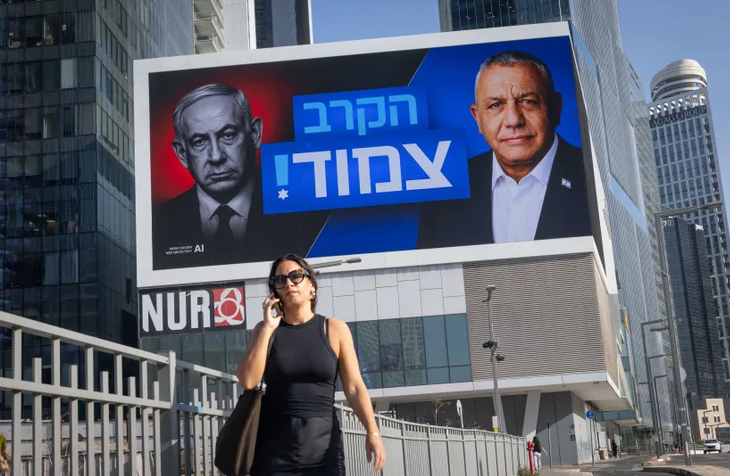
Eisenkot: Vote against Netanyahu
Eisenkot likewise did not declare victory during his speech at his campaign headquarters in Tel Aviv. However, he argued that Israelis voted against Netanyahu. "We made history! Citizens voted for change. The coalition of failure lost the people's confidence," he stated. "Israeli citizens voted against Netanyahu remaining as prime minister of Israel." Eisenkot, who served as chief of staff of the Israeli armed forces and lost a son in the battles in Gaza, stated that "a leader worthy of the office would accept the people's vote of no confidence and announce his retirement from political life today."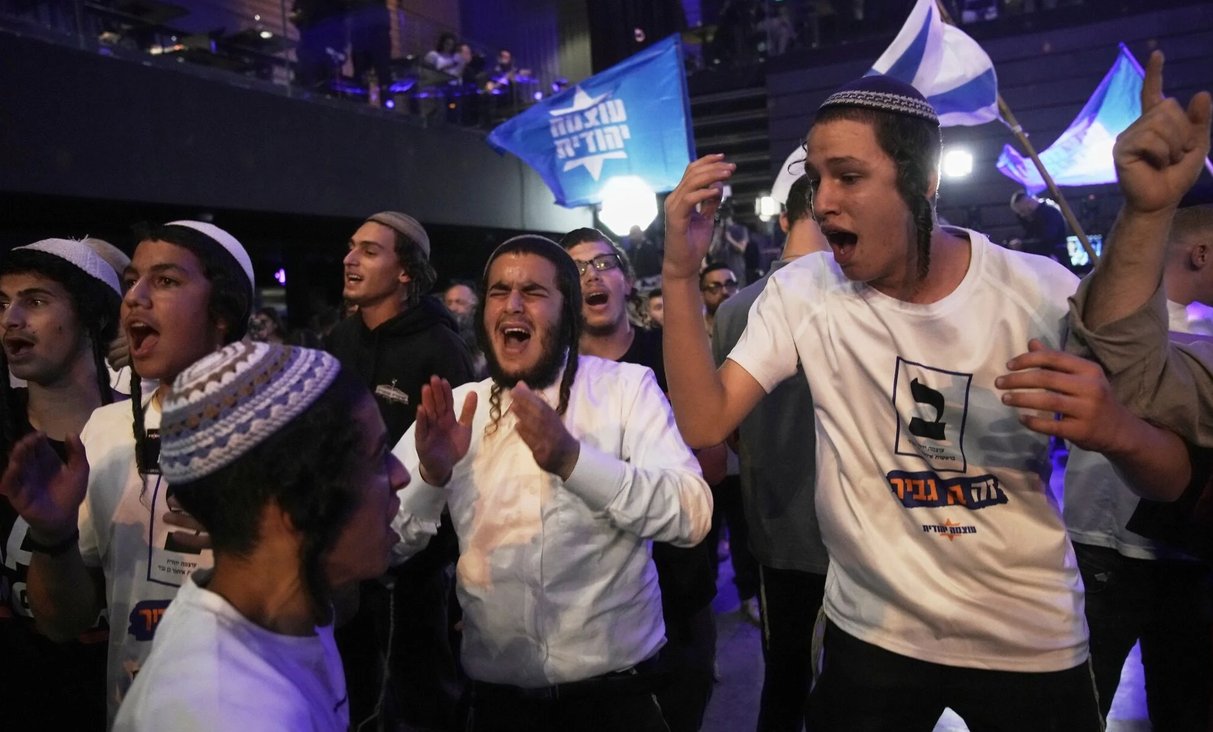
Turnout reaches 77.7%
The elections recorded the highest overall turnout rate since 1999, reaching at least 77.7%. The increase in turnout was particularly noticeable among the country's Arab population, which traditionally turns out at lower rates than Jewish Israelis. Arab parties announced that turnout exceeded 75%, reflecting high voter participation.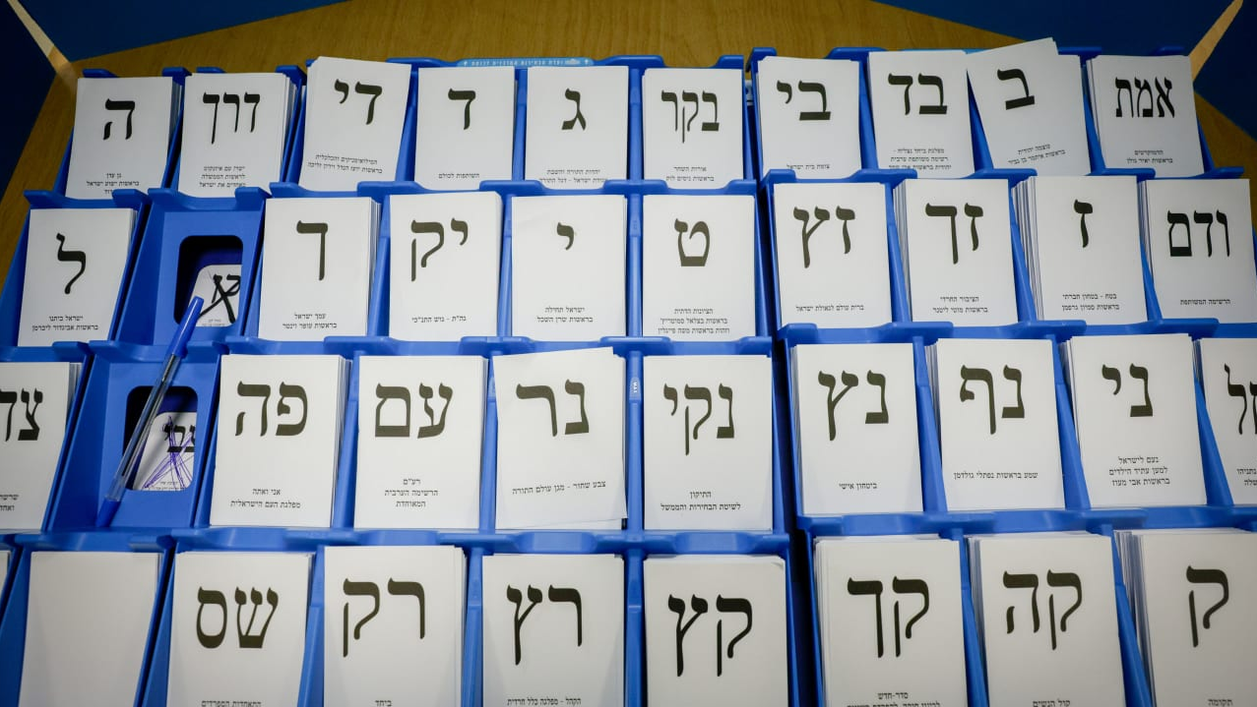
Best electoral performance for Arab parties
The two parties, Joint List and Ra'am, are projected to secure a total of 17–19 seats, marking their best electoral performance in history. Palestinian citizens of Israel, who make up about 20% of the country's population, were mobilized by a strong desire to overturn Netanyahu's right-wing governing coalition, which is largely dominated by hardline ministers Bezalel Smotrich and Itamar Ben-Gvir. Ben-Gvir's tenure as Minister of National Security was accompanied by a dramatic surge in crime and homicides within Arab communities. "We proved that we constitute a political force that cannot be ignored and that it is impossible to build a future here without our voice," stated Yousef Jabareen, chairman of the Joint List, calling the day "historic."
Electoral achievement
Mansour Abbas, head of the Ra'am party, told i24news that "this record electoral achievement is due exclusively to Ben-Gvir, Smotrich, and the entire government that neglected Israel's Arab community." The increased turnout of Arab voters may have prevented Netanyahu from securing a parliamentary majority, but at the same time it complicates Eisenkot's efforts to replace him. Eisenkot has set specific conditions for any governing partner, including the recognition of Israel as a Jewish state and the recognition of Hamas as a terrorist organization that must be dissolved—conditions that most Arab lawmakers would find difficult to accept. Furthermore, two of his opposition allies, Avigdor Liberman and Naftali Bennett, have categorically ruled out forming a government involving Arab parties, leaving Eisenkot's path to power uncertain.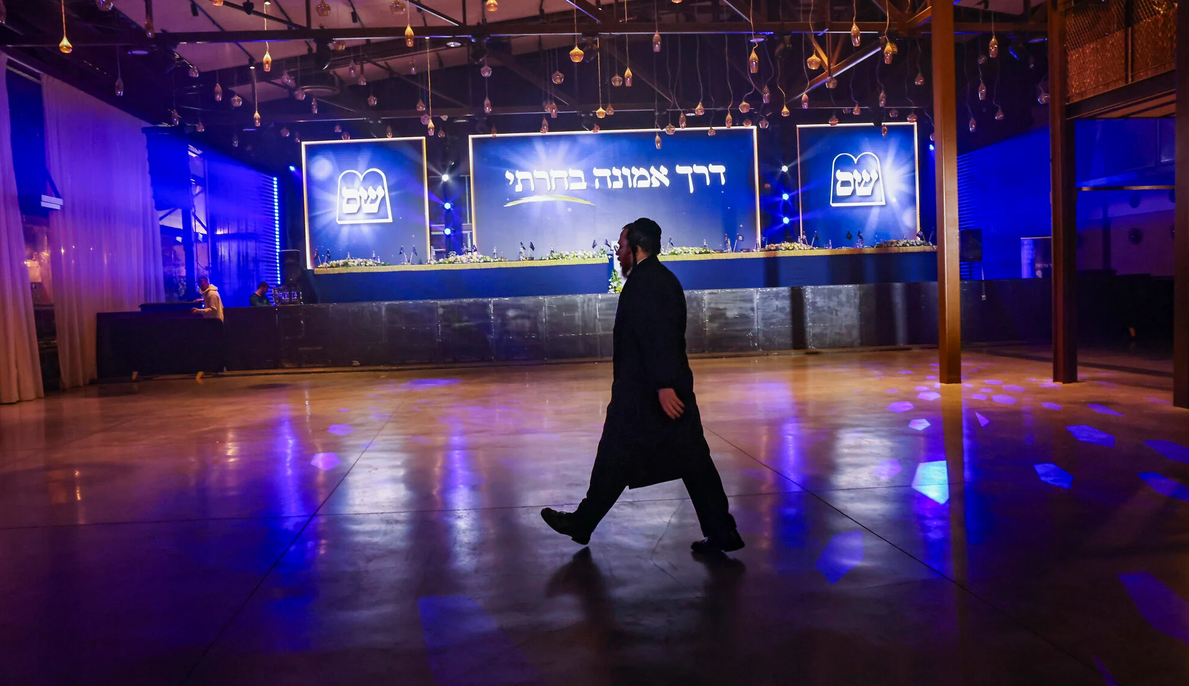
What comes next?
Exit polls are only projections, and the picture may alter as actual votes are counted and finalized, a process that usually takes several days. Once the results are certified, the electoral process passes into the hands of Israel's president, Isaac Herzog. In a series of meetings in Jerusalem, Herzog will initiate a round of consultations during which each party elected to the Knesset will recommend its chosen candidate for prime minister. Based on these recommendations, the president will then entrust a candidate with the mandate to form a government. This candidate is not necessarily the leader of the largest party, but the one whom the president deems, at his discretion, has the best chance of putting together a majority of 61 seats.
The president's mandate
Electoral victory, therefore, depends not only on votes and seats, but also on the ability to form and maintain a viable governing coalition. Herzog's first decision will be whether to hand the mandate to form a government to Netanyahu or to Eisenkot. Netanyahu leads the largest party, but with the support of Arab parties, Eisenkot is likely to gather more recommendations from parliamentary parties regarding the prime ministerial mandate.
Government negotiations
After receiving the mandate, one of the two will begin negotiations that may last for weeks, focusing on the allocation of ministerial portfolios, budgetary priorities, and policy commitments. The prime minister-designate has a deadline of 28 days to form a government, with a possible extension of 14 days. If he fails, the president assigns the mandate to another candidate, who receives an additional four weeks. If that attempt fails as well, the Knesset has a brief window of time to propose another candidate for coalition building.
Scenario of new elections
If it fails to do so, the country automatically heads to a new round of elections. As neither side possesses a clear majority, the prospect of a political stalemate is now considered quite likely. Herzog may attempt to push Netanyahu and Eisenkot toward forming a national unity government between the two largest parties. However, it remains unclear whether such an agreement is even feasible. Netanyahu has a long history of politically undermining individuals with whom he entered into similar agreements in the past, while Eisenkot has ruled out participating in a government alongside him.
www.bankingnews.gr






Readers’ Comments