

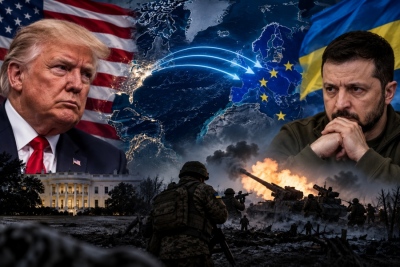
At a time when battles continue from Donetsk to Zaporizhzhia and diplomatic initiatives surrounding the Ukrainian issue are multiplying, a second "front" is acquiring growing significance. It is not located on the front line of the war, but thousands of kilometers away, in Washington. The midterm elections on November 3 may constitute the most significant political event for Ukraine since Donald Trump's return to the White House. Not because Americans will vote on the war, but because the election outcome can decisively influence the man who still holds the primary levers of US power in his hands. In Kiev, Brussels, Moscow, and Washington itself, the core question is no longer just who will control Congress. The question is whether Trump will emerge from these elections politically strengthened or whether he will enter the second half of his term as a president with significantly limited room for maneuver domestically and externally.
Democrats lead, but an upset remains possible
The dominant picture of recent weeks is that Democrats find themselves in a better position than a few months ago. High inflation, high fuel prices, increased housing costs, social discontent, and fatigue among a significant portion of the electorate regarding the Trump administration have created conditions that traditionally operate in favor of the opposition. Many polls within and outside the United States indicate that Democrats possess serious chances of regaining control of the House of Representatives. At the same time, several analysts estimate that Republicans risk facing unpleasant surprises even in states considered safe until a few months ago. Yet herein lies the first major trap. The fact that Democrats appear to be favorites does not mean they have already won. American political history itself shows how dangerous it is to take any election outcome for granted when Donald Trump is on the political scene. Polls have repeatedly missed the mark regarding him. Voter mobilization remains extremely difficult to predict. Simultaneously, redistricting, massive party funding by financial and technological elite moguls from Silicon Valley, and liberal-conservative polarization make many contests exceptionally volatile. The battle for the Senate remains even more difficult. Democrats need significant gains in states where Republicans maintain strong bases, and just a few thousand votes could decide control of the chamber. In other words, a Democratic victory is possible. But it is not certain.
Why Kiev is watching the American ballots with such anxiety
Of all the world's capitals, perhaps none is watching the American elections with greater interest than Kiev itself. The reason is simple. Despite significant European financial aid, the core pillars of the prolonged and partly effective Ukrainian war effort remain directly linked to the United States. American intelligence information, satellite capabilities, high-tech systems, military training, advanced weapons systems, and a critical portion of funding are directly tied to American political will. That is why political developments in Washington are not treated in Ukraine as a distant internal American political event. They are treated as a factor that can directly influence the strategic balances of the war.
Trump and the Democrats are miles apart on Ukraine
The essence of the issue lies not only in the political confrontation between Republicans and Democrats. It lies primarily in the differing interpretation of the Ukrainian conflict itself. For most Democrats, as well as a large portion of the American and European liberal establishment, the war in Ukraine constitutes a pivotal front of the broader confrontation with Russia. In this perception, maintaining support for Kiev is tied to the overall architecture of Western security and the credibility of the United States toward its allies. Trump, by contrast, has repeatedly shown that he approaches the issue differently. He has not abandoned Ukraine. He has not stopped aid. He has not withdrawn American support. However, he approaches the issue more through the prism of American cost-benefit analysis, economic priorities, and the strategic interests of the United States. This difference in approach largely explains why political balances in Congress are of such intense interest to Kiev.
Why Kiev considers Democrats a more predictable ally
This does not mean that Democrats and the Zelensky administration are politically aligned on all issues. However, since 2022, a stable strategic relationship has formed between Ukraine and the majority of the American political establishment aligned with the Democrats. For many in Washington, the Ukrainian conflict was not treated merely as a regional security issue. It was tied to the overall credibility of American geopolitical and geostrategic power, the cohesion of NATO, and the ability of the collective West to deter revisionist forces from changing borders by force. Within this logic, support for Kiev acquired an almost strategic character. It was not viewed merely as yet another foreign intervention by the United States, but as a core element of the broader confrontation being waged over the shape of the international system (unipolar or multipolar). For this reason, several in Kiev estimate that a strengthening of Democrats in Congress could act as a political bulwark against any attempt to revise global American policy.
Trump sees different priorities
Conversely, Trump never showed the same ideological investment in the dispute surrounding Ukraine. This does not mean, of course, that he sided with Russia or abandoned Ukraine. It means, however, that from the very first moment, he treated the war as an issue that had to be evaluated based on the American national interest rather than as a historical or moral mission. In his public statements, he repeatedly returned to issues of cost, funding, and the priority that should be given to the internal problems of the United States. The economy, inflation, immigration, competition with China, and more recently the crisis in the Middle East frequently appear higher on Trump's scale of priorities than the Ukrainian conflict. This is precisely what causes concern in Kiev.
The Trump-Zelensky personal relationship was never easy
Unlike other Western leaders, Trump and Zelensky never managed to develop a relationship of mutual political trust. Public disagreements, differing approaches to the war, and frequently conflicting assessments of how the conflict can end created a relationship characterized more by pragmatism on both sides than by geopolitical alignment. This does not mean the two sides have headed toward a definitive rupture. It does mean, however, that Kiev knows it cannot take Trump's support for granted in the same way it took it for granted from a significant portion of the American Democratic political establishment in previous years. And that is why the midterm elections acquire special significance for the Ukrainian leadership. They do not concern only control of Congress. They also concern who will wield greater political influence in Washington over the next two years.
The lame duck scenario
In American politics, there is an old term: lame duck, describing a leader who remains formally in power but has lost a significant portion of their political influence. This is precisely the scenario being discussed increasingly around Trump. If Democrats reclaim the House of Representatives and perhaps the Senate, the president will remain in the White House. He will continue to serve as Commander-in-Chief of the US Armed Forces. He will continue to largely dictate foreign policy. Yet he will find himself facing a much more hostile political environment. Democrats have already announced that in the event of a victory, they intend to launch extensive investigations into administration policies. Ministers, agencies, funding, contracts, policy toward Iran, immigration strategy, and even the role of Elon Musk will come into the crosshairs. A president constantly facing committees, hearings, and parliamentary clashes clearly possesses less political capital to impose difficult foreign policy initiatives. This is precisely the scenario several in Kiev consider favorable. This is what Zelensky himself is waiting for. That is why on many recent occasions he appears to openly mock the American president.
Can the course of the war actually change, however?
Caution is required here. Many analysts tend to overestimate the influence of American elections. The fact that Democrats might win the House of Representatives does not automatically mean that American geostrategy toward Russia will change. NATO does not change because the correlation in Congress shifts. The Pentagon does not alter its core strategic directions overnight. American intelligence agencies continue to operate independently of party balances. And the president himself retains significant powers. For this reason, a Democratic victory does not equate to an automatic political defeat for Trump on the Ukrainian issue. It can complicate his handling. It cannot fully cancel it.
What if the opposite happens?
This is perhaps the most interesting and simultaneously least discussed scenario. What will happen if Republicans ultimately manage to limit their losses? Or even better, if they maintain control of the House of Representatives or the Senate? In this case, the picture is completely reversed. Trump will be able to claim that voters essentially approved his policy course two years after his return to power. His negotiating position will be strengthened. Internal pressures will subside. And America's foreign allies or rivals will be forced to readjust their calculations. Such an outcome would send a message not only to Kiev, but also to Brussels, Moscow, and every capital attempting to predict Washington's next moves.
The real stake goes beyond Congress
Midterm elections are frequently presented as a battle for seats, committees, and parliamentary correlations. In reality, their significance is far greater. For Ukraine, the outcome will serve as an indicator of how much political power Donald Trump still possesses to impose his will on the Ukrainian issue. For Democrats, it will serve as a measure evaluating their political comeback. For Russia, it will offer indications regarding the American president's capabilities to move in the future toward a different approach, potentially closer to the Russian view of the Ukrainian crisis. And for Europe, it will constitute yet another factor in the already difficult security equations shaping up in recent years.
All eyes are on November 3
American voters will not go to the ballot box to decide the future of Ukraine. They will vote on inflation, fuel, immigration, the war with Iran, and their daily lives. And yet, their decisions might profoundly affect the political balances surrounding the largest military conflict Europe is currently experiencing. That is why November's midterm elections are not being watched only in Washington. They are being monitored with equal attention in Kiev, Brussels, London, and Moscow. Because, regardless of what happens on the battlefield, the next phase of the war may depend more than ever on who emerges politically stronger from the American ballots.
www.bankingnews.gr









Readers’ Comments