

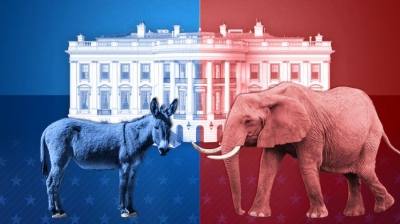
Less than a week before the critical midterm elections on November 3, most analysts agree that Democrats find themselves in a better position than a few months ago. High inflation in fuel and food, the high cost of living, the war with Iran, and the attrition of the Trump administration have created conditions that traditionally favor the opposition. Yet, despite the climate of optimism in the Democratic camp, nothing is taken for granted, especially in a political system where a few thousand votes can decide control of Congress.
Polls favor the Democrats
Most forecasting models converge on the view that Democrats possess serious chances of regaining control of the House of Representatives. The political juncture resembles traditional midterm elections in which the president's party suffers losses. Furthermore, the popularity of Donald Trump—primarily due to the war in the Middle East and the unrestricted support he provides to Israel—stands at relatively low levels, while voters' primary economic concerns remain unresolved. High prices for food, gasoline, diesel, and housing constitute the dominant theme of the election campaign and operate to the detriment of the White House, fueling a potential blue wave.
Why Democrats cannot celebrate just yet
Despite the favorable climate, CNN analysts themselves warn that it is too early for conclusions. There are several reasons for this. First, the redistricting of many electoral districts has created new dynamics. Second, Republicans command massive funding, with Elon Musk having invested hundreds of millions of dollars into the electoral battle. Third, no one knows with certainty which voters will ultimately turn out at the ballot box. American political history has taught time and again that polls and actual ballot results do not always align in midterm elections.
The Senate remains the big puzzle
Even if Democrats win the House of Representatives, the battle for the Senate is far more difficult. Critical contests in Texas, Ohio, Alaska, Michigan, and North Carolina are literally decided on the details. Democrats need four additional seats to gain control of the chamber, and this requires victories in states where Republicans historically hold strong footholds. In other words, it is possible for Democrats to achieve a overall better performance nationally and yet fail to reach the coveted Senate majority.
Why Trump continues to be a factor
Yet another element holding back Democratic enthusiasm concerns Donald Trump himself. Many of his political opponents made the mistake in the past of assuming his political influence had been exhausted. Trump has repeatedly disproved similar forecasts. Despite the wear and tear on his administration, he continues to possess an exceptionally loyal electorate that often mobilizes more effectively than pollsters predict, keeping voter turnout dynamics unpredictable. That is why Democrats are avoiding triumphalism for now.
If Democrats ultimately win, what do they intend to do?
Here lies the second big question of the midterm battle. If Democrats gain control of one or both chambers of Congress, they plan to use their new power on three main fronts. First, to launch extensive parliamentary oversight of the Trump administration. Second, to attempt to overturn or limit policies they consider responsible for driving up the cost of living, such as tariffs or certain energy choices of the administration. Third, to focus on health issues, Medicaid, Obamacare, and social protection.
The real significance of the vote
The midterm elections will not only determine who controls Congress. They will also function as the first major political assessment of the second Trump presidency. If Democrats prevail, the president will find himself facing a far more aggressive and scrutinizing Congress that will impose checks on all his strategic choices concerning the Middle East, Russia, and Taiwan. If Republicans hold on, Trump will be able to claim that he retains not only the White House but also the political initiative in Washington. That is why the key question is no longer just what Democrats will do if they win. The primary question remains whether they will actually win. And right now, one week before the vote, the answer remains far from self-evident.
www.bankingnews.gr












Readers’ Comments