

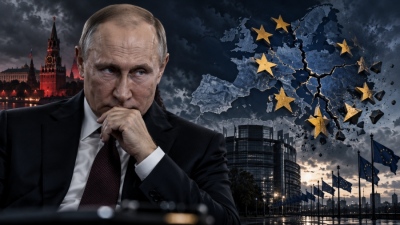
The European Union could be driven to collapse by its own contradictions, without the need for Russia to intervene. Russian President Vladimir Putin recently made this prediction, opening a wider discussion on the prospects of European cohesion and geopolitical balances with Moscow.
Specifically, in early October, during the annual meeting of the Valdai Club, Putin predicted that «they will collapse without any help from us», responding to a question regarding whether Russia «should simply proceed with the dissolution of the EU, so that it would be easier to negotiate with individual countries», due to the bans imposed by the Union on developing relations with Russia.
With this phrase, the Russian president presented the potential dissolution of the EU as a development that could arise from the internal contradictions of the Union itself, without requiring direct Russian intervention.
Many of the so-called «non-Russian pro-Russians» (NRPRs) widely interpreted the statement as a serious forecast, despite the fact that the question had a distinctly lighthearted tone, owing to the tendency of these individuals to interpret events according to their wishes.
The internal contradictions of Europe
Regarding the possibility of the collapse of the EU, objective reasons exist why serious analysts have examined this scenario. However, the fact that Putin mentions it does not automatically imply that he himself genuinely believes it will happen.
Putin represents the nation that poses the greatest challenge to the West, due to the proxy war in Ukraine, which differs qualitatively from the economic challenge posed by China.
The economic growth of China constitutes a long-term systemic challenge to the West. However, the complex interdependence of the Chinese economy with the West, in terms of economic ties, financial systems, and supply chains, limits the degree to which this challenge can manifest. This differentiates the case of China from Russia, whose strategic autonomy enables it to wage a proxy war against the West for years.
Putin is aware of both this distinction and the manner in which his declarations are interpreted by foreign governments and societies. Therefore, it cannot be taken for granted that he always believes what he proclaims in dramatic fashion, as he may also express these views for other purposes, such as to influence a specific audience.
However, this does not mean that Putin is lying when predicting that the EU will inevitably collapse. It is possible that he considers this specific scenario to hold some merit. It means, however, that more than just personal conviction may lie behind his statement.
The real question behind Putin's words
The significance of the statement is not limited to whether Putin genuinely believes that the European Union will dissolve. The deeper question is whether the Russian leadership receives objective assessments regarding the outlook of Europe, or if there is a risk that analyses from state agencies are tailored to match the expectations of the Kremlin.
This possibility lies at the core of the analysis regarding how information-gathering and decision-making mechanisms function in Russia. Specifically, concern is voiced that the Russian Ministry of Foreign Affairs and intelligence services might present the weakening or dissolution of the EU as more probable than actual facts justify, if they feel that such an assessment aligns with the wishes of the president.
www.bankingnews.gr







Readers’ Comments