

The outlook for Greek banks remains positive, with JP Morgan maintaining its target prices unchanged and estimating that operational momentum will remain strong during Q3 2026, despite the expected normalization of certain revenue sources and the increase in provisions and tax burdens. The American investment firm updated its models ahead of the earnings announcements by Greek banks, taking into account its recent contacts with management teams and the latest sector trends. JP Morgan maintains an Overweight rating for all four systemic Greek banks, with target prices of 5.80 euros for Alpha Bank, 6.10 euros for Eurobank, 20.70 euros for National Bank of Greece, and 13.70 euros for Piraeus Bank. According to its estimates, net interest income will continue to strengthen, mainly thanks to credit expansion, while in certain cases a decline in fees and income from financial transactions will be recorded following the strong performance of the previous quarter.
Alpha Bank: Profits of 257 million euros and target price of 5.80 euros
For Alpha Bank, JP Morgan forecasts net profit after tax of 257 million euros for Q3 2026, down 4% quarter-on-quarter. The main driver of support will be the growth in net interest income, which is estimated to be partially offset by the normalization of fees, higher provisions for credit losses, and the tax burden. Additionally, results are expected to be impacted by an annual donation of 25 million euros for the renovation of school facilities. This specific charge is expected to be recorded in Q3, unlike most other banks, which are estimated to book it in Q4. JP Morgan forecasts a return on tangible equity (ROTE) of 9.8% on a reported basis and 11.4% on an adjusted basis.
Net interest income is expected to increase by 3% quarter-on-quarter, driven primarily by loan volume growth. Total loans are estimated to rise by 1%, while the net interest margin (NIM) is projected to remain virtually unchanged at 2.17%. In the fee sector, the firm expects a decline to 155 million euros, down 17% compared to the previous quarter due to the high comparison base of Q2, when results were boosted by the Prodea dividend without a corresponding impact on final profitability. On an underlying basis, however, fee income is estimated to grow by 6% quarter-on-quarter.
Concurrently, revenue from trading and other activities is expected to recover to 23 million euros, up from just 4 million euros in Q2, when it had been negatively impacted by the valuation adjustment of the stake in Prodea. Operating expenses are projected to decrease by 1%, while the cost-to-income ratio (C/I) is estimated to improve to 38%, down from 38.4% in Q2. The cost of risk (CoR) is expected to rise to 44 basis points, up from 39 basis points, while the non-performing exposure ratio (NPE) is projected to decline to 3.4%, down from 3.6%.
Regarding capital, the CET1 ratio is expected to remain virtually unchanged at 14%. Alpha Bank's stock is recording a 19% gain year-to-date and is trading at a P/E ratio of 8 times estimated 2028 earnings and a P/TBV ratio of 1 time. The bank's planned Investor Day on November 5 is also in focus. Target price: 5.80 euros – Rating: Overweight. The earnings announcement is scheduled for October 30, before the market opens.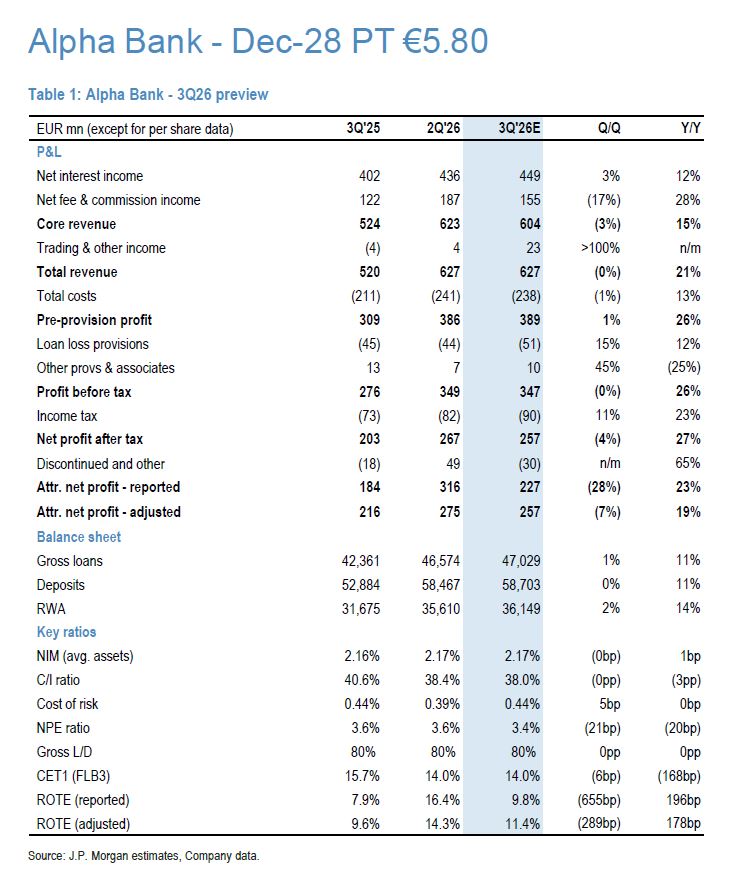
Eurobank: Net profit of 419 million euros and ROTE of 16.8%
For Eurobank, JP Morgan forecasts net profit after tax of 419 million euros for Q3 2026, down 2% quarter-on-quarter. Core operations are expected to maintain strong momentum, with the positive contribution of core revenues partially offset by higher expenses, provisions for credit losses, and taxes. On a reported basis, however, net profit is estimated to increase by 1% compared to the previous quarter. Return on tangible equity is projected at 16.8%, compared to 17.2% in Q2.
Net interest income is expected to strengthen by 3% quarter-on-quarter, with total loans increasing by 1% compared to the previous quarter and by 8% on an annual basis. Conversely, the net interest margin is estimated to decline by 3 basis points to 2.46%, down from 2.49% in Q2. Fee income is projected to rise by 3%, while revenue from trading and other operating activities is expected to normalize following the strong performance of the previous quarter.
Operating expenses are estimated to increase by 1%, with the cost-to-income ratio remaining essentially unchanged at 35.7%. The cost of risk is projected at 54 basis points, compared to 51 basis points in Q2, while asset quality is expected to remain at favorable levels. JP Morgan also factors in an extraordinary negative cost of 10 million euros in Q3 related to restructuring expenses.
The CET1 ratio is expected to settle at 15.3%, compared to 15.4% in the previous quarter. Eurobank's stock has gained 26% year-to-date and is trading at a P/E ratio of 7.9 times estimated 2028 earnings and a P/TBV ratio of 1.3 times. Target price: 6.10 euros – Rating: Overweight. The earnings announcement is scheduled for October 29, after the market closes.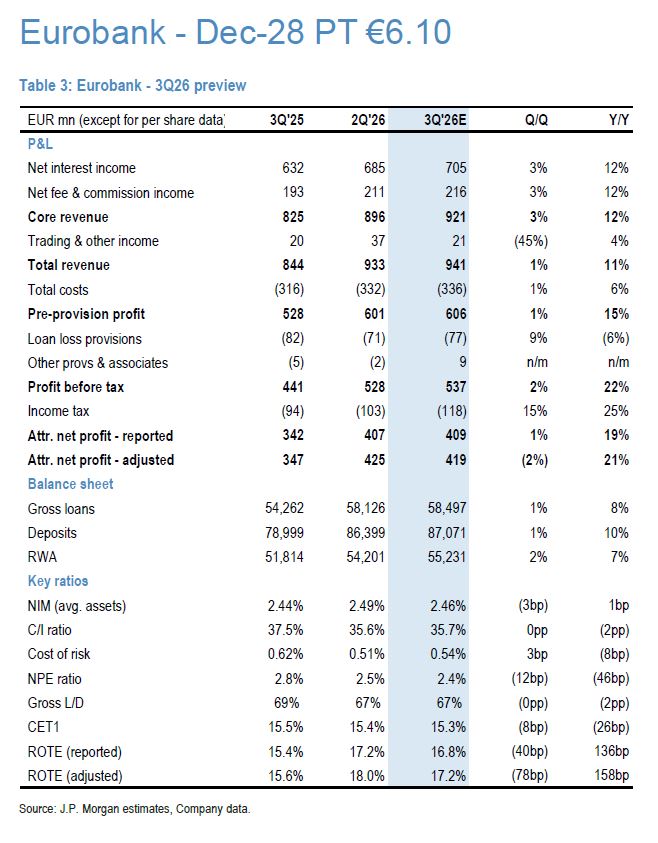
National Bank of Greece: Profit of 308 million euros and strong credit expansion
For National Bank of Greece, JP Morgan estimates that net profit after tax will reach 308 million euros in Q3 2026, remaining essentially flat quarter-on-quarter. Profitability is expected to be supported by growth in net interest income, which will be partially offset by the normalization of fee and trading income, as well as an increase in operating expenses. On a reported basis, net profit is estimated to rise by 4% compared to the previous quarter due to the smaller impact of extraordinary charges in Q3. Return on tangible equity is projected at 13.4%, compared to 13.9% in Q2.
Net interest income is expected to increase by 4% quarter-on-quarter, reaching 577 million euros. This development will be supported by a 5-basis-point increase in the net interest margin to 2.73%, as well as by credit expansion. Total loans are projected to grow by 1% quarter-on-quarter and by 12% year-on-year.
Conversely, fee income is estimated to decline by 6% compared to Q2, mainly due to the high comparison base. The previous quarter's results had been boosted by higher fee income associated with lending under the Recovery and Resilience Facility (RRF), as well as strong capital markets activity. Trading revenue is also expected to normalize, dropping to 12 million euros, down from 18 million euros in Q2.
Operating expenses are projected to rise by 4%, with the cost-to-income ratio settling at 37.1%, up from 36.2%. The cost of risk is estimated to decline to 37 basis points, down from 38 basis points in the previous quarter. Concurrently, asset quality is expected to remain on a favorable trajectory, with the non-performing exposure ratio declining to 2.3%, down from 2.4%. The CET1 ratio is projected at 17.2%, compared to 17.3% in Q2.
JP Morgan also notes that National Bank management has hinted at room for a slight overshoot of the fee growth target for full-year 2026, which sits in high single digits. Current market consensus estimates point to an annual increase of 9%. National Bank's stock has gained 18% year-to-date and is trading at a P/E ratio of 8.4 times estimated 2028 earnings and a P/TBV ratio of 1.2 times. Target price: 20.70 euros – Rating: Overweight. The earnings announcement is scheduled for November 5, before the market opens.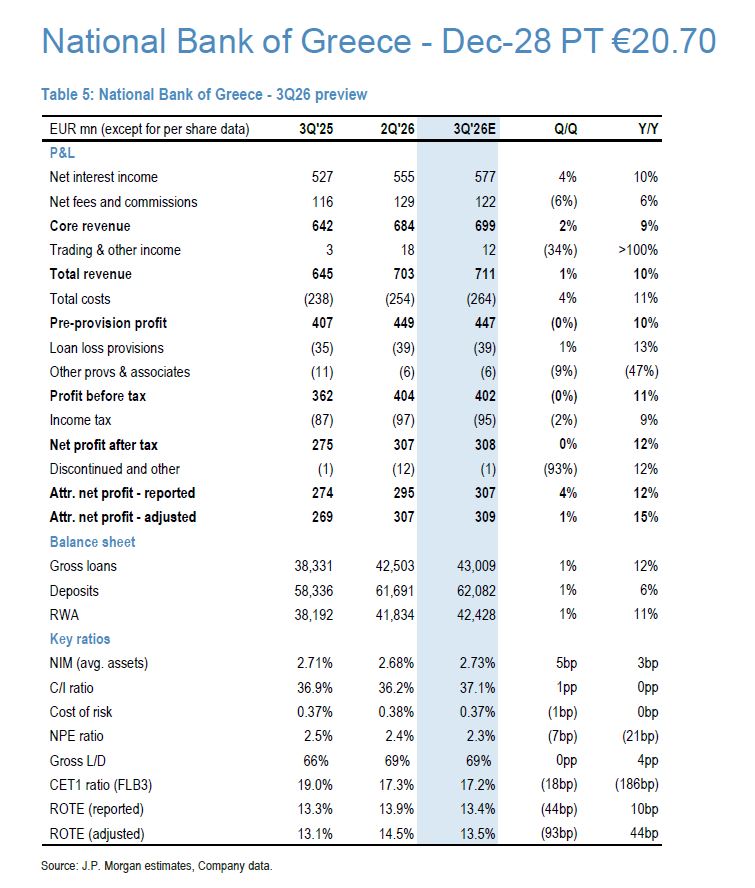
Piraeus Bank: Profit of 313 million euros, with strengthening interest income
For Piraeus Bank, JP Morgan forecasts net profit after tax of 313 million euros in Q3 2026, down 7% quarter-on-quarter. The decline is expected to stem mainly from the normalization of service revenues, higher provisions for credit losses, and a small loss from trading operations. Counterbalancing these factors will be the growth in net interest income. On a reported basis, net profit is estimated to reach 315 million euros, down 6% compared to the previous quarter. Return on tangible equity is projected to fall to 15.2%, down from 16.7% in Q2.
Net interest income is expected to increase by 5% quarter-on-quarter, reaching 533 million euros. This development will be supported by a 2-basis-point increase in the net interest margin to 2.32%, as well as by an increase in total loans of 1% quarter-on-quarter and 8% year-on-year. Conversely, service revenues are expected to fall by 14% quarter-on-quarter to 216 million euros due to the high comparison base of Q2. Concurrently, revenue from trading and other activities is estimated to enter negative territory with a small loss of 5 million euros, owing to volatility in bond markets.
Operating expenses are projected to drop by 3% compared to the previous quarter, as Q2 had been burdened by higher variable compensation. However, the cost-to-income ratio is expected to rise to 32%, up from 31%. JP Morgan estimates that the cost of risk will rise to 65 basis points, compared to 57 basis points in Q2. This development is linked to the proactive strengthening of the bank's balance sheet, aligning with updated management guidance.
In terms of capital adequacy, the CET1 ratio is projected to rise to 12.9%, up from 12.8% in the previous quarter. Piraeus Bank's stock records the largest gain among the four banks examined by JP Morgan, with profits of 39% year-to-date. It is trading at a P/E ratio of 7.6 times estimated 2028 earnings and a P/TBV ratio of 1.2 times. Target price: 13.70 euros – Rating: Overweight. The earnings announcement is scheduled for October 30, before the market opens.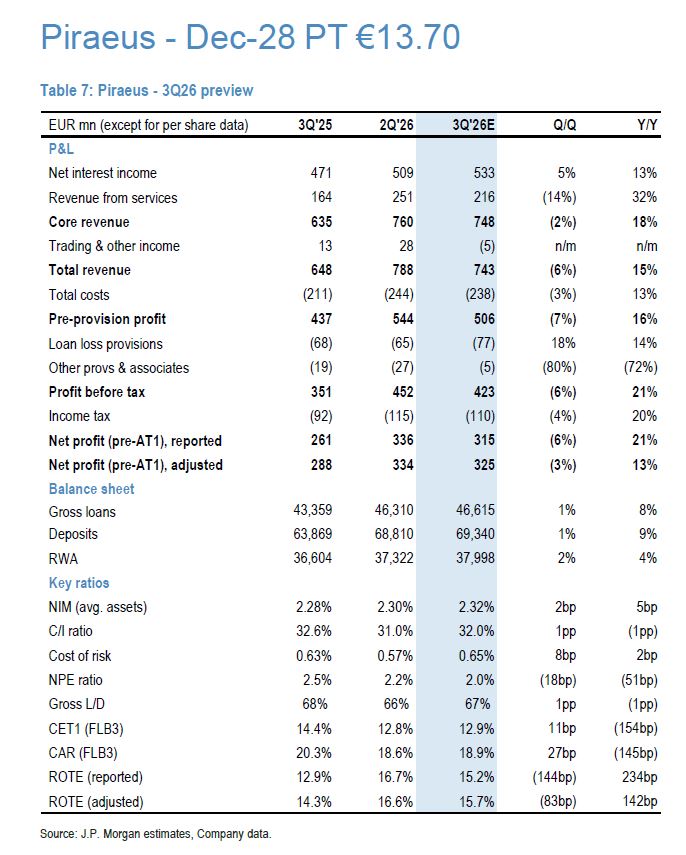
JP Morgan's message for the Greek banking sector
The overall picture painted by JP Morgan is that of a sector continuing to exhibit strong operational momentum, driven primarily by net interest income and ongoing credit expansion. At the same time, the normalization of fees and trading income, increased provisions at certain banks, and tax or extraordinary charges are expected to impact the quarterly evolution of profitability. Despite individual variations in performance, the American firm maintains its target prices and Overweight rating unchanged for Alpha Bank, Eurobank, National Bank of Greece, and Piraeus Bank. Investors will focus on the resilience of net interest income, the trajectory of fee income, the evolution of costs and provisions, as well as the preservation of strong capital ratios.
www.bankingnews.gr













Readers’ Comments