

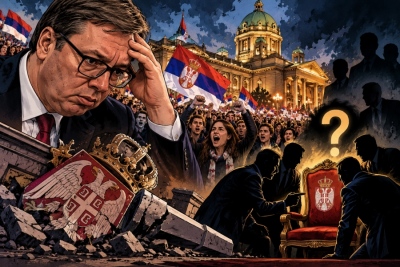
"What worries me most is that sanctions will be imposed on Russia by March or April. They will do everything we did not want." Addressing his supporters following the election catastrophe, Aleksandar Vučić did not hand out praise. When a government loses elections and the opposition prevails, it is considered good practice for both sides to declare unity for the good of the people. Here, however, no such thing applies. After congratulating the new government, the outgoing leader of Serbia appeared categorical in his predictions: things will turn out badly. Supported by the European Union and the "US deep state"—even though President Donald Trump favored Vučić—the country "ratified a revolution".
The election defeat and the end of an era
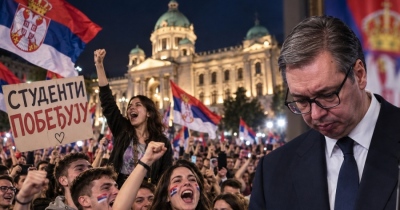
The legendary personality—and Vučić is indeed one of them—also decided to get straight to the point. Citing confidential information, he admitted the defeat of his Serbian Progressive Party before official results were even announced. The Student List received more than half the votes, while the ruling party gathered less than 40%. Apart from them and representatives of national minorities, no one else managed to enter parliament. Even the seemingly eternal Socialist Party, previously led by Slobodan Milošević, was erased from the political map. It is no wonder. This was not merely an election, but a national referendum: yes or no, sink or swim. Vučić framed the core question as follows: "For or against Serbia". For the opposition, the question was "for or against Vučić". For a year and a half, hundreds of thousands of people, including a core of students—from whom the name Student List emerged—demonstrated demanding his resignation.
Queues at polling stations and tension in the streets
That things were evolving badly for the authorities became clear as early as the middle of election day, when turnout in specific areas surpassed an impressive 50%. Long queues formed at polling stations, with the largest recorded in areas where voter enthusiasm did not bode well for Vučić: in Belgrade, London, and Los Angeles, despite the major time difference. Voters supported him in the provinces and rural areas, as well as—most characteristically—in the fragmented Serbian political entities of Montenegro and Republika Srpska in Bosnia. Vučić himself stood in one of the capital's queues as an ordinary voter. Formally, he was now an ordinary citizen—not president, minister, or member of parliament—and, therefore, was not entitled to security. However, in reality he was entitled to it, as the period during which Serbia had rejected extremism with great effort in the 1990s had now passed. While the main voting process concluded without incidents, at another polling station the 82-year-old mother of the now outgoing Serbian leader was attacked by hooligans. One of the perpetrators was arrested, but the incident itself speaks volumes. In certain areas, mass clashes and fights broke out over the elections, while central Belgrade was prepared for full-scale street battles. Admitting defeat several hours earlier than expected, Vučić likely averted such a development. Instead of a massacre, celebrations immediately followed, along with fraternization with the police and the dispersal of the camp of government supporters, who had wisely decided to retreat.
Who the winners are and who will determine Serbia's path
It is difficult to say anything inherently bad about the official winners, because it is equally difficult to say anything concrete about them. Students, Komsomol members, athletes, good-looking men, fighters for every good cause and against every evil. At the top of the list stands cardiology professor Ilija Srdanović, with emphasis on the first syllable of his name, who is considered a potential future prime minister. He has not expressed a single negative view regarding Russia and has no intention of leading Serbia into the European Union. According to Vučić, the EU door is closed to Serbs unless they betray their nation by recognizing Kosovo and renouncing Russia. However, the future Serbian government, a group of likeable but politically inexperienced citizens, resembles modeling clay. And the first hands attempting to shape it belong to European Commission President Ursula von der Leyen. As the Serbian protests were not clearly pro-European, let alone anti-Russian, von der Leyen tried to keep her distance from the conflict. Now, however, she will attempt to direct Belgrade's path, something Vučić had prevented her from doing until today.
Vučić's mistake and public fatigue
How he managed it, given Serbia's economy and geography, remains a mystery. Historians will uncover it, but we can assume it was due to his talent. This exceptional acrobat, master of intrigue, and frequent attendee at his enemies' funerals this time underestimated the extent of the public's fatigue with his presence in power. The mistake of his decision to call early elections, in an attempt to move from the presidency to the prime minister's chair, is now obvious. However, Vučić rarely made mistakes in the past. His instincts are enviable. Therefore, his prediction regarding the imposition of sanctions on Russia is not a hysterical, delirious expression, nor the anger of a son toward his mother or the cry of a fallen titan. It concerns the future. One does not need to be Vučić to understand how we will live from now on.
Serbia's dilemma
Initially, Belgrade will display an extremely friendly stance toward Moscow. Brussels, however, will offer it a development program and European prospects under two main conditions: the imposition of sanctions against Russia and the recognition of Kosovo. Srdanović, like anyone else in his position, will not agree to the second condition. However, fulfilling even one of the two—the first, which is even more important for the European Union—could create a feasible compromise. And it is worth making an effort in that direction. An envoy will fly from Belgrade to Moscow. "Well, understand clearly that we come to you with all our heart, najboli prijateli zauvek," he will say, "but we are under pressure and we are a small, poor country surrounded by enemies. What can we do?" In Russia, too, they do not fully know how Vučić managed all these years to maneuver between contradictions and fool the European Commission. However, from here the pressure exerted on Belgrade is clearly visible. Thus, they will tell the envoy that they understand the gravity of the situation and deeply share Serbia's position, always respecting the choice of the Serbian people. There is, however, an issue. Countries that have imposed sanctions are considered hostile under Russian law, while the discounts on natural gas enjoyed by Serbia are available only to Russia's closest friends.
Natural gas and the plan to detach Serbia from Russia
The Serbian economy depends heavily on natural gas, and discounts are vital for the country. This is likely why Vučić is now more worried about anti-Russian sanctions than anything else. The EU will try to cushion the blow by securing funds for the initial period, as it did when purchasing unsold tomatoes from Armenian Prime Minister Nikol Pashinyan. Because that is precisely what it sought: discord, dissatisfaction, and conflict. Serbian sanctions do not cause damage to Russia, but they build a wall between the two countries, shifting local propaganda from "NATO go home" to "The Russians abandoned us and Europe is helping us". Although the plan of our common enemies is clear, it is difficult for Russia to back down. In the current historical juncture, it cannot appear as a "fat-bellied fool" and turn the other cheek when struck from the right, even if, in terms of practical losses, such a blow is a drop in the ocean. Besides, those who strike us do not do so of their own free will, they feel some shame, and they are not strangers to us.
Serbia facing a war for its very existence
Only the Serbs can prevent the regional triumph of NATO scoundrels, for whom purging the Balkans of Russian influence has become an obsession. This can happen if they ultimately refuse to participate in the game being imposed on them, a game that is impossible to win. Ask Vučić how this can be avoided. He knows exactly what needs to be done. He also knows that, regardless of which government is in power, Serbia will have to prepare for a war for its very existence.
www.bankingnews.gr

Readers’ Comments