

The thriller in the Persian Gulf continues unabated, and Brent crude at 117 dollars per barrel causes tremors... however, the game of psychological warfare is played well by both Iran and Trump...
The American President stated: «Maybe I have to finish the job, or maybe the Iranians will make a deal.
An attack could happen tomorrow».
Concurrently, there were reports stating that Iran, via Pakistan, submitted a new proposal to the US, but Iran immediately and officially denied the information.
The only proposal Iran is considering is the 7-point plan, which is admittedly humiliating for the Americans.
At the same time, Iran warns the states in the Persian Gulf that the new war, whenever and if it breaks out, will mark the annihilation of the Emirates and Israel; it will attack all infrastructure, nothing will be left standing...
It is now evident that as retaliation, Iran will not only strike military bases but civilian infrastructure as well... the danger of the Persian Gulf being reduced to ashes is dramatically high.
Trump: I will finish the job, an attack could happen... tomorrow
Continuing the tactic of recent days, the President of the US repeated his contradictory statements regarding Iran, within the framework of psychological warfare.
According to Al Jazeera, US President Trump, seeking to boost his own morale and that of his supporters, as well as to secure votes for the midterm elections of the country, claimed that he has handled Iran very effectively.
I will finish the job, an attack could happen tomorrow, the American President emphasized.
Intervention by Obama: Iran does not have nuclear weapons, the war was a huge mistake
Iran did not have nuclear weapons, former President of the US Obama emphasized.
Trump started an unnecessary war.
I did not have to launch a single missile while I was President.
All I had to do was pursue a diplomatic course.
They said: «Oh, this is the best war in history», but after 7 months, our allies and our bases have been attacked, Americans have been killed, we have largely depleted our missile stockpile, and Iran now holds a veto right over the Strait of Hormuz.
Tasnim: Reports of an Iranian proposal to the US are false
A well-informed source told the Tasnim agency that the report by the Al Arabiya network, which speaks of an Iranian proposal to the United States, is false and pure fantasy.
The claim of the Saudi-backed outlet Al Arabiya, according to which Iran allegedly proposed opening the Strait of Hormuz in exchange for lifting the naval blockade, is, like much of the content produced by this outlet regarding Iran, completely false and fabricated.
The source added that Iran categorically rejects any arrangement along the lines of «Strait of Hormuz in exchange for the blockade»; on the contrary, Iran bypasses the blockade through its own methods and will ultimately break it.
As Iranian officials have explicitly stated, the firm position of Iran is determined by the seven conditions it has officially communicated through intermediaries.
Any other speculation or fanciful scenario presented by the media on the matter is groundless.
The «7-point plan» of Iran, which outlines its demands regarding the reopening of the Strait of Hormuz, has already been transmitted to the American side.
As long as all legitimate demands of Iran are not satisfied, including ending harassment of its ports and shipping, the insecurity imposed by the American adversary on the Strait of Hormuz will not be resolved.
Everything will turn to ashes, The new missile capabilities of Iran and the asymmetric response
The military capability of Israel to inflict severe damage on the infrastructure of Iran does not necessarily entail the ability to achieve its own political and strategic objectives.
As the possibility of a new conflict remains open, the enduring capability of Iran to retaliate, combined with uncertainty regarding the scope of American support, has complicated the calculations of Israel to launch fresh strikes.
As reported by Al Jazeera, one of the most critical challenges facing Israel is how to translate the potential gains of a large-scale military operation into a permanent change in the political structure of Iran.
Although Israel possesses the firepower to hit crucial military targets and infrastructure, a significant gap remains between inflicting military damage and achieving political goals, a gap for which no clear bridging strategy exists.
Air superiority does not guarantee political victory
Air superiority and the possession of advanced fighter aircraft are considered the most significant military advantages of Israel.
However, experience from recent conflicts has demonstrated that superiority in hardware and strike capabilities is not sufficient, in itself, to achieve political goals.
The core question for the Israelis is this: even if new strikes inflict extensive damage on the military capabilities of Iran, what guarantee is there that such operations will lead to a change in the strategic behavior of Iran?
Iran held out and is rearming for a major counterattack
Conversely, after two rounds of attacks, Iran has preserved its capability to strike back.
This reality could increase the potential cost of any future operation and make it harder for Israel to make decisions regarding the timing, scope, and targets of an attack.
Under these circumstances, initiating a new war, without a clearly defined and achievable goal, raises the risk of becoming trapped in a protracted confrontation... a conflict where initial military gains may be overshadowed by much greater costs in terms of security and the economy.
The response of Iran will be chaos across the Gulf states
A primary concern in calculations for a new attack involves the potential breadth of the Iranian response.
A new conflict may not remain confined to the territories of Iran and Israel, but could affect the security of other states in the region.
The states of the Persian Gulf, which host American military bases, equipment, and installations, would face heightened risks in the event of an escalation of the conflict.
Attacks against targets linked to the American military presence in the region could broaden the crisis, putting regional governments in a difficult position.
This represents a particular source of concern for Israel: the wider the potential Iranian response is, the more difficult it becomes to predict the consequences of a military operation or control the trajectory of escalation.
In reality, Iran does not necessarily need an air force equal to that of Israel to raise the costs of a new attack.
Its capability to execute asymmetric tactics, strike vulnerable points, and exert pressure across various security domains could radically alter the variables of a potential war...
Uncertainty regarding American support
Another crucial factor in the calculations of Israel is the degree to which Washington is willing to become embroiled in a new round of conflict.
Although American backing could bolster the operational capabilities of Israel, this does not imply automatic approval from Washington for any military action Israel might undertake.
Experts remain skeptical regarding the appetite of the American administration to engage once again in war, particularly given the absence of a clear and credible strategy that would force Iran to comply with the demands of Washington.
In this context, the decision to launch a new attack is not merely a military option, but a political decision with broader regional and international ramifications.
Beyond evaluating the defensive and offensive capabilities of Iran, Israel must also factor in the level of potential American support, as well as the risk of the conflict spreading to other states in the region.
The preservation of the counterattack capability of Iran, the lack of guarantees for achieving the political objectives of Israel, and the uncertainty regarding American support constitute factors that complicate the decision to launch a new strike.
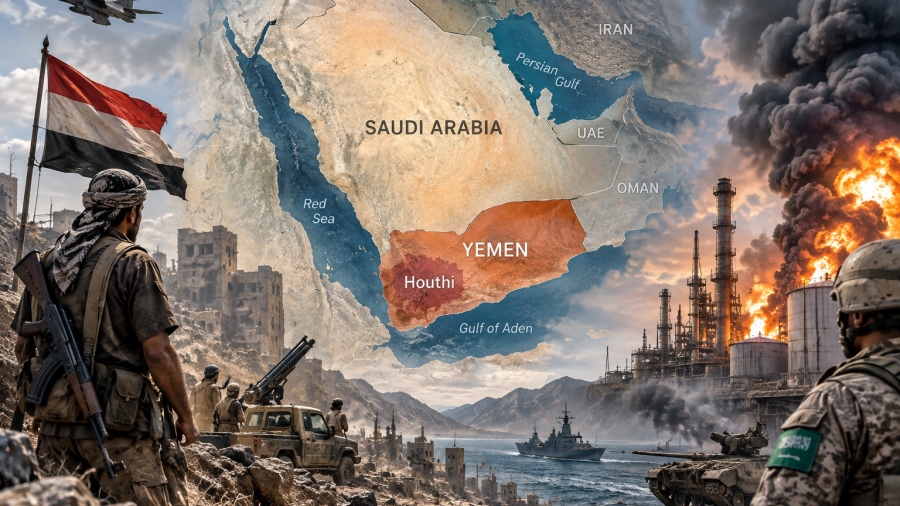
New Houthis ultimatum: King Khalid Airport in Saudi Arabia is not safe
The spokesperson for the Armed Forces of Yemen issued an official statement warning all airlines and passengers of the severe risks associated with traveling through one of the main airports of Saudi Arabia.
All international, regional, and local airlines, as well as personnel and passengers, must avoid traveling or transiting through King Khalid Airport in Riyadh, Saudi Arabia.
Due to its nature, this specific airport is considered a military target by the Armed Forces of the Houthis and is not, under any circumstances, safe.
Middle East Eye: If war breaks out between the US and Iran, it will mark the total destruction of the Gulf states
The mood among Arab and American officials in the region speaking to the news outlet Middle East Eye suggests that the question is no longer whether the US and Israel will resume attacks against Iran, but when.
Given that Iran has threatened to target data centers and artificial intelligence facilities linked to the US in the countries of the Persian Gulf, valued at trillions of dollars, alongside energy facilities and airports in the event the war resumes, conditions appear ripe for a new round of conflict.
«Escalation is coming», Aaron David Miller, a former negotiator for the Middle East under both Republican and Democratic administrations of the US, told Middle East Eye.
«Whether it happens before or after the midterm elections of the US is irrelevant. What matters is the purpose of this escalation».
Direct conflict between the United States and Iran largely halted after the signing of a fragile ceasefire in April, but the two sides never implemented the 14-point memorandum of understanding signed in June to advance a final agreement.
Enormous gulf between the US and Iran
«There is a fundamental divide between the two sides that cannot be bridged».
«The Iranians will not change their positions on the Strait of Hormuz, the nuclear issue, or the Houthis».
Envoys of Trump are setting the stage for a return to military confrontation.
«Ultimately, we must continue our efforts to ensure that regime change occurs», a Republican senator, a key ally of Trump, stated in an interview on Fox News.
«America and Iran are moving toward a devastating new war»
Mike Waltz, ambassador of Trump to the United Nations, told the Financial Times that the White House is prepared for a long-term conflict.
«The president and the US Navy can continue this blockade of Iranian ports for the foreseeable future».
The war started by the US targeting the nuclear program of Iran has gradually morphed into an all-out struggle over who holds the final word in the Middle East.
For instance, Iran wants to collect tolls from ships transiting through the Strait of Hormuz.
Iran and the United States have also engaged in mutual attacks in the waterway.
The United States has imposed a blockade on Iran that has heavily strained its economy.
In response, Iran attacks vessels in the region, causing shipping costs to skyrocket.
In October 2026 alone, at least 27 ships have been attacked, the highest figure since March 2026.
Inevitable new war
Experts say a return to war may be inevitable because the status quo is favorable neither to the administration of Trump nor to Iran.
However, neither side views itself as weak enough to be forced into making concessions.
«America controls the volume of oil, Iran controls its price»
Eurasia Group, a geopolitical consulting firm, told Middle East Eye that both Iran and Trump are monitoring the oil market, but hold divergent perceptions of developments.
The firm Kpler published data showing that exports of oil and petroleum products from the Middle East returned to levels prior to the war with Iran last week.
Certain experts have cautioned that the data might not provide an accurate picture of a stable export situation due to a temporary spike in activity. Nevertheless, more oil is being exported from the region and by allies of the US, while Iranian exports have been curtailed by the naval blockade of the US.
The increase in export volumes has failed to bring prices down.
Brent crude oil, the international benchmark for oil prices, has surged by 43% since the signing of the Memorandum of Understanding with Iran.
Diesel prices have risen by approximately 35%, while gasoline prices have increased by less than 10%.
No one doubts that the economy of Iran is under severe pressure.
Inflation exploded to 90% in September 2026.
However, the leadership of Iran believes it can endure another round of conflict, while the administration of Trump will ultimately back down.
www.bankingnews.gr





Readers’ Comments