

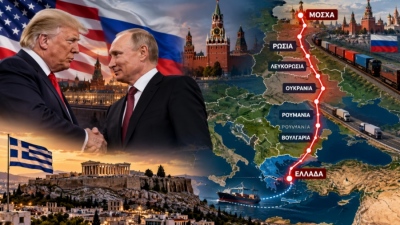
The future of the Vertical Corridor and the ambition of Greece to emerge as an energy hub for Southeastern Europe may be decided by a development lying outside the direct control of Athens: the potential rapprochement between Washington and Moscow in the energy sector.
Greek strategy rests on the assumption that the gradual decoupling of Europe from Russian natural gas creates a major commercial void, which American exports of liquefied natural gas (LNG) can fill, with Greece serving as a primary entry and transit gateway.
Revithoussa, the FSRU of Alexandroupolis, interconnections with Bulgaria, and transmission networks toward the North form the material foundation of this ambition.
There is, however, a factor that complicates the equation: Russia does not take the permanent loss of the European market for granted, while in the US, according to press reports, business arrangements that could return Russian gas to Europe under different commercial terms are under review.
The question is not whether Greece should abandon cooperation with the US.
It is whether it can design its energy strategy as if the chapter of Russian natural gas has already been closed definitively.
The message from Moscow: Russian gas can return under a different identity
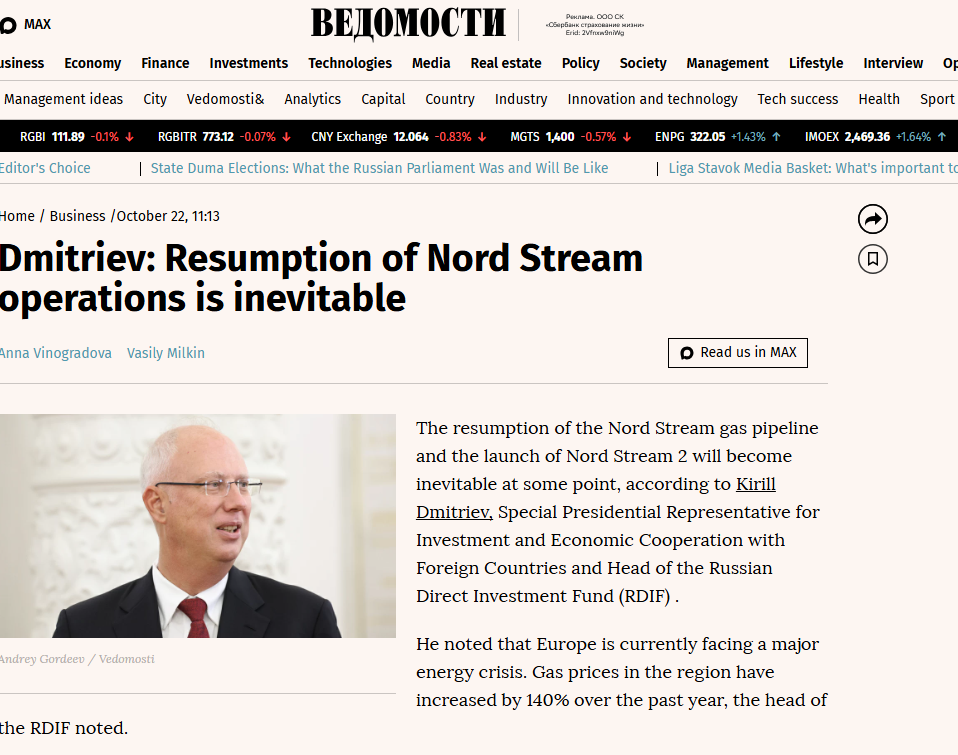
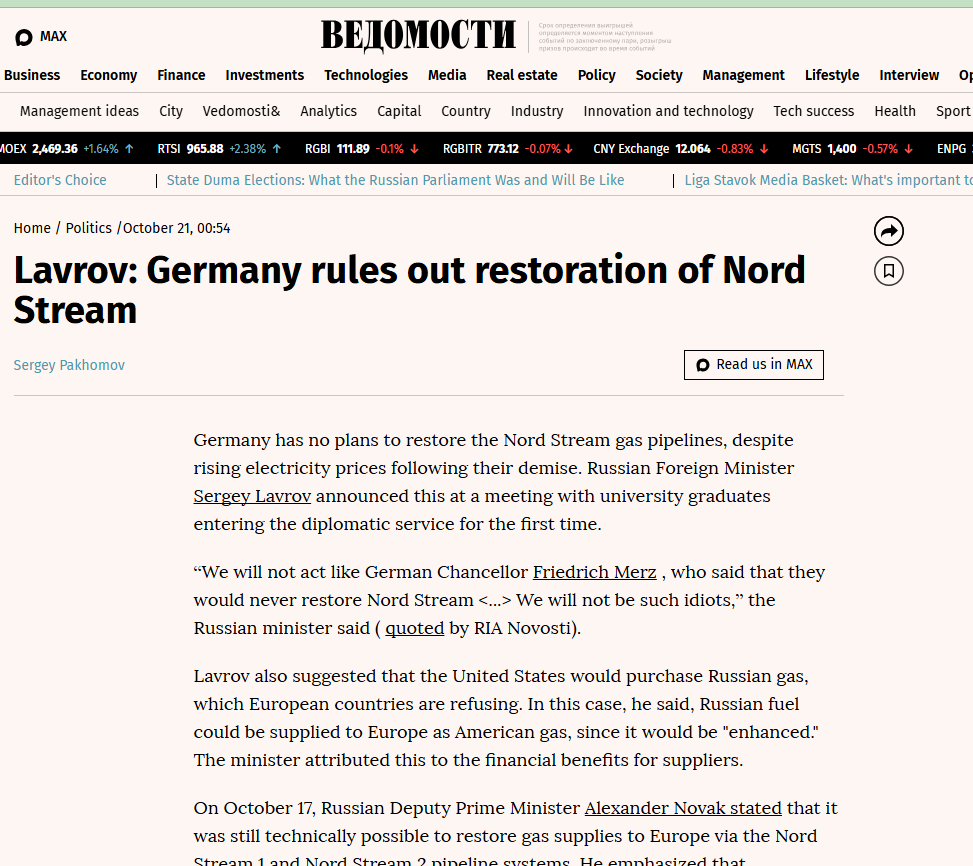
Two reports by the Russian financial newspaper Vedomosti, on October 21 and October 22, illuminate this dimension.
In the first, citing remarks by Russian Foreign Minister Sergey Lavrov, it is assessed that Germany does not intend to restore operations of the Nord Stream pipelines, despite the energy and economic fallout from the loss of Russian supplies.
Lavrov contrasts the stance of Berlin with the Russian approach and articulates an exceptionally interesting assessment: the US could purchase Russian natural gas and subsequently sell it to Europe as an American product, reaping the commercial benefits of intermediation.
This statement highlights a logic essential to Greek strategy: the origin of an energy product, the control of commercial routes, and the political identity of the supplier do not always align.
On October 22, Kirill Dmitriev, special envoy of Vladimir Putin for international investment and economic relations and head of the Russian Direct Investment Fund, went one step further.
According to the Vedomosti report, he argued that the restart of Nord Stream 1 and Nord Stream 2 will become inevitable at some point, without specifying a timetable.
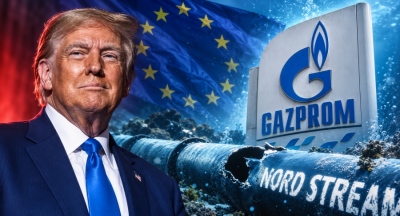
These statements take on greater significance when combined with a report by Reuters on October 8, according to which American and Russian officials had discussed the potential involvement of American investors in the Nord Stream system and the prospect of restoring Russian supplies to Europe following the war in Ukraine.
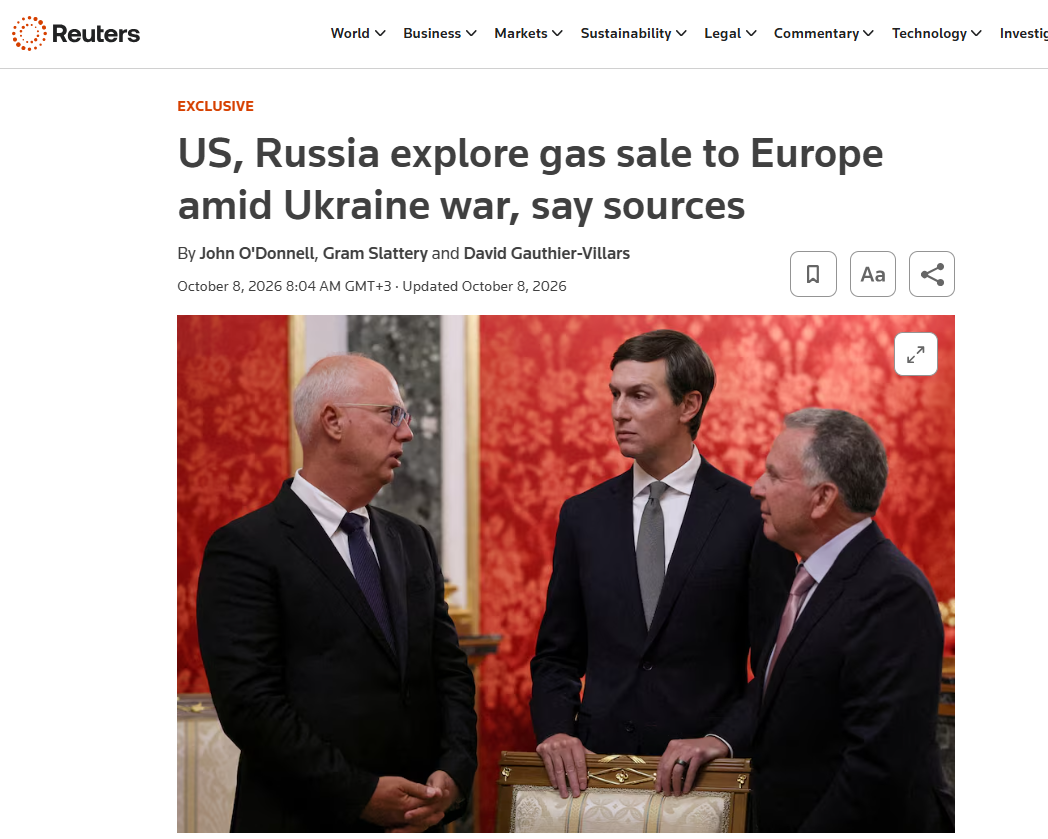
The mega deal between Trump and Putin is in the making
Formidable obstacles exist: sanctions, damage to the pipelines, unresolved ownership issues, and the opposition of Germany and other European nations.
Nevertheless, the discussion has already acquired tangible substance: consideration is being given to whether a future political settlement could create fresh commercial opportunities for American capital and Russian energy enterprises.
For Athens, this suffices to ensure that maintaining current balances in the European natural gas market is not taken for granted.

The Vertical Corridor facing market reality
The core problem of the Greek blueprint has come to the fore: political support from the US and the strategic drive of Europe to decouple from Russia have not automatically secured the requisite commercial demand.
The Vertical Corridor was conceived to channel natural gas from Greece to Bulgaria, Romania, Moldova, and Ukraine, with the prospect of expanding toward Central Europe.
The scheme combines existing infrastructure and interconnections, aspiring to turn the country into a focal point for regional supply.
The strategy is transparent: Greece imports LNG, predominantly from the US, and moves it to markets seeking alternative procurement sources.
In doing so, it enhances the energy security of its neighbors while acquiring commercial and geopolitical weight.
The difficulty lies in the fact that markets do not operate based on geopolitical intentions, but based on price and commercial risk.
Gas entering Greece must travel through consecutive national grid systems, incurring respective tariffs.
These costs can render the Greek route less competitive compared to alternative paths originating in Poland, Lithuania, or Croatia.
Concurrently, several target markets possess domestic output, alternative supply channels, or limited demand.
The most significant problem is that commitments to purchase American LNG are not matched across the board by binding off-take agreements with the principal buyers who could anchor the corridor.
«Take or pay» clauses render the matter even more complex, since agreed payments may fall due even when contracted volumes are not absorbed by the market.
The distinction is pivotal: a firm that has assumed obligations to procure specific volumes over multiple years could face substantial financial exposure if it fails to place them at competitive prices.
Consequently, the Vertical Corridor does not confront merely a technical or regulatory challenge.
It confronts the question of whether sufficient demand will exist for the gas Greek corporations are bound to purchase.
It is here that the prospect of a return of Russian natural gas becomes of paramount importance.

The US-Russian deal and the Greek contradiction
Should Washington and Moscow conclude a wider energy understanding, the ramifications will not be confined to the Nord Stream pipelines.
They could affect gas price expectations, the commercial behavior of European firms, and decisions regarding long-term supply agreements.
Greece has invested politically and commercially in the prospect that American LNG will fill a substantial portion of the void left by the phased ban on Russian supplies across the European Union.
This specific strategy simultaneously serves American commercial interests and Greek aspirations to elevate the country's geopolitical standing.
The potential re-entry of Russian flows, even under American commercial intermediation, could upend this calculus.
First, the anticipation of cheaper gas could curb the willingness of buyers to commit to long-term LNG imports via Greece.
Second, American corporations could assume a different role, operating not merely as LNG exporters, but as commercial brokers within energy flows connected to Russia.
Third, existing investments in import terminals and interconnectors would have to compete against an altered matrix of supplies and transit paths.
This does not mean that American LNG will inevitably forfeit its competitiveness or that the Vertical Corridor will become redundant.
European nations have compelling reasons to diversify their supply sources and supply routes, while a potential restart of the Nord Stream conduits would demand political determinations and the removal of substantial legal impediments.
It means, however, that Greece cannot premise the financial viability of its plan on the assumption that Russia will remain permanently excluded from the European market and that American LNG will plug the gap uncontested.
European energy policy can pivot.
Trade arrangements, sanctions, and prices can alter baseline parameters.
And Greece must possess a contingency plan for every scenario.

Moscow does not need to win to affect the Greek plan
The crux of the matter is that Moscow can sway the trajectory of the Vertical Corridor even without pulling off the complete restoration of its exports to Europe.
It suffices that the prospect of a future comeback generates market uncertainty among buyers.
If European utilities anticipate having access to more supply options and potentially lower price levels within a few years, they may shun long-term volume commitments for LNG that must be paid for irrespective of prevailing market conditions.
This constitutes the less visible, yet perhaps more consequential, facet of Russian strategy.
Energy leverage is not determined solely by actual natural gas flows, but also by expectations fostered regarding future deliveries.
The Greek side stands, accordingly, before an awkward reality: it invests in a network engineered to substitute Russian gas, while the mere prospect of a fresh energy accord between Washington and Moscow can erode its commercial viability.
The matter grows even more convoluted due to Turkey.
The neighboring country represents a significant natural gas transmission hub and maintains active energy relations with Russia.
If Russian volumes continue to flow into the European market through alternative commercial channels, Greece will have to compete not only against other LNG import facilities, but against a broader system of regional pipeline flows.
Diversifying sources and transit paths remains indispensable for European security.
Yet, it does not suffice as a commercial argument on its own.
For the Vertical Corridor to function, it must prove competitive in terms of cost, reliability, and market access.

Greece requires an autonomous strategy beyond transient political alliances
The takeaway for Athens is not to dismantle its cooperation with the US, but to avoid the one-dimensional conflation of national energy strategy with the commercial objectives of a single supplier.
It must open a clear diplomatic channel of communication with Russia to secure a seat, even in second place, at the deal that will define the continent's energy future.
Greece must pursue long-term sales agreements that correspond to its LNG purchase commitments, reduce transmission tariffs, deepen coordination with neighboring transmission system operators, and systematically examine actual gas off-take capacity in Central and Southeastern Europe.
Concurrently, it must monitor international developments without assuming that today's geopolitical confrontation between the West and Russia rules out every future commercial deal.
Contacts regarding Nord Stream, as reported by Reuters and the Russian press, warrant rigorous evaluation across all contingencies.
The ultimate success of the Vertical Corridor will depend on whether it can operate effectively under differing market environments: whether Europe remains committed to total decoupling from Russia or new commercial arrangements take shape downstream.
This demands an energy blueprint combining political collaboration with the US, close observation of Russian moves, alignment with European energy policy, and, above all, the financial viability of invested capital.
The high-stakes bet
The path of the Vertical Corridor may pass through Washington, but its viability will hinge largely upon developments in Moscow and decisions made across European markets.
Greece does not need to forecast with certainty whether Trump and Putin will strike a grand energy pact.
It needs to ensure that, even if that happens, the Vertical Corridor commands competitive costs, secured clients, and a genuine economic raison d'être.
Otherwise, the risk looms that Greece will have invested in the political and technical development of a major energy hub without locking in the commercial fundamentals necessary to sustain it.
And then the overarching challenge will not be whether Russia stages a return to Europe, but whether Greece will have managed to carve out an enduring role in the energy market regardless of who ultimately supplies the natural gas.
www.bankingnews.gr




Readers’ Comments